


Interviews

Exoticism in reverse: Virgen & Child imagery reinterpreted in the Mughal and Iranian worlds
Alexis Renard, a dealer and expert, has for more than twenty years occupied a singular place in the field of Indian and Islamic arts. What distinguishes him, beyond the practiced eye of connoisseurship, is a methodical attention to the conditions under which images circulate. How does an engraving become the model for other works? How does that model become fixed within an album? How does the workshop rework it? What does a composition lose, preserve, or acquire as it passes from one visual world to another?
His gaze restores works to a concrete economy - made of cabinets and collections, exchanges, provenances, and uses. For it is there that the essential is decided: at the moment when an imported figure ceases to be a quotation and becomes the matrix of a local invention, a source of inspiration for another culture, with its own hierarchies.
His expertise, here set in perspective, provides a decisive point of departure. Alexis Renard has had in his hands four representations of the Virgin and Child. Examining them makes it possible to understand how a European model is received, fixed in an album or transposed onto a ceramic tile, then re-elaborated by the Mughal workshop at the turn of the sixteenth and seventeenth centuries. He finally illuminates its later afterlives in an Iranian context, under the Qajar period (1779–1926).

Between the end of the sixteenth century and the beginning of the seventeenth, the Mughal court gained access to Christian subjects and European types through reproducible images, first among them, the print. Under Akbar (r. 1556–1605), Western engravings circulated through missionary networks and entered workshops as models. Under Jahangir (r. 1605–1627), this stock expanded and diversified, carried by diplomatic intermediaries and by agents of European trading companies. The West did not function there as a norm. It offered, rather, a repertoire of forms - poses, draperies, jewels and precious objects, depth, furnishings, the gesture of reading - which the workshop could sample, re-hierarchize, and adjust to the conventions of the album folio.
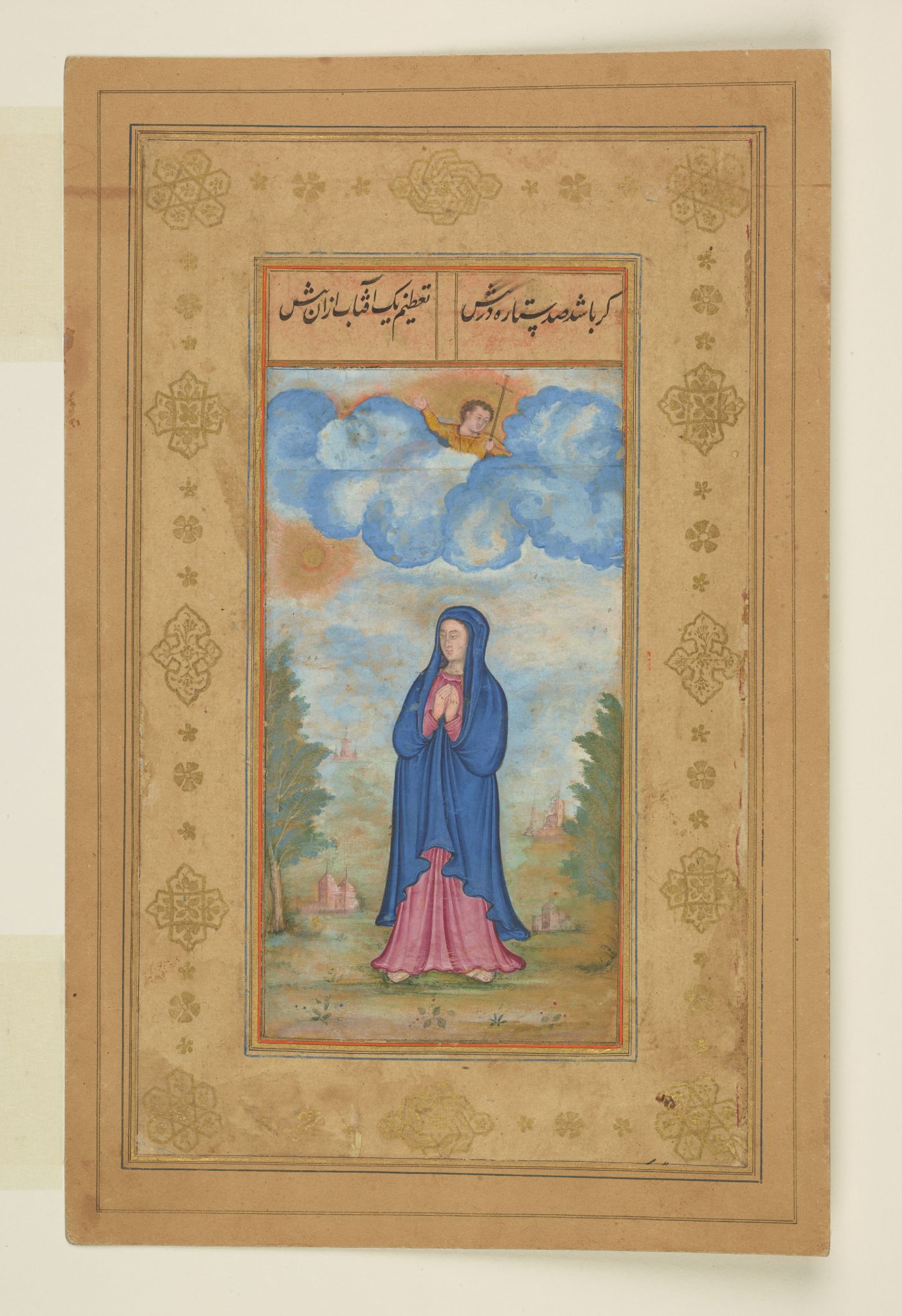
At Harvard, the Portrait of Madonna (inv. 2009.202.78), attributed to Manohar around 1600, crystallizes this dialogue between European model and Mughal hand. The red tunic and blue mantle belong to the Western code of the Madonna. The face, the coiffure, and the jewellery (earrings and a forehead jewel, a ferronnière/frontlet, comparable in function to a tikka) in gold and fine pearls belong to a courtly language. Above all, the work bears the trace of a complex material history. Technical examinations indicate a trimmed fragment, later reused as a medallion, whose background, initially turquoise, was reworked in blue. Several details now emerge only under close examination, and the halo as well as the gilded framing may result from a later intervention. The image is therefore not merely taken up; it is transformed through successive states, in the course of uses and alterations.

In the Mughal album, the European image is not conceived as an autonomous “painting”; it is perceived, rather, as a unit for comparison. Court artists privilege what strikes at first glance - whether a profile, a puffed sleeve, a ruff collar, a “Renaissance” chair, or a landscape constructed in perspective. These motifs can be isolated and reused. Otherness is not erased; it is transformed into a range of variations.
The rereading of Christian themes first opens onto a shift in register. The Virgin and Child remain recognizable, yet they are often heightened according to Mughal court codes. A profusion of ornaments, a crown, heavy textiles belong to an iconography of rank more than to mere decoration. These signs tip the Marian figure toward a courtly visibility, in which dignity is symbolized by display.

A more discreet clue illuminates the very nature of these circulations: inversion. Speaking of a Virgin and Child, Alexis Renard points to a Western prototype, Titian’s Madonna of the Rose (c. 1530, Florence), and notes a “mirror-like” organization, most likely linked to the passage through print. In intaglio, the image does not travel intact: it reverses. What is printed inverts what has been engraved. Copying a print can thus mean inheriting a scene already reversed, not by intention, but through the very logic of the process.

The model rarely arrives in the form of a single painting, seen directly, in its matter and colour. It reaches India and Iran in the form of a printed sheet, multiplied, made to circulate. The workshop receives a composition, a framework of figures and gazes, rather than pictorial substance. This framework lends itself to reprise. The miniaturist may tighten the scene, shift a figure, simplify the décor, without breaking legibility in the least. The print does not merely transmit a Western image; it delivers a structure that artists can reconfigure according to their codes.
Narrative scenes from Christ’s infancy form part of this inspiration. The offering provides a telling example. In the Indian Virgin and Child below, fruit may signify homage; but it can also be read against offering practices informed by the notion of prasād. The scene remains Christian; only its intelligibility shifts.

Winged figures offer another, highly revealing index. In certain Indo-Mughal Virgin and Child images, angels are brought closer to winged beings already familiar in Indo-Iranian worlds, such as the pērī, a figure of Persian origin. Once again, the subject remains Christian, but the staging is interpreted in the workshop’s language, through forms familiar to the painter. Nimqalam (pen drawing with highlights) supports this adaptation through soft gradations and surface effects suited to wings, halos, and transitions between shadow and light.


Alexis Renard grounds these observations in a broad museum corpus. At the Metropolitan Museum of Art, Manohar’s Madonna and Child in a Domestic Interior and The Virgin and Child Attended by Angels (c. 1600) show Christian themes reread by the Mughal workshop, in ink and gold, within the logic of the album folio. At Cleveland, the European Costume Scene (c. 1590–1595) recalls, in the same perspective, that these European types also circulated through images introduced by Jesuit missionaries. Europe appears as a repertoire of costumes, gestures, and stagings rather than as a model to be reproduced. At Boston, Melancholic Woman and Attendant, attributed to Basawan, c. 1590, with a later border, extends this reading by privileging attitude and expression over costume.
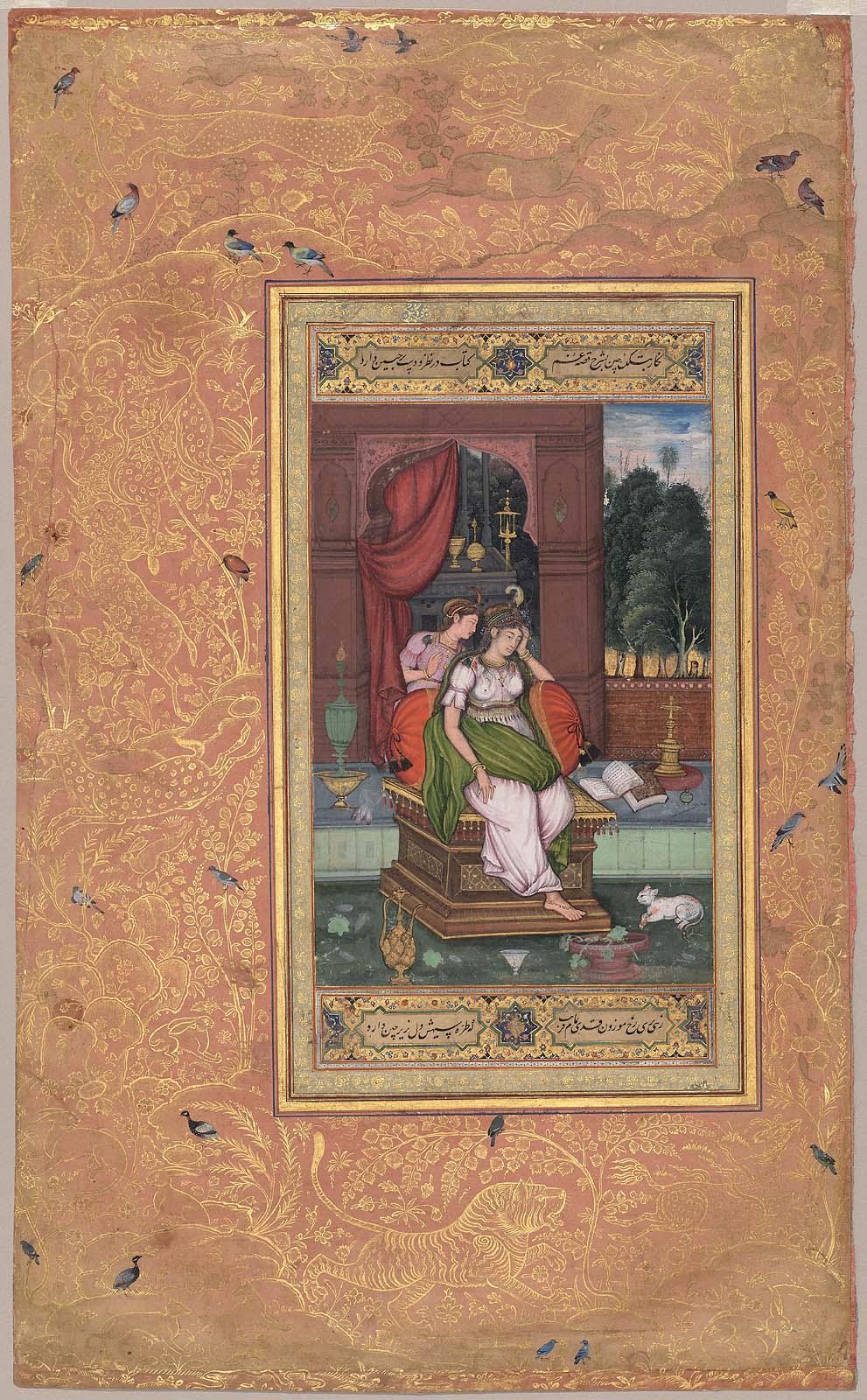
Manohar, Basawan’s son, was among the most prominent painters of the imperial atelier under Akbar and then Jahangir. In the Virgin and Child images attributed to him, he remains closest to Western prototypes. His Marian figures without jewelled adornment bear witness to this. The Indo-Mughal background appears in the angels, here adorned and bearing precious objects.
In the European Costume Scene (Cleveland Museum of Art), female adornment, discreet, is limited to a small aigrette diadem, a long necklace with pendant, and a gold bracelet at the wrist. It remains secondary to costume and setting. In Melancholic Woman and Attendant (MFA Boston), by contrast, adornment structures the image: a diadem heightened with a plume (which over time will become the jīgāh, the jewelled aigrette), stacks of gold bracelets, layered necklaces, a metallic choker and a long pendant cord frame the face and the chest.

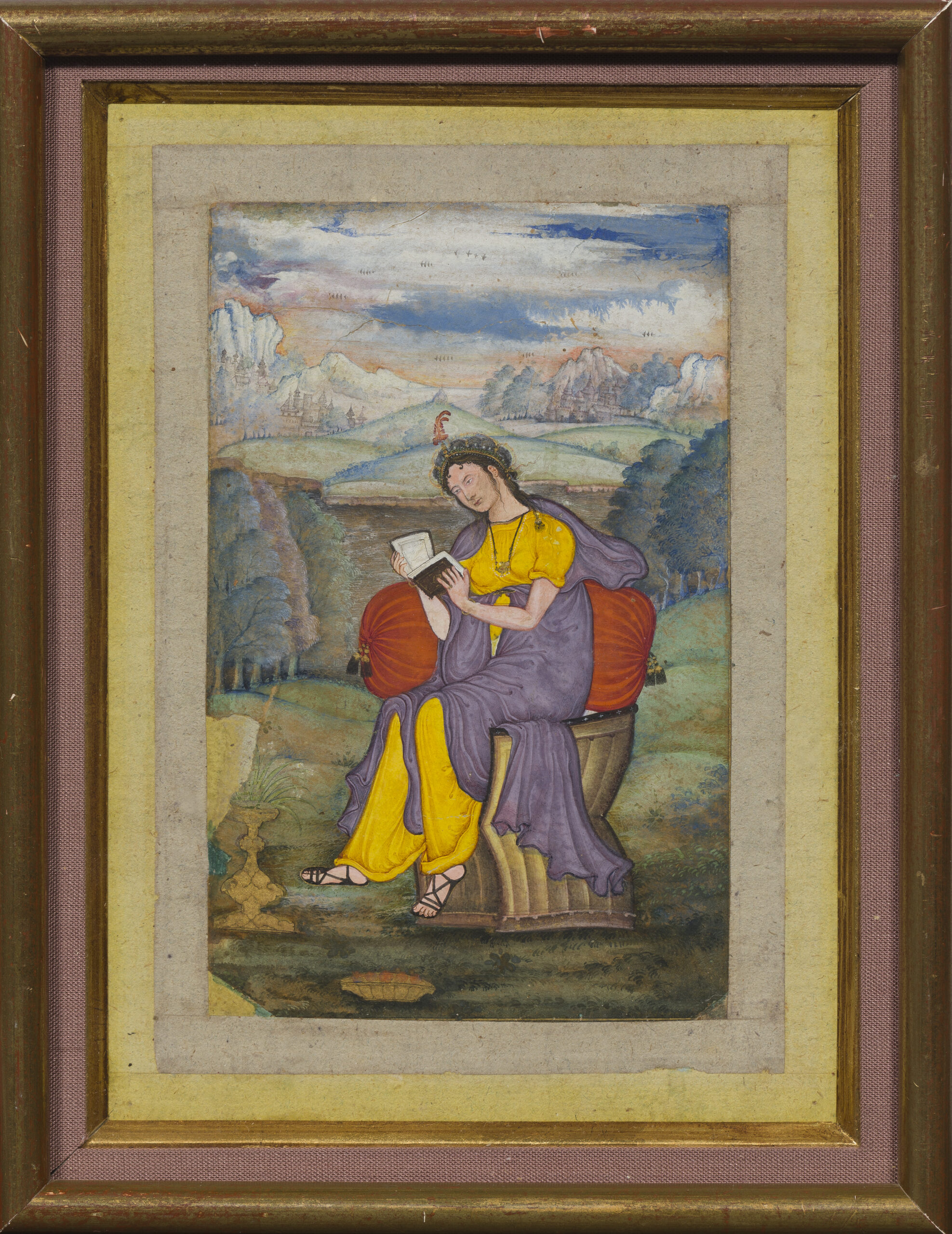
Within this ensemble, the fine Mughal portrait of a European woman sold on 17 December 2025 (Boisgirard–Antonini; Alexis Renard) provides an additional anchoring point in the corpus. Absorbed in reading, the figure wears court jewellery similar to the above but richer still. Looking closely, one discovers a pair of gold bracelets, a ring set with a green stone, a long rosette pendant necklace, and a diadem heightened with an aigrette; a small shoulder ornament, punctuated with green highlights, completes the ensemble. The pose and the framing (seat, cushion, depth, landscape, and distant architecture) belong to a Western repertoire now integrated into the language of Mughal miniature.
On the margins of the Mughal corpus, Alexis Renard recalls that the motif later circulates onto other supports and changes destination, without belonging for all that to the practices of the imperial album. Such is the case of a rare Qajar tile, where the Virgin and Child pass from the album folio to ceramics.

The Safavid counterpoint, finally, prevents us from immediately assimilating “mother and child” to a Marian scene. In a seventeenth-century Iranian portrait, the same grammar of borrowing - “European-style” depth, a landscape constructed in planes, imported compositional conventions - comes with a wholly different tonality. The register is secular, courtly, made of sensuality and distinction. Femininity is heightened by jewellery composed of ranks of pearls and rosettes. One notes a small frontal rosette at the parting (a very simplified tikka), a choker of dark beads, and a longer necklace alternating red pearls and dark elements, punctuated by rosette medallions across the chest. The right arm wears a garland-like armlet studded with rosettes, and the wrist a polychrome bracelet. In this magnificent leaf, the mother-and-child motif persists, but its function is reversed.
Thus, in the East, what Christian iconography organizes as sacrality can become a scene of distinction and pleasure.

These works, exotic to our eyes, belong neither to a strange mélange nor to servile imitation. They reveal workshop competence and the artists’ great talent. The imported image is welcomed, made legible, then inflected according to local hierarchies, without being dissolved or frozen. Europe is not a sovereign model. It becomes a repertoire of forms, gestures, and dispositifs that the album collects and that the workshop rewrites. In short: to remain recognizable while becoming other. It is within that tension that their true refinement is played out.
Alexis Renard
5, rue des deux ponts. 75004 Paris
courrier@alexisrenard.com
+33 1 44 07 33 02
Opening hours
Tuesday–Friday
10:00–13:00 | 14:00–18:00
or by appointment
Veuillez cliquer sur ce lien pour consulter les catalogues d'art indien et islamique Alexis Renard
Alexis Renard – Presents from the past, and other treasures

With thanks to Audrey Liber and Alexis Renard.


Télérama – The Disquieting Fate of a Vanished National Treasure, by Sophie Cachon
Jewellery historian Capucine Juncker rejects the theory of a heist commissioned by a billionaire collector. She fears that this national treasure of eight jewels will be broken up and sold off piece by piece.
By Sophie Cachon
Published 22 October 2025
The world now knows that it took barely seven minutes for thieves to wrench from the world’s greatest museum eight jewels from its collections—imperial masterpieces of the nineteenth century, some set with older stones of royal provenance. These unique creations, immortalised in their time by court painters, form part of the very DNA of French history. Now vanished—and perhaps already spirited out of the country—the question is what fate awaits these treasures, valued at €88 million according to the Paris prosecutor. Universally recognised, more so than ever today, they are in practice almost impossible to resell intact.
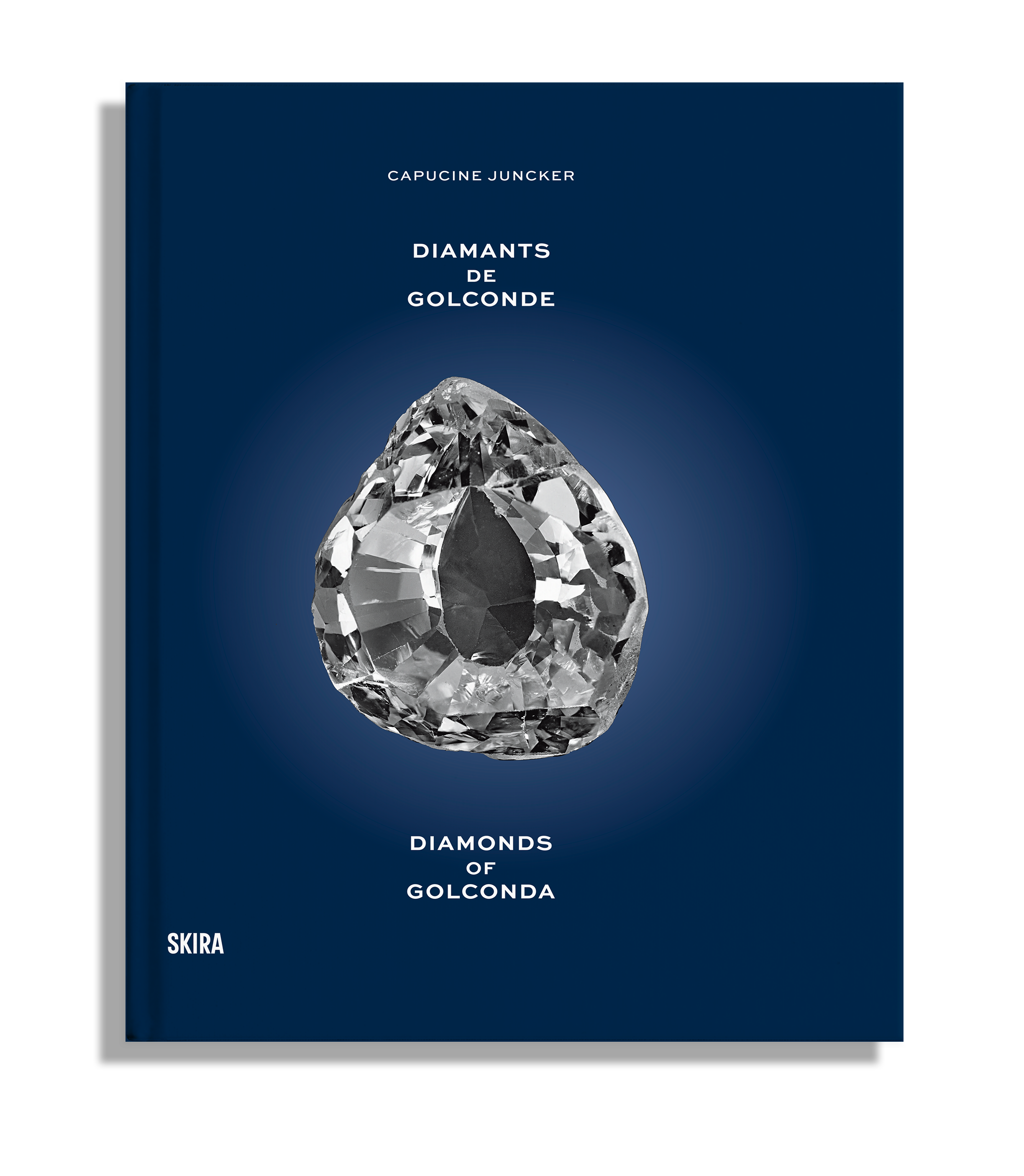
Set with a staggering number of precious stones—7,811 in all, including remarkable sapphires and emeralds, and an overwhelming majority of small, old-cut diamonds—the great fear now is their dismantling and dispersal, scattered like a puzzle. Capucine Juncker, art and jewellery historian, gemmologist, and author of the first book devoted to the fabled Golconda diamonds of India (Diamonds of Golconda, Skira Paris, 2024), offers her considered view on the troubling future that may await a national treasure that has simply vanished.

A discreet billionaire collector? A diamond dealer ready to break them up? Where could the stolen jewels go?
Two outcomes dominate: either a partial reappearance, negotiated by intermediaries after police or judicial pressure; or dispersal. In the latter scenario, stones are removed from their settings, the gold is melted down, and the components are sold off individually to obscure the trail. The tempo of the heist—extremely rapid—together with the equipment used, suggests an operation geared towards dismantling, though the other scenario cannot be ruled out. Smuggling the jewels abroad is difficult but entirely feasible. Illicit markets have existed since time immemorial; few commodities are more negotiable or more stable than a diamond.
As for the romantic notion of a heist commissioned by a fabulously wealthy collector, I remain sceptical. Investigations consistently show that thefts are almost never “commissioned”. The economics of resale prevail.
If the jewels are dismantled, will the gold be melted down? Must the diamonds be recut to pass unnoticed?
If dismantling occurs, the gold will indeed be melted, refined, anonymised, and reintroduced to the market bearing a maker’s mark and an assay mark indicating its purity.
The diamonds do not necessarily need to be recut to circulate. Most often, simple removal is enough: opening the setting and extracting the stone turns it back into an unmounted “loose” diamond—immediately negotiable and with no loss of weight. Recutting is undertaken only to obscure the identity of a celebrated stone. The emblematic case remains Louis XIV’s blue diamond, stolen in 1792 from the Crown Jewels kept at the Garde-Meuble royal, rediscovered in London in 1812 in another form. Recut, it became the “Hope Diamond”, now at the Smithsonian Institution in Washington.
While the pedigree of an exceptional gem can sometimes be reconstructed, one never recovers a pavé of small diamonds; they dissolve into the flow of the market. Once removed and recut, these stones become anonymous gems.
Are old-cut diamonds like those stolen from the Louvre actually sellable?
Rose cuts—flat-backed stones with a faceted dome—are readily traded on the antique market. They were produced between the sixteenth and eighteenth centuries, with twelve, eighteen, or more facets depending on the variant. Recutting them makes little sense: the risk of breakage is high and the yield poor.
To recognise the largest stones, one would essentially compare certain elements with any existing pre-theft photographs: carat weight, facet pattern, overall outline (round, oval, flattened pear), the height of the dome, and recurring idiosyncrasies—nicks, oblique scratches, flattened corners. Individually, these markers prove nothing; taken together, they may provide leads.
Some diamonds stolen from the Garde-Meuble in 1792 were later recovered. How are such stones authenticated?
At the time, the Crown jewellers cross-checked inventories, names, weights, measurements, and cutting peculiarities—building a converging set of clues.
Today, curators and scientific teams in gemmological laboratories prepare in advance a dossier for each stone, invaluable in case of reappearance: frontal, profile, and back photographs; ideally a 3D scan; a diagram of inclusions; and the faint polishing marks as distinctive as wood grain. Non-destructive optical tests read impurities and defects, producing a luminous signature and internal imagery that reveals the crystal’s stable identifying markers.
We often hear that their value is “inestimable”, chiefly historical. But are these stones really so rare and valuable?
It is a significant—and unsettling—question. On the market, some of these stones, especially the small ones, are worth very little because of their imperfections. The pearls in Empress Eugénie’s tiara (1853), however, are exceptional.
We must stop fantasising about “astronomical sums”. Once removed from their settings and recut, the stones become anonymous gems, generally sold at a steep discount. From an economic standpoint, if the thieves had wanted to make a substantial profit, they would have smashed the display cases of a major Place Vendôme jeweller and taken new, standardised pieces that are easily resold.
Here, the so-called “heist of the century” is an economic fallacy as well as a heritage disaster. The principal value of these jewels is historical: their mounts survive intact, their prestigious provenance is known. This is the real tragedy of the theft: we lose not only a part of our heritage, but also the expertise and irreplaceable craftsmanship of the jewellers who created them.

Refashioned, recut, resold… What futures await the jewels stolen from the Louvre? Insights from a gemmology expert
The Louvre Heist
Melted down, recut, resold… What possible fates await the jewels stolen from the Louvre?
Answers from a gemmology expert
By Malika Bauwens — Published 21 October 2025
Four minutes. That was all it took for the thieves to smash the display cases in the Galerie d’Apollon at the Louvre and disappear with eight historic jewels. On Sunday, 19 October, at 9:30 a.m., Empress Eugénie’s tiara—set with 212 pearls and nearly 2,000 diamonds—together with the necklaces of Queen Marie-Amélie, Empress Marie-Louise and several other pieces, vanished in one of the most spectacular museum heists in recent memory.
What happens to national treasures if they are not recovered by investigators from the BRB (Brigade for the Repression of Banditry) and the OCBC (Central Office for the Fight against Cultural Property Trafficking)? Are they dismantled, the stones recut, the mounts melted down? Do they end up with an unscrupulous private collector, or vanish into the shadowy circuits of international trading hubs?
We put these questions to Capucine Juncker, a gemmologist and specialist in Golconda diamonds, the subject of her 2024 monograph published by Skira.
Malika Bauwens: What are the most likely resale routes?
Capucine Juncker: The scenario of a clandestine, ultra-wealthy collector belongs almost to the realm of fiction; if it did occur, it would, paradoxically, be the least damaging outcome for the integrity of the pieces. The real risk is liquidation as raw material: breaking up the jewels, melting down the mounts, removing the stones, then repolishing or recutting them before feeding them—piecemeal—into illicit trading streams to make them harder to trace. Just as devastating would be the deliberate destruction of the pieces by thieves who find themselves unable to move their loot.
M. B.: Which countries are most likely to see this loot?
C.J.: As a first hypothesis, I would look to markets with deep liquidity: Dubai (trading in rough and polished stones); Surat and Mumbai in India (repolishing/recutting, remounting); Antwerp in Belgium (resales of polished stones, under regulatory oversight); Ramat Gan in Israel (polished trading); Bangkok in Thailand (coloured stones, remounting); Hong Kong (gateway to the Asian market). Bahrain is more specifically a hub for natural pearls. In every scenario, the haul could be broken down into smaller parcels and routed through relay countries to make any trail harder to follow. Unless, of course, the thieves simply decide to use… the postal service.
For the anecdote: in 1958, the legendary Hope diamond -the largest blue diamond in the world -was sent by post by the dealer Harry Winston to the Smithsonian Institution. The same was true of the Cullinan in 1907, which travelled via ordinary mail while the heavily guarded safe that was supposed to contain it held only a replica. A famous ruse, but within the framework of legal, insured shipments, with no connection to illicit networks.
M.B.: If we imagine the worst: can recut stones still be traced back to their origins?
C.J.: For coloured stones, it is sometimes still possible to propose an origin after a light recut, on the basis of inclusions and laboratory profiles; the conclusion remains probabilistic, and a more substantial recut may erase those clues entirely. For diamonds, geographical origin cannot be established in the laboratory: only documentary traceability, or comparison with earlier records (photographs, measurements, reports), can help—and recutting further lowers the odds. Historical benchmarks (Brazil after 1725; Southern Africa from 1867 onwards) guide the analysis but do not, in themselves, amount to proof.
M.B.: Could the thieves simply melt the metal and recut the stones?
C.J.: Gold, platinum or silver mounts can be melted down without difficulty; melting erases hallmarks and provenance while leaving the metal’s intrinsic properties intact. Sapphires can be recut, with some loss of weight and a manageable technical risk. Emeralds, by contrast—low in toughness and often fissured—respond badly to recutting: breakage is frequent. A calibrated suite of 32 stones of “imperial” quality—a very rare occurrence—would, moreover, remain highly traceable.
Diamonds can also be recut, but the operation calls for exceptional skill, reduces the carat weight and can efface the reading of the original cut, complicating historical identification. Take the Wittelsbach, reputedly from Golconda and of royal provenance: originally an old-cut stone, it was acquired by Graff in 2008, recut to 31.06 ct and re-certified by the GIA as Fancy Deep Blue, IF. In purely financial terms, the stone gained in value, but it lost its soul.
The pieces concerned at the Louvre display early brilliant-type cuts, related to the first “brilliants”, with a softer lustre than the modern round brilliant that now dominates the market. Taylor Swift’s widely publicised engagement ring, set with an oval “old-cut” diamond, is reminiscent of this older cutting tradition.
M.B.: Empress Eugénie’s tiara contained 212 pearls. Can pearls be altered?
C.J.: They can—but it would be an exceptional, risky and, above all, detectable choice. Surface peeling or re-drilling alters the diameter and the orient (the play of lustre), leaving marks that can be seen by a trained eye; whitening or dyeing treatments likewise. For a heritage ensemble of 212 natural pearls (their precise provenance has not been published), such interventions would only depreciate the piece. The most plausible scenario remains extraction and dispersion of the pearls rather than their transformation.
M.B.: Have there been similar cases where jewels—or the stones themselves—were recovered after being dismantled?
C.J.: The 2019 Green Vault heist in Dresden, sadly, did not serve as much of a warning. Some stones—recut, alongside others left intact—were recovered in 2022, but several pieces are still missing. In roughly half of such cases, the jewels are never found. I am nonetheless inclined to keep a measure of hope: a pendant set with a pearl associated with Marie-Antoinette resurfaced and was sold at auction in 2018, after two centuries of documentary wandering.
To read the full interview, please click the link below:
Beaux Arts — Louvre Heist — Interview Malika Bauwens & Capucine Juncker
***
The eight jewels stolen from the Galerie d’Apollon display cases on Sunday, 19 October:


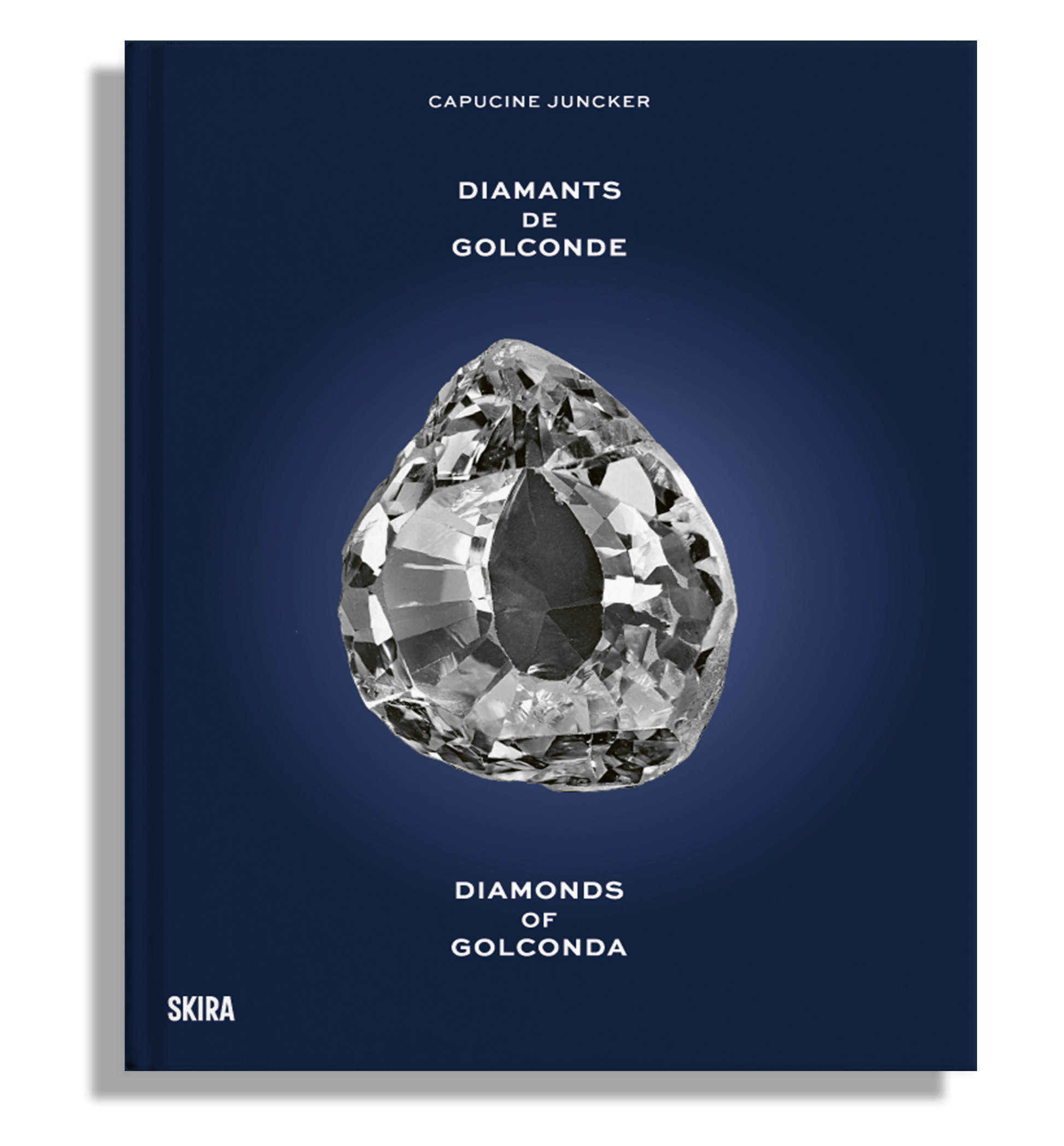
Diamonds of Golconda
Éd Skira • 208 p. • 50€

AMA, Mountains of light, by Phillip Barcio
AMA Art Media Agency #370
Mountains of light by Phillip Barcio
If asked to identify the cradle of diamond mining, most novices will likely say Africa. Though incorrect, it would not be a completely ignorant answer. Around two-thirds of newly mined diamonds today do come from Africa. But that is a relatively new development. The history of diamond mining stretches back at least six centuries, while the earliest known African diamond mines are only around 150 years old. “India is the historical cradle of diamonds,” says Capucine Juncker, a historian, gemologist, and author specialising in the history of jewellery and the cultural exchange of gemstones. “With the exception of modest deposits in Borneo, India remained the world’s only known source of diamonds until the discovery of Brazilian mines around 1725.”
Juncker’s latest book, Diamonds from Golconda (Skira, 2024), is devoted to India’s legendary Golconda diamonds, considered by many to be the most desirable diamonds in the world. Hers is the first book focused exclusively on the subject. “According to available sources, it is reasonable to assume that diamond mining took place [in India] at least as early as the fourth century BC, and may even be rooted in an older mining tradition, Juncker says. The earliest reference text on the subject is found in the Arthashastra, a Sanskrit treatise written between the third century BC and the third century AD, which describes an organised system for the production, control and trade of diamonds and gems under state control. This organisation appears to be an extension of even older practices, as suggested by the Ratnapariksa, the founding text of the Indian lapidary tradition.” The first century AD Roman author Pliny the Elder explicitly mentions Indian diamonds in his book Natural history, Juncker notes. “This confirms not only the antiquity of their exploitation, but also their circulation in an active international trade network between India and the Roman world.” But Juncker’s interest in Golconda diamonds is not only relegated to facts and dates. It is a passion ignited by the cultural, spiritual and mythical power these stones have wielded over human history. Part of that power comes from the fact that Golconda diamonds are some of the purest diamonds ever mined.
“Who says Golconda, says perfection of the material,” says historian and journalist Gabrielle de Montmorin, who is moderating a talk on Golconda diamonds with Juncker at the 2025 edition of GemGenève. “The fascination exerted by the so-called Golconda diamonds is an alchemy mixing history and gemmology, with this chemical Type IIa. That is to say, the purest carbon material. You add the fact that the mine is exhausted and you have all the elements of a success story.” Type IIa refers to the rating scale that indicates a diamond’s chemical quality. Much of that quality is related to nitrogen, says gem and jewellery journalist Richa Goyal Sikri. “Nitrogen is the element that is responsible for the yellow tinge in a diamond, Sikri says. Diamonds from the Golconda region are famed because many contain no measurable traces of nitrogen.”
Around 98% of natural diamonds contain significant amounts of nitrogen and are classified as Type Ia. “Type I does not in any way prevent a diamond from being colourless and internally flawless, Juncker notes. Visual and optical grading criteria used in gemological assessment are evaluated independently of the diamond’s chemical type. ”Type IIa diamonds, which are prized for their chemical purity, represent less than 2% of global production. Type IIb diamonds, which account for less than 0.1% of diamonds mined but include such famed stones as the Hope diamond, the Wittelsbach, the Farnese blue and the Idol’s eye, contain boron.“ That gives them a characteristic blue-greyish tint, says Juncker. Although even rarer than Iia diamonds, they are not purer, since boron is also an impurity.”
“Most of the ancient diamonds sourced from India were also high quality because they were alluvial,” says Sikri. Alluvial refers to something that was transported from its point of origin by moving waters. When a natural diamond deposit is disrupted by water erosion, the lower quality stones can break apart or be damaged during the process. Only the strongest survive the journey, which is why alluvial deposits tend to contain the best diamonds. The alluvial deposits from which the legendary Golconda diamonds were mined were exhausted by the early 19th century. That is one cause of their rarity today. Also adding to that rarity is the fact that proving a diamond’s provenance is difficult at best. “It is impossible to certify a Golconda diamond, Montmorin says. There are other sites for the extraction of Type IIa diamonds, starting with South Africa. A stone quarried there could very well have travelled to India to be cut, so the association that IIa equals Golconda is unfounded. Moreover, a laboratory like The Swiss Gemmological Institute (SSEF) refuses to certify such an origin because it is simply scientifically and geologically impossible.”
Juncker agrees. “It is scientifically impossible to determine where a diamond was mined,” she says. Anyway, she notes that the term Golconda does not even refer to a single mine. “It refers to a historic region and a series of mines, most of which were located along the Krishna River, she says. What is more, not all the diamonds mined there were of exceptional quality. They also produced Type I diamonds. The ‘Golconda’ label is often idealised. ‘Golconda’ refers to an area (the Deccan), a history, a date (before 1725 — when Brazilian mines began producing stones of similar quality) and a specific Indo-Islamic culture, not a universal quality. In reality, the true definition of a Golconda diamond is based on a long history of mining, documented traceability and sometimes exceptional gemmological qualities.”
If diamonds of similar quality have been mined elsewhere for centuries, and provenance is debatable, how have Golconda diamonds maintained their unique value? One reason is the mysterious, intangible quality they are said to possess, which some believe is perceptible more by feeling than by scientific analyses. Olivier Baroin is the owner of La Golconde, an antique jewellery shoppe in Paris that also manages the archives of legendary jewellery designer Suzanne Belperron. Baroin recalls a recent commission he received from a major auction house to appraise some jewellery. “While consulting the archives of the original client, I came across a note dated 17 August 1938, Baroin says. “This revealed that the client had been presented with two rings — one featuring a 7.80-carat Golconda diamond priced at 200,000 francs, and the other with an 8.28-carat Brazilian stone, offered at 100,000 francs. The emphasis was not on factors such as colour or clarity, but rather on a unique crystalline quality referred to as ‘la matière’. This purchase, and the emphasis placed on its provenance, underscores the notion that this exceptional quality, this ‘matière’, was already held in high regard.” But what is ‘la matière’ of a Golconda diamond? Is it a substance? Is it a form? Is it a quality?
“They are mythical diamonds!” says Juncker. Ancient Sanskrit lapidary treatises attributed “highly codified symbolic, astrological and spiritual properties” to diamonds, she points out. “Certain crystalline shapes, colours or sexual ‘natures’ (female, neutral) could be considered inappropriate or even harmful, depending on the caste, sex or situation of the wearer. Certain diamonds were strongly discouraged for pregnant women, as their energy was said to be disruptive.”
Some Golconda diamonds have even been associated with curses. “The most emblematic of these is undoubtedly the Koh-i-Noor, Juncker says. This legendary diamond, whose name translates to “Mountain of light”, has passed through the hands of many dynasties — Mughal, Persian, Afghan, Sikh and then British — in a history of conquest, plunder and murder.” There is a belief that only female rulers could wear the Koh-i-Noor and any male who wore it would die.“We know from the remarkable book on the subject by William Dalrymple and Anita Anand that this legend was born in 1849, at the time of the British annexation of the Punjab, when the diamond was taken from the hands of the last Sikh ruler, the young Duleep Singh, to be given to Queen Victoria, Juncker says. Since then, it has only been worn by England’s queens, a practice that continues to this day, most notably in the Queen Mother’s crown.”
Other Golconda diamonds have been linked to upheavals of history. “One of the most famous thefts in French history, that of the Crown diamonds of France, took place in 1792 during the turmoil of the French Revolution, Juncker says. Stolen over several successive nights from the Garde-Meuble de la Couronne, some of the diamonds were recovered, others disappeared irretrievably and still others were ‘masked’ by remnants such as the Hope.” The so-called Hope diamond — a 45.52 carat, blue-violet diamond currently in the collection of the Smithsonian — is believed to have been cut from one of the stones Juncker mentioned were stolen during the French Revolution. The original, larger diamond is said to have left India in 1666 in uncut form with French gem merchant Jean-Baptiste Tavernier. Tavernier gave it the name Le bleu de France and sold it to King Louis XIV two years later. Through succession, it became the possession of King Louis XVI and his wife Marie Antoinette, who were executed by guillotine shortly after Le bleu de France was stolen in the revolution. Sometime later, Le bleu de France was re-cut, which darkened the stone, and was then purchased by members of the Hope banking family, who gave it its current name.
In 1911, Evalyn Walsh McLean, an American heiress and socialite, acquired the Hope diamond, an event that Juncker says is in part responsible for the place Golconda diamonds hold in Hollywood lore and contemporary pop culture. “Pierre Cartier orchestrated its sale with an almost cinematic mise-en-scène: royal heritage, ancient spell, family tragedy, Juncker says. The Hope became Walsh McLean’s favourite piece of jewellery, which she wore on social occasions and even made her dog, Mike, a Great Dane, wear it! This kind of story helped to fuel a collective imagination that Hollywood gradually seized upon. Films featuring ‘cursed’ diamonds, inspired by the story of the Hope or similar legends were made. Examples include The Hope diamond mystery (1921), inspired directly by the Hope, and The Moonstone, adapted several times for the cinema, based on the earlier novel by Wilkie Collins.”
Ultimately, it may not matter whether the curses associated with some Golconda diamonds are real, or even whether a particular diamond can definitively be traced to the original mines. The origins of diamonds have always been enmeshed in unprovable layers of mystery and myth. That is part of their allure. Juncker quotes her favourite legend about the origins of diamonds in the first chapter of her book. “It is a story from the Sanskrit tradition about an asura — a kind of titan or demigod — who was captured by the gods of the Hindu pantheon and forced to sacrifice himself, she says. Struck by Indra’s thunderbolt (vajra), his limbs are said to have been transformed into ‘a seed of jewels.’ Since then, ‘various diamonds have been found in the places on Earth where some fragments of the bones of the Lightning Bearer’s rival happened to fall.’” It is the beauty and ambiguity of stories like this that give these precious stones their strange appeal. Connoisseurs are left to their own sensibilities to determine whether their diamonds have “la matière”, or “the stuff”, to be called Golconda.
3 questions to… Capucine Juncker by Phillip Barcio

What inspired you to write your book Diamonds from Golconda?
This book was born of the convergence of several passions: my background in gemmology, my interest in cultural exchanges between India and Europe, and my fascination with the very name Golconda — a word charged with prestige, but often dissociated from its historical and geographical reality. The aim was to tell the real story of these diamonds: their Indian roots, and their journey from the alluvial mines of the Deccan to the various empires that fought over them. I wanted to combine geography, history, myths, culture and gemmology, to offer an account that was both rigorous and sensitive.
Have diamonds always been used as adornment?
While it is true that diamonds have been used as ornaments since ancient times, especially in the ancient statuary of Hindu temples depicting goddesses dripping with jewels, it seems to me that their primary function was of a different order: spiritual, talismanic and political. In ancient India, the diamond was seen as a stone of power: it protected, associated with the divine and consolidated sovereignty. Hindu lapidary treatises such as the Ratnapariksa or the Brhatsamhita, written for jewellers, merchants and princes, show that diamonds were valued according to both physical and symbolic criteria: their crystalline form (for example, octahedral), their colour (associated with a deity or a caste), their optical purity and their “sexual nature” (male, female or neutral) determined their beneficial or harmful virtues. It was also associated with the planet Venus (Sukra), reinforcing its astrological value. In this tradition, a good diamond would protect the ruler, ward off evil forces and promote balance in the kingdom.
Do the utilitarian qualities of diamonds also have ancient roots?
Yes, in addition to their symbolic function, diamonds had an economic and strategic dimension. As early as the Arthashastra, diamonds are mentioned as a precious commodity with high added value, used to build royal treasuries, forge alliances and assert the power of the state. Hindu jewellers used the exceptional hardness of diamonds to cut or engrave other precious stones. It was probably only later that their aesthetic value came to the fore, particularly in royal jewellery. This use was first established at the Bahmanid and Deccan courts, before reaching its apogee under the Mughals, then the Safavid, Ottoman and finally European jewellery traditions, where the diamond became the stone par excellence of royal prestige.

AMA Art Media Agency #370
Mountains of light by Phillip Barcio
Veuillez cliquer sur ce lien pour découvrir l'intégralité de la revue AMA #370 :
ama-370-hd-en
The Taveez set in a necklace, 17th century, diamonds and silk cord, SANTI 1.36 × 1.18 × 0.84 cm (dimensions of the central diamond)

Diamonds of Golconda, IAJA, by Amber Michelle
International Antique Jewelers Association IAJA
Diamonds of Golconda
February 19, 2025
Capucine Juncker
Through the centuries some of the world’s most famous diamonds have been traced back to the Golconda Mines of India. In her book “Diamonds of Golconda”, published by SKIRA, author Capucine Juncker explores the history and lore around the mine and the gems that came from the legendary mines.
A former public relations specialist in “art de vivre” and luxury, Juncker a gemologist and historian, created the website “Property of a Lady” where she dives into jewelry history, creators and the overall market. Juncker studied history and earned a Master’s Degree in philosophy from the Sorbonne University and she also holds a diploma in gemology from the Institut National de Gemmologie and a “Diamond Essential” certificate from the De Beers Diamond Institute. After completing those studies, she then made the decision to focus on historic jewelry, writing for magazines and auction catalogs as well as authoring numerous books on the topic.
Juncker has lived in Rome, London and Dubai and currently resides in Riyadh, Saudi Arabia. Living in different cities inspired Juncker to focus on the international aspect of jewelry history and cultural exchanges. After years of research, “Diamonds of Golconda” was born. We spoke with Juncker about researching and writing “Diamonds of Golconda”.
What inspired you to write a book about Golconda diamonds?

I had been researching ancient diamonds from India for a long time, but always from a narrow prism: The Diamants de la Couronne de France (a collection founded in June 1530 by Francois I), Mughal jewelry and the Mughal Empire founded by Babur in 1526, as well as record-breaking historic diamonds at auction.
I realized that these various views formed a common thread running through the entire history of jewelry and I wanted to draw upon that thread. I also realized that the usual research on Golconda diamonds contained a number of inaccuracies because diamonds that were not from India were often called Golconda. Golconda diamonds have such an exceptional history and are so ancient that they have become a myth! The prestige of these diamonds has blurred their origin, as well as their historic and geographic background.
When SKIRA contacted me, I decided to go back to the origins of the diamonds and treat the subject in a cross-disciplinary way. The book is an historical account that traces the genealogy of diamonds, mined in India’s Deccan region, between antiquity and the 18th century, with a major peak in activity during the 17th century. If the Hindus, then the Sultans of the Deccan and Mughal emperors had not made diamonds the ultimate symbol of power, Europeans may not have been so interested in them.
This book is meant for those who love diamonds, but it is also for readers who are interested in history with a particular focus on international relations, both diplomatic and commercial, between India and the rest of the world. “Diamonds of Golconda” is in two parts, with an historical essay entitled “An Indian History” and an anthology devoted to the globalization of Indian diamonds. A final section devoted to contemporary jewelry using Golconda diamonds brings the book to a close.
What was the most surprising piece of information that you found out while researching the book?
While we all have an image of emperors dripping with jewels, I was surprised to discover during my iconographic research into Mughal miniatures that diamonds were very rarely depicted on portraits, but mainly on regalia — throne, crown, parasol, fly swatter, etc., weapons such as daggers, handles and sword pommels as well as horse and elephant mounts – harnesses and saddles, along with crockery, and other decorative items.
Diamonds were not part of the culture of the conquerors from Central Asia. For them, the red spinels of Badakhshan were the dynastic gems par excellence and symbols of power. Pearls, followed by emeralds that had been recently imported from Colombia, were the next most important jewels. It wasn’t until the reign of Jahangir (ruled 1605-1627), which coincided with the boom in mining in the Deccan, that diamonds, the most prized gems among Hindus since antiquity, became a full part of imperial culture and were elevated to the pantheon of the most sought after gem.
How rare is it to find a diamond from the Golconda Mines today?
 The Beau Sancy, modified pear double rose-cut diamond, 34.98-carats, faint brown, private collection, Galerie Kugel© Diamonds of Golconda, Capucine Juncker, Skira, pages 130-133
The mines were exhausted over two centuries ago. Golconda diamonds are extremely rare, hence the myth and aura that surrounds them. Occasionally, during the rainy season “the miracle of the monsoon” occurs. The dry, arid land disintegrates revealing a few rare diamonds. This phenomenon leads farmers to rush to certain sites, such as Kurnool and Vajrakarur in the state of Andhra Pradesh in hopes of finding a diamond.
Golconda diamonds are rare in absolute terms and we must be extremely cautious when using this term. Diamonds are made of carbon so their geographic origin cannot be determined scientifically. The discovery of diamond mines in Brazil around 1725 put an end to the monopoly of Indian diamonds. If we want to be strict, Golconda diamonds and Indian precious objects set with Golconda diamonds should be recognized as such only if their history and the genealogy of the successive owners are officially traced.

Did you visit the area of Hyderabad where the Golconda Mines were located and how did it influence what you wrote?


I visited the bustling city of Hyderabad. I walked around and admired the majestic ruins of the Golconda Fort and wandered around the sublime tombs of the Qutb Shahi sultans. My trip to the state of Telangana was the first step towards writing “Diamonds of Golconda”, which opens with a description of the ramparts of the citadel by Pierre Loti that I love so much.
My extensive reading of 17th century travel literature added to my empirical knowledge and helped me to imagine Golconda in its heyday. One author in particular has been a major influence on my work: Jean Thevenot (1633-1667). Thevenot was a French traveler who crossed India from Surat to Masulipatam between 1665 and 1667. His account is packed with information on Hyderabad, the fortress of Golconda and the rarely seen court jewelers during the time of Sultan Abdullah Qutb Shah (1626-1672).

Today we view diamonds as beautiful gems to adorn ourselves, but historically diamonds, many from Golconda, have held deeper meaning – symbols of power, sovereignty – could you talk about the culture of diamonds prior to the 20th Century and how they were used in ways that were more than just adornment?
Diamonds have great symbolic value in India. Ancient Hindu lapidaries have shown that as early as the 6th century BC, a “science” of “gem appreciation” had developed and was compiled in a technical treatise: Ratanpariksa. This document was used by jewelers and merchants and was also intended to educate future sovereigns, whose ability to judge precious stones was an integral part of royal prestige.
For Hindus, diamonds have a metaphysical, religious and cosmological dimension – they are associated with Venus. Depending upon the shape of the rough diamond and its optical qualities, diamonds were imbued with a thousand beneficial or harmful virtues. For example, kings had to wear diamonds that were perfect in every way if they wanted a successful reign.
For a very long time, diamonds were one of India’s major trading resources. Since diamonds were found nowhere else in the world, they were a commodity that was unique to the subcontinent. Their value enabled political regimes to build up a treasure trove for trade, fueling regional and international exchange, as well as boosting the owner’s prestige. Jewelry was a symbol of that prestige and that is why there is a close association between diamonds, political and economic power.
Simultaneously, the idea of pageantry emerged very early in India. The Russian merchant Athanasius Nikitin (1433-1472), was one of the first Europeans to travel to India between 1469 and 1472, when most of the Deccan was ruled by the Muslim Bahmani dynasty (1347-1518). He described the extreme opulence of the court of Bidar: “The sultan, riding on a golden saddle, wears a habit embroidered with sapphires, and on his pointed headdress a large diamond; he also carries a suit of gold armor inlaid with sapphires, and three swords mounted in gold.”
IAJA
The International Antique Jewelers Association (IAJA) is a consortium of antique and period jewelers around the globe. The IAJA is committed to safeguarding the integrity and ethical behavior of our industry. We seek to elevate the understanding and appreciation of the unique, irreplaceable treasures we collect and trade.

Golconda Diamonds: Uncovering the Magic and Myth, Jill Newmann
ONLY NATURAL DIAMOND
Golconda Diamonds: Uncovering the Magic and Myth
JANUARY 30, 2025
Updated: November 11, 2025
Written by: Jill Newman
The story begins in India, where the earliest documentation of the stones comes from a 4th century Sanskrit manuscript. In 327 BC, when Alexander the Great invaded India, he returned to Europe with diamonds. Later, Marco Polo recorded the alluring beauty of diamonds on his 1292 travels to the region.
“The story of the Golconda diamonds is fundamentally Indian, rooted in Indian religion, politics, literature and economics,” said Capucine Juncker, author of Diamonds of Golconda, published in 2024 by SKIRA. “What fascinates me is that the story of the Golconda diamonds is never fully known, despite the investigations carried out in various parts of the world by leading specialists.”
In her two years of research, she learned the stories are still unfolding. “The Florentin, the Nassak and the Akbar Shah literally disappeared in the last century, while the Princie and more recently the Farnese Blue appeared by surprise; the Koh-i-Noor, a symbol of British colonization, is still at the center of a heated dispute between India and England; other Golconda diamonds are part of cultural heritage, such as the Darya-ye-nur in Iran, the Orlov in Russia and the green Dresden in Germany.”


What Makes a Golconda Diamond?
Unique Characteristics Explained
(...)
It’s impossible to verify a stone’s Golconda origin without a paper trail...
Click here to read the full article @naturaldiamonds.com


Capucine Juncker, 2024. Skira.
The Archduke Joseph Diamond. (Courtesy of Christie’s Auction House)

Santi Jewels by Krishna Choudhary, an ode to Mughal jewellery
"My great desire is to tell the world about the rich history and culture of India through the story of my family.”
Krishna Choudhary represents the eleventh generation of a family of jewellers who have been practising their art in Jaipur since the 18th century. Of Hindu origin, named after one of India's most revered and popular deities, Krishna has a long-standing passion for the history of the Indian subcontinent, its ancient artefacts and especially for the decorative arts of the Mughal period (1526-1857).
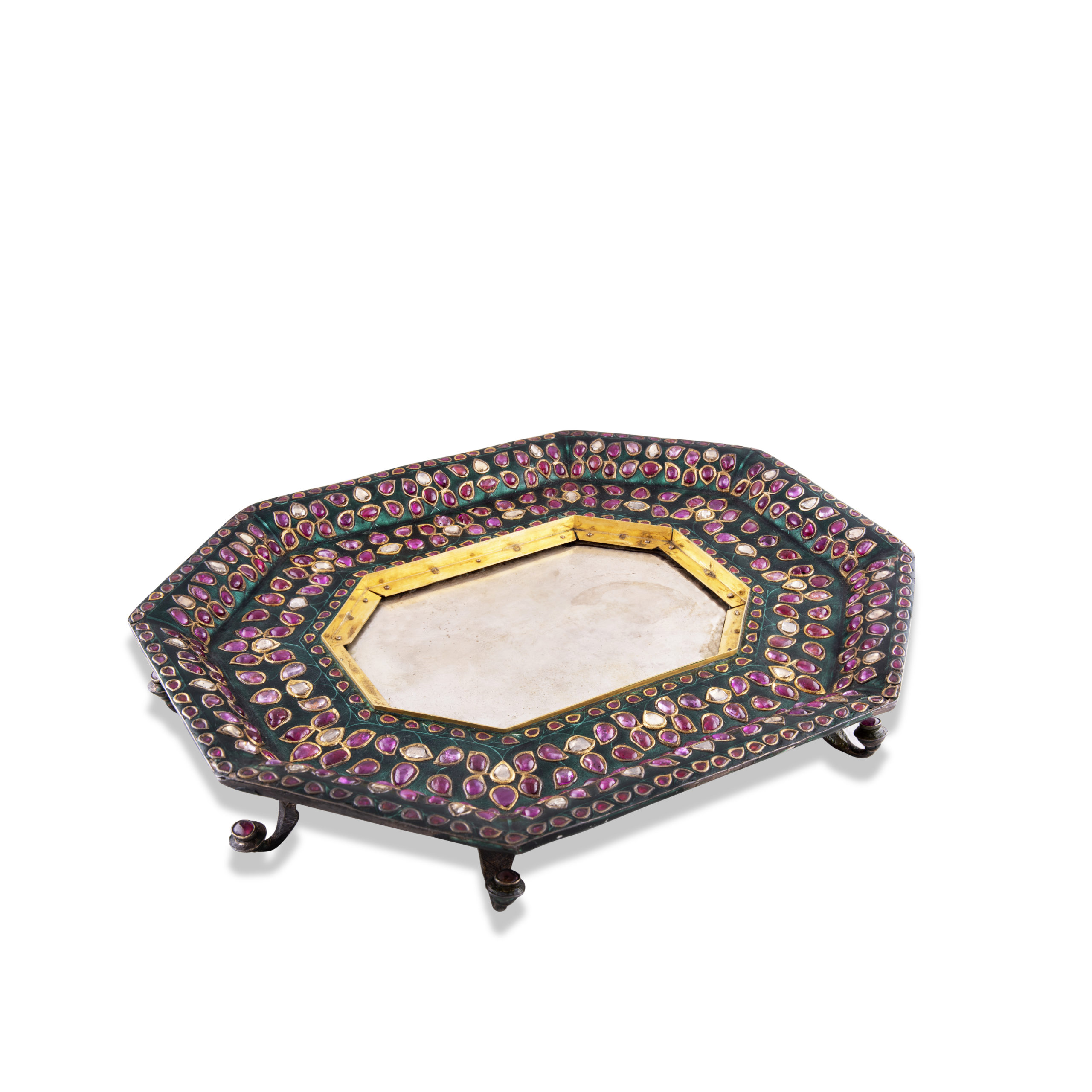
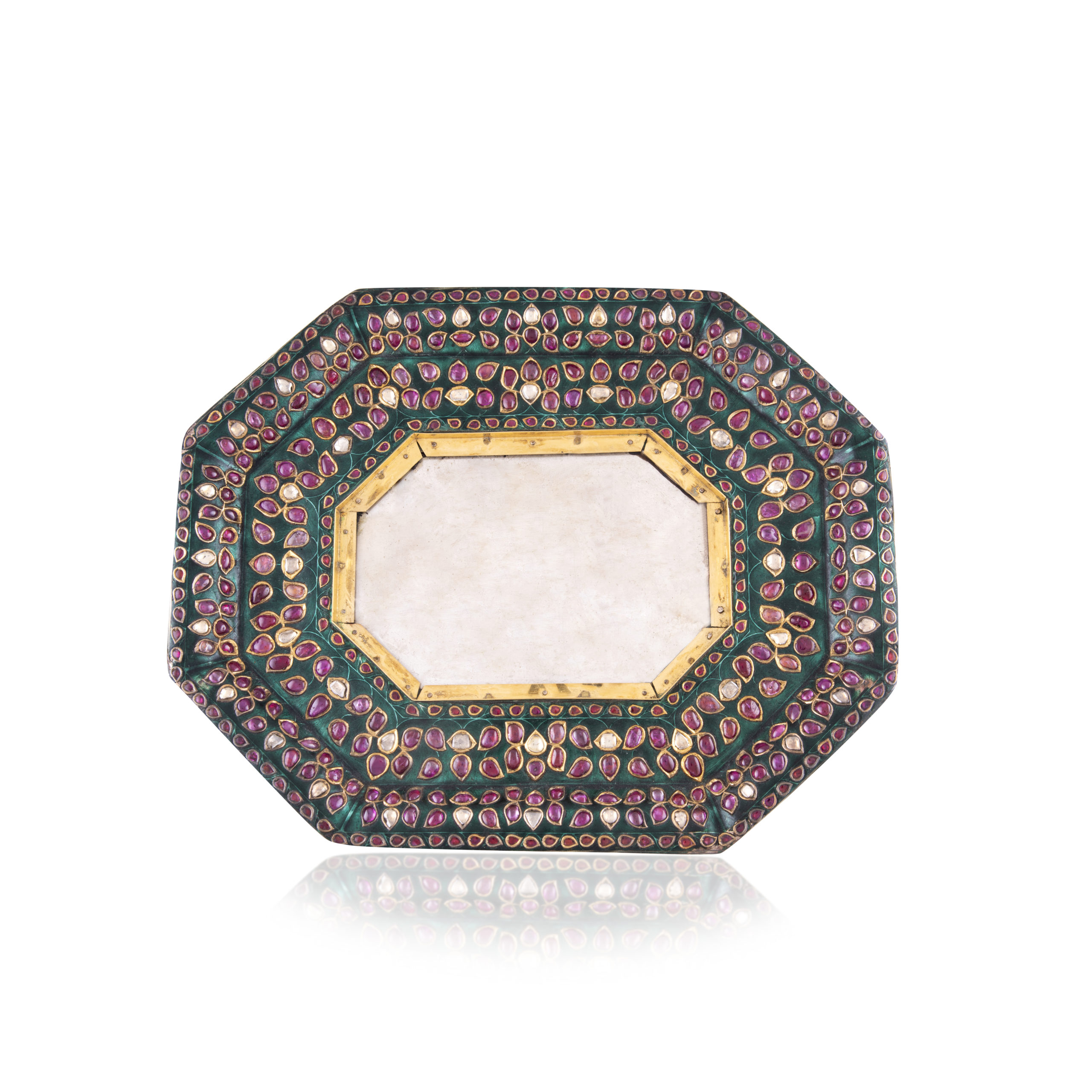
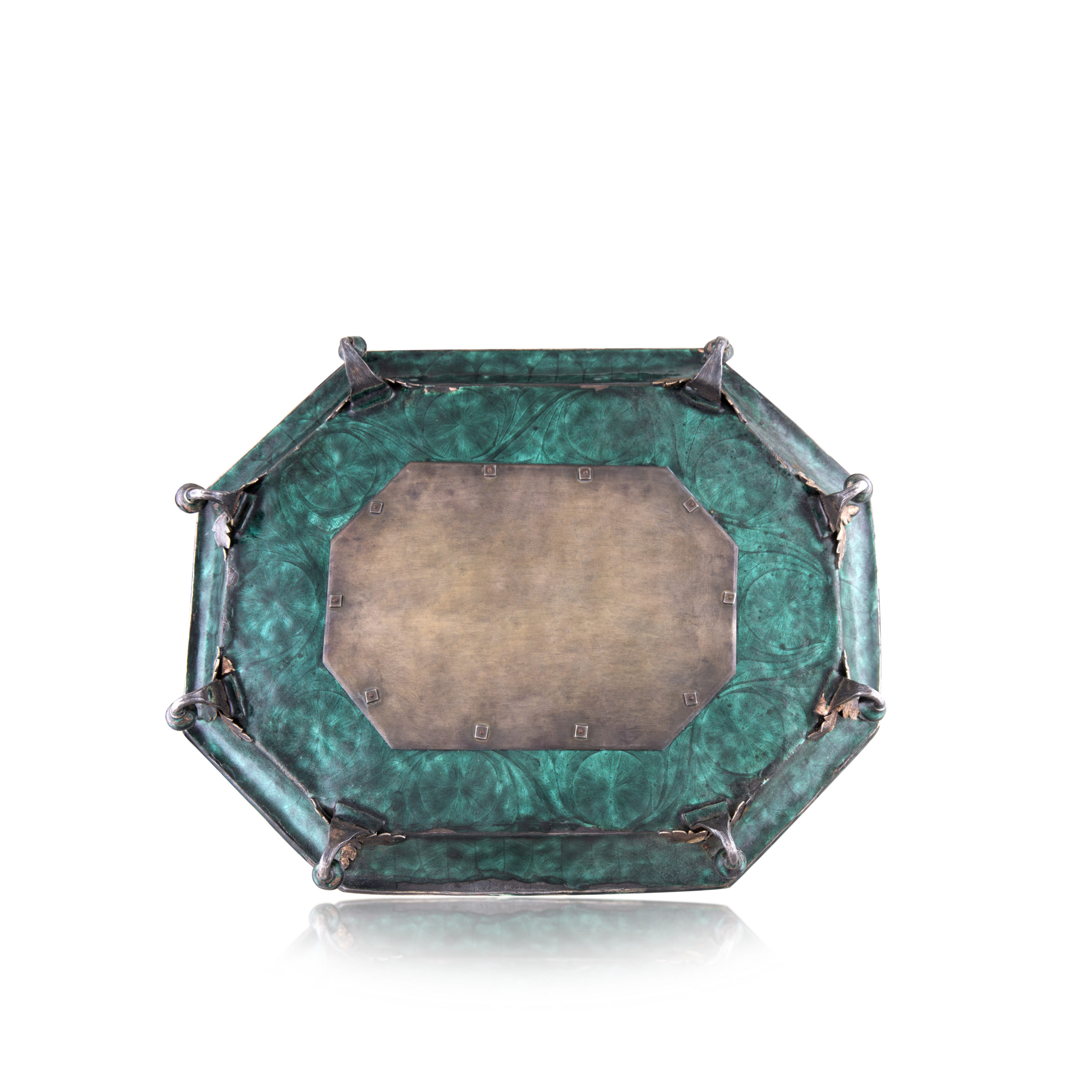
After graduating from Middlesex university London, he completed his studies in Islamic history and Hindu arts at the School of Oriental and African Studies (SOAS). In 2011, he completed a degree in gemology at the Gemological Institute of America. He then returned to his hometown, Jaïpur, to train at his family's business, Royal Gems & Arts. In 2018, Krishna Choudhary moved back to London and in 2019 he opened his own jewellery house: Santi Jewels. Located in a private salon in Mayfair, Santi Jewels is characterised by elegantly understated pieces adorned with dazzling gems and multiple references to Mughal jewellery. As a whole, Krishna's creations pay homage to his father, Santi, to the jewellery tradition of his native Jaipur, and to the even more distant tradition of India. Krishna nevertheless remains a man of the 21st century. Nourished by an ancestral tradition, he manages to break away himself from it in his own creations. We met to go back in time to discover his roots, influences and artistic tastes, references that allow us to fully appreciate the refinement of his creations.

The Choudhary family, Royal Gems & Arts and the Pink City of Rajasthan
Krishna Choudhary’s ancestors came from Dausa, a town fifty-five kilometres from the capital of Rajasthan. They settled in Jaipur in 1727, twenty years after the reign of the last “Great Emperor” Mughal Aurangzeb (r. 1658-1707) ended. The patriarch Choudhary Kaushal Singh was initially a financial advisor to Maharaja Sawai Jai Singh II (1686-1743), the founder of the city of Jaipur. He was in charge of minting coins and lending money, and also managed a Jagiri (i.e. an estate) of eleven villages around Jaipur. His role was to maintain law and order and to collect revenues and taxes. Choudhary Kaushal Singh soon rose to prominence in the Royal Court of Jaipur.
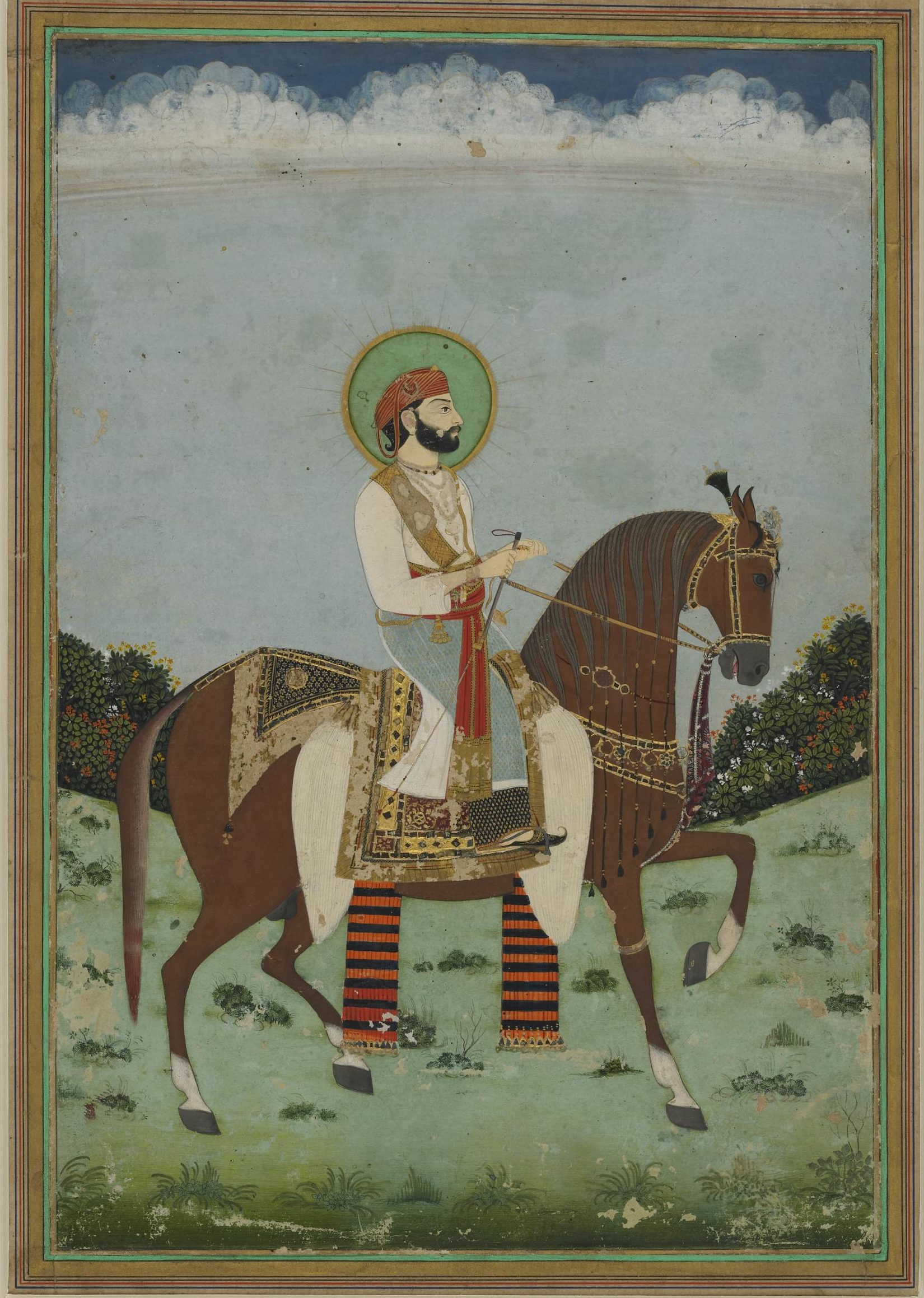
© The Trustees of the British Museum
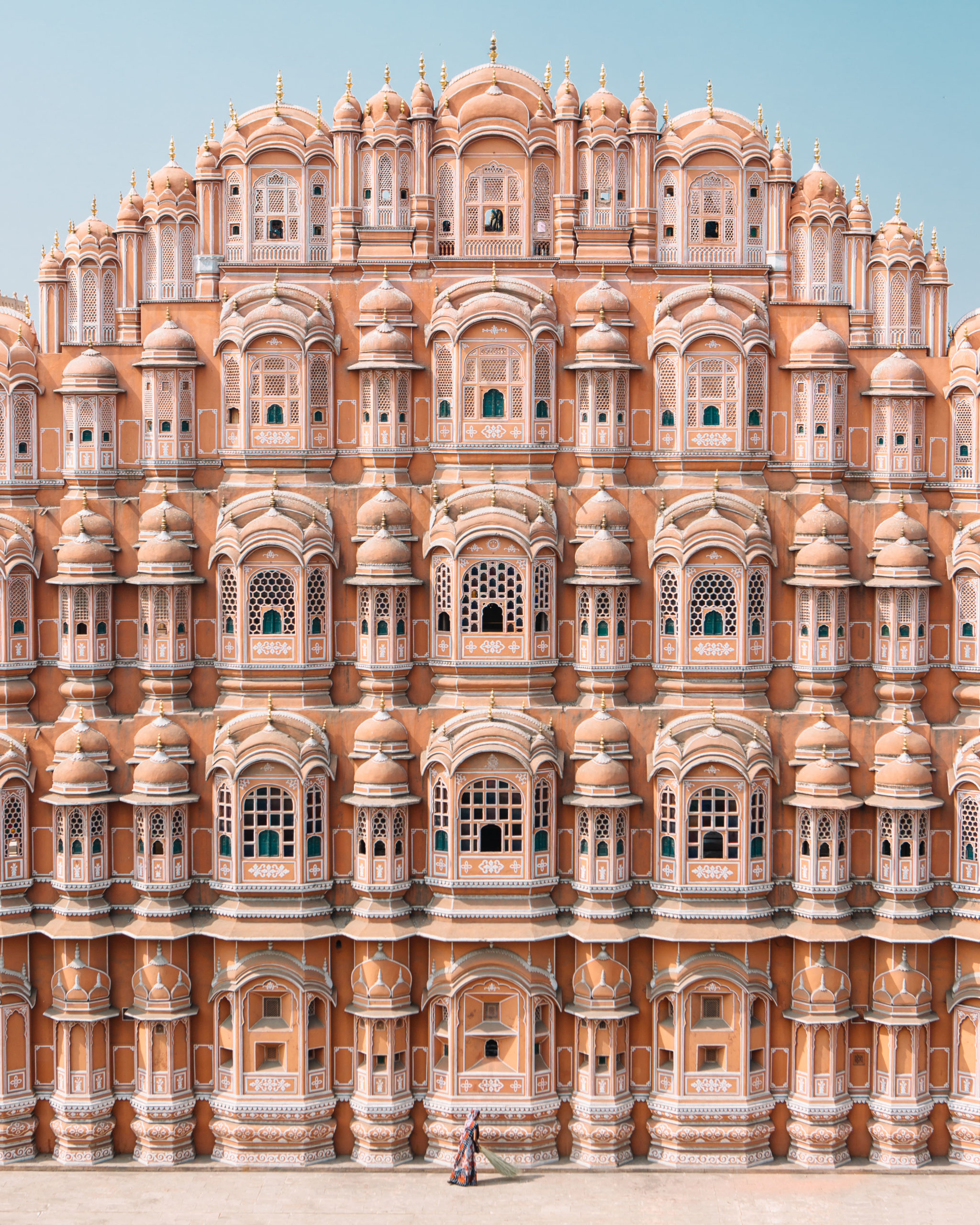
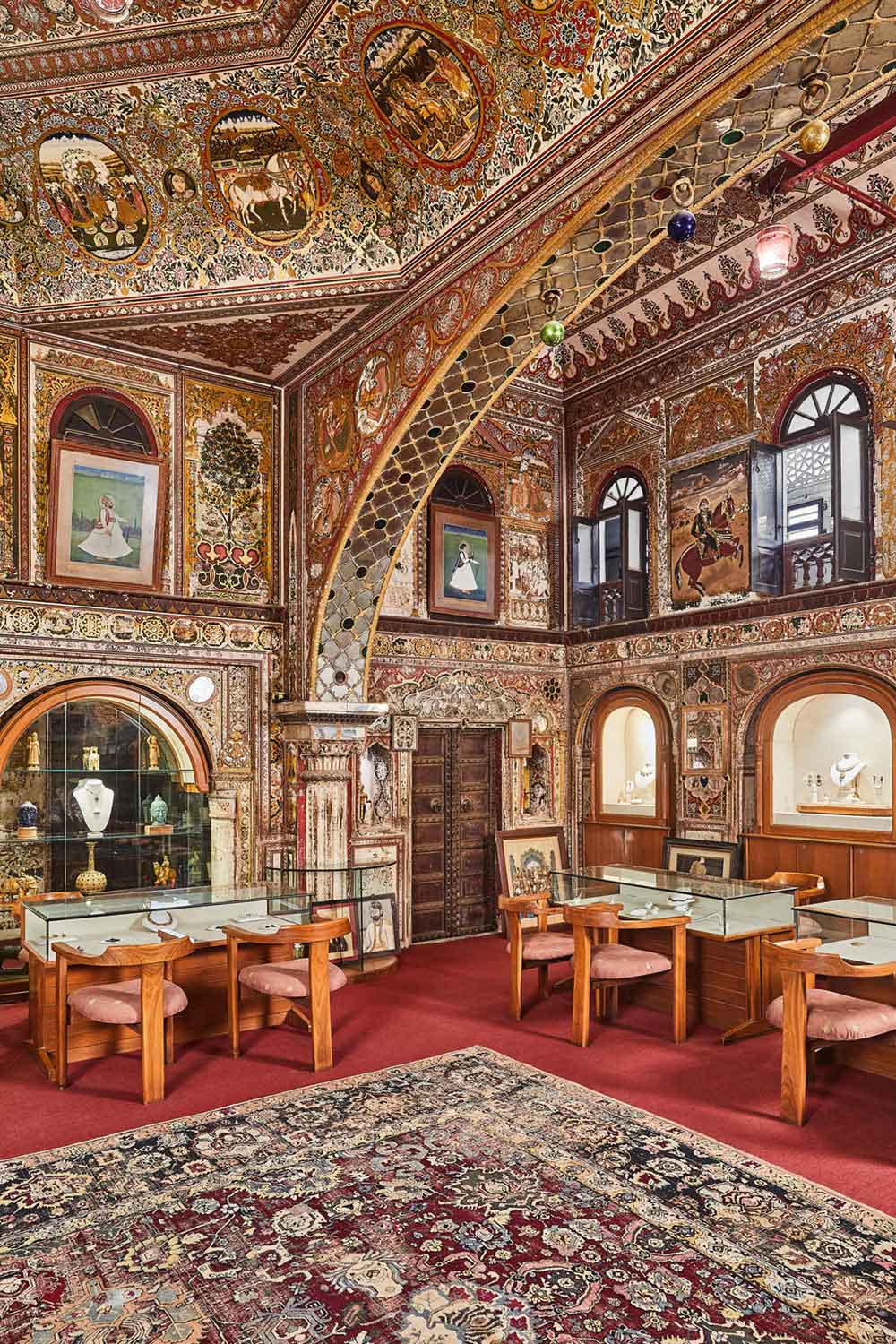
Over the decades, the “Choudharys” became gem dealers and jewellers. “This transition occurred several generations before my grandfather, says Krishna Choudhary, but although we have records going back to 1696, we don't know exactly when”. Initially settled on the site where the Hawa Mahal, the Palace of the Winds, was built in 1799, the Choudharys then lived for a time opposite this Palace before settling permanently in the early 19th century in what is still today their family haveli “Saras Sadan”. This haveli houses the family business, Royal Gems & Arts. It is a unique place where the walls are entirely decorated with colourful frescoes from the late 18th and early 19th centuries. Plants and garlands of flowers, rosettes and geometric patterns, draperies and gilding stand alongside the legends of ancient India - an innumerable pantheon of gods, Maharajas, Hindu princesses, horsemen and scattered clouds of birds. For the visitor, and I was lucky to be one, it is tempting to stay for hours in this wonderful atmosphere; fortunately for the master of the place, Santi Choudhary, the brilliance of the jewels and precious objects displayed in the wooden niches of the walls quickly attracts the visitor's eye!
Jaipur, over three centuries of jewellery tradition
The link between Jaipur and jewellers dates back to the early 18th century, when the city was founded by Maharaja Sawai Jai Singh II. He was a central figure in the Mughal dynasty, although he was a Hindu. At the head of his armies, he supported Emperor Aurangzeb, then his successors, and in return enjoyed imperial protection. Having become privileged and powerful thanks to this alliance, Sawai Jai Singh II brought to his court renowned artisans, including jewellers, who all participated in the development of the city and dissemination of the arts.
Three centuries later, Jaipur is a major centre for international jewellery. Professionals go there to cut and trade coloured stones. For example, three quarters of the world's emeralds are cut by lapidaries in Jaipur! “Diamond cutting, which requires a different kind of expertise, is mainly done in the city of Surat, and its trade in Mumbai” says Krishna Choudhary.
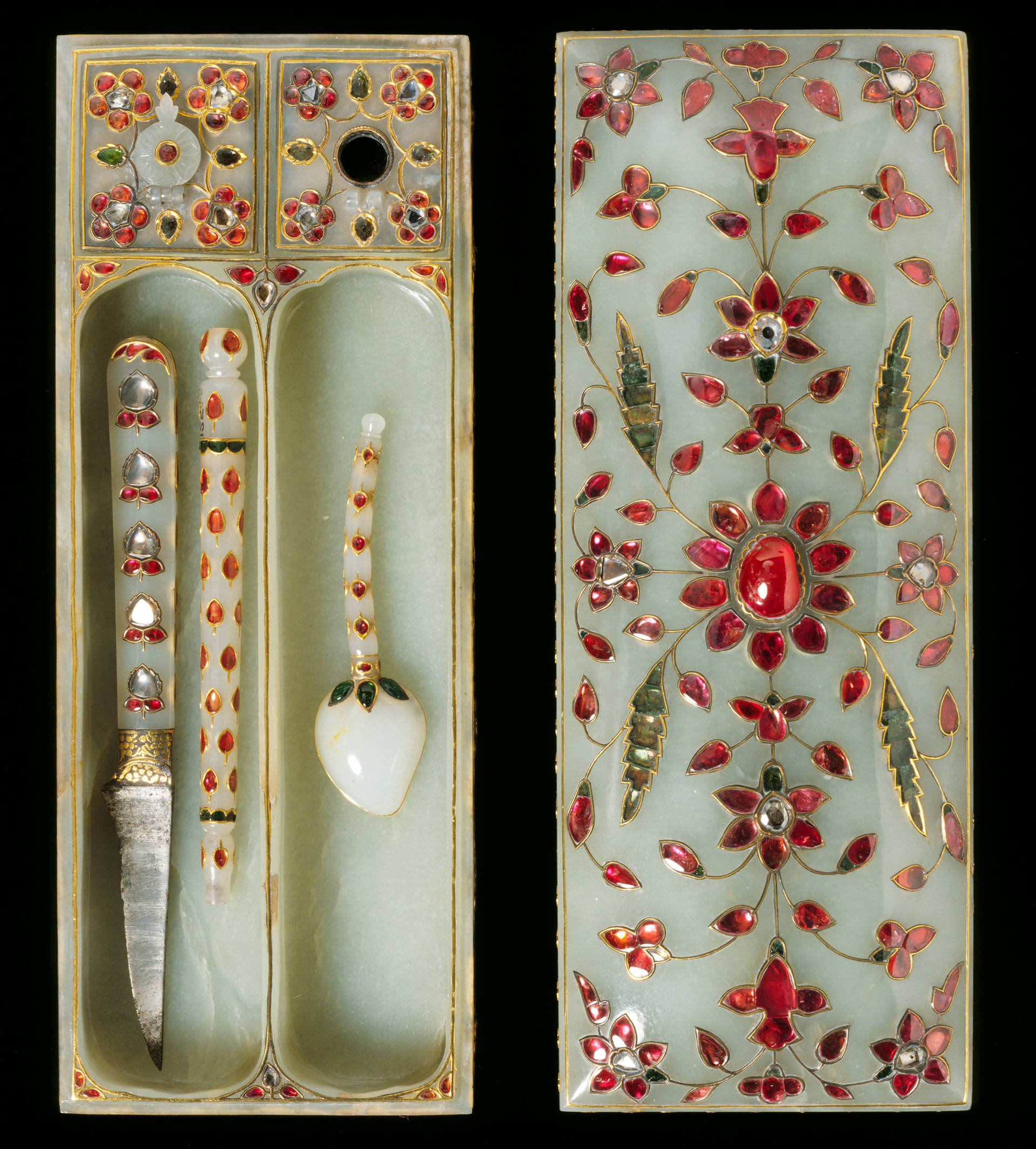
It is also in the Pink City that 90% of Indian kundan settings are made. This setting technique appeared during the reign of Emperor Jahangir (r.1605-1627), an important aesthete and patron of the arts whom Krishna Choudhary greatly admires. The kundan consists in surrounding a gem with a thin sheet of pure gold to fix it well in its support. The manipulation is done at room temperature and the setting is done by molecular bonding. This technique of inlaying gems, still in use today, allows the jeweller to work on any type of surface (gold, rock crystal, jade) and to set stones of various shapes.
Another typical art of Jaipur is that of enamelling, even if it tends to be “not as good as it used to be”, regrets Krishna. Red, blue, green and white are the signature colours of Jaipur enamel.
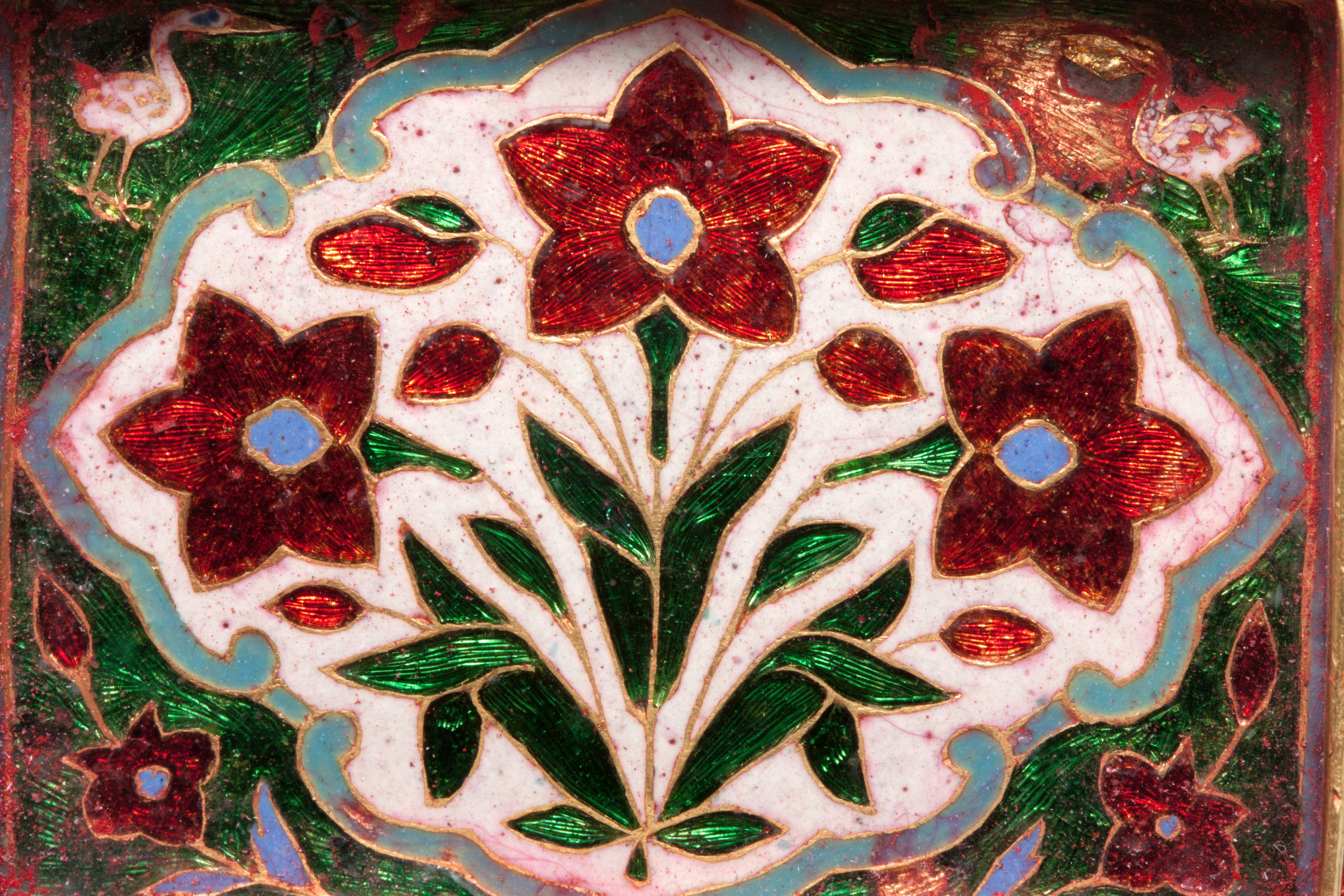
Finally, the capital of Rajasthan is also renowned for its jewellery. Designers come here from all over the world to buy or have their jewellery made; as for tourists, it is “at the Johri Bazaar that they can buy gold or silver jewellery, while the Bapu Bazaar is more devoted to costume jewellery” explains Krishna Choudhary.
The Pink City, a favourite place for jewellery professionals and enthusiasts, is part of a larger and even older history of jewellery in India.
A glimpse into an age-old art: jewellery in India
Hindu beliefs about precious stones
There are many texts on the importance of coloured stones and diamonds in Vedic literature. “Each stone, explains Krishna Choudhary, has particular spiritual and cosmological significance and is classified according to a hierarchy of value”. Thus, the five most important gems are grouped under the name Maharatna (ruby, diamond, emerald, sapphire and pearl) and the next four under the name Upratna (coral, garnet, cat's eye and yellow sapphire). The gem par excellence for Hindus is the ruby, Ratnaraj, which is associated with the sun.
“In the Hindu culture of ancient India, says Krishna Choudhary, the most beautiful stones and jewels were offered to the temples. The king came second”. However, all Hindus adorn themselves with jewellery, more or less richly, depending on their place in the hierarchy of the caste system. This is often shown in ancient Hindus statues.
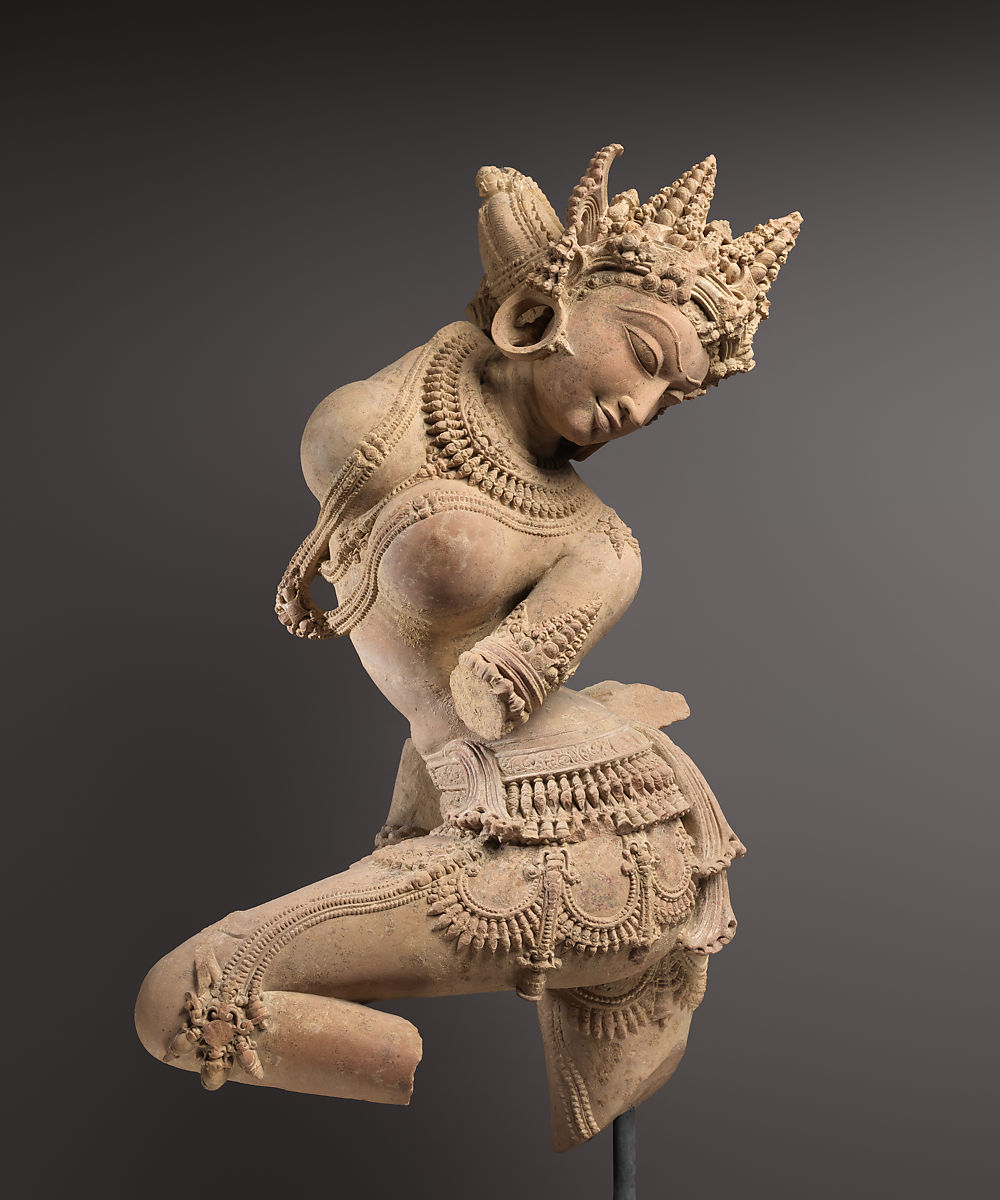
@The MET Fifth Avenue
Some typical characteristics of Hindu jewellery
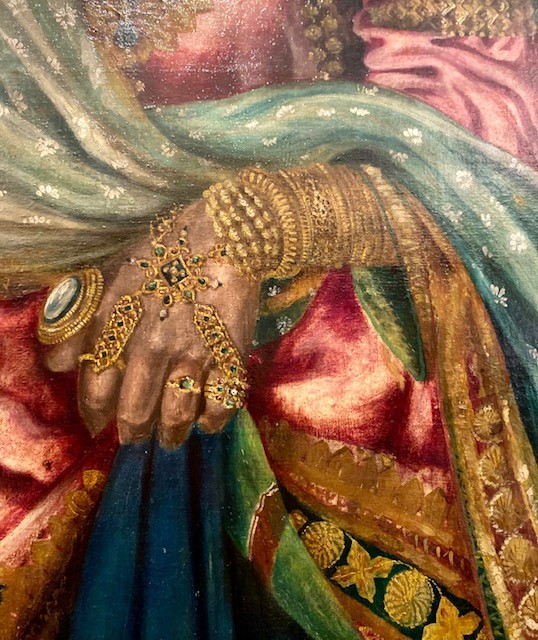
Hindu jewellery is traditionally mounted on yellow gold. It is brightly coloured by precious or semi-precious stones cut in cabochon, pear, shuttle-cut or presented in the form of pearls. The main colours that come to mind when thinking about this jewellery are green (emerald, enamel), red or pink (ruby, spinel, tourmaline) and white (pearls, enamel). Necklaces, bracelets and head ornaments are studded with flat diamonds, simply polished, as jewellers continue the age-old tradition of keeping as much weight as possible on the gem compared to the rough. Cultural references appear in the designs, such as the sun, certain flowers (lotus, water lilies, orchids or jasmines) or the makara, the mythological creature with multiple symbols - half terrestrial-half aquatic - and which can be recognised by its attributes: a trunk on the top of the head, a gaping mouth and the tail of a fish or marine animal at the end of the body. “This type of jewellery, says Krishna Choudhary, is very popular in India, and can be found in all the workshops in the country, with some variations depending on the state”.
According to Krishna Choudhary, the essence of Indian jewellery could be defined by this aphorism: “More is more”. In contrast, the jewellery pieces he has been creating since 2019 are characterised by “Less is more”. More than the Hindu tradition, his sensibility leads him to Indo-Mughal art, influenced by Persian culture and Islamic Arts.
The Mughal contribution to Indian aesthetics
“In the arts of Islam, the representation of the living is banned from the spiritual or sacred domain but not from the private or profane domain”, says Krishna Choudhary. Thus we find scenes of daily life (court ceremonies, hunting, romantic or warlike scenes) as well as an important animal and plant iconography on buildings, in interiors, on textiles, tapestries, ceramics, illustrated manuscripts and in jewellery.
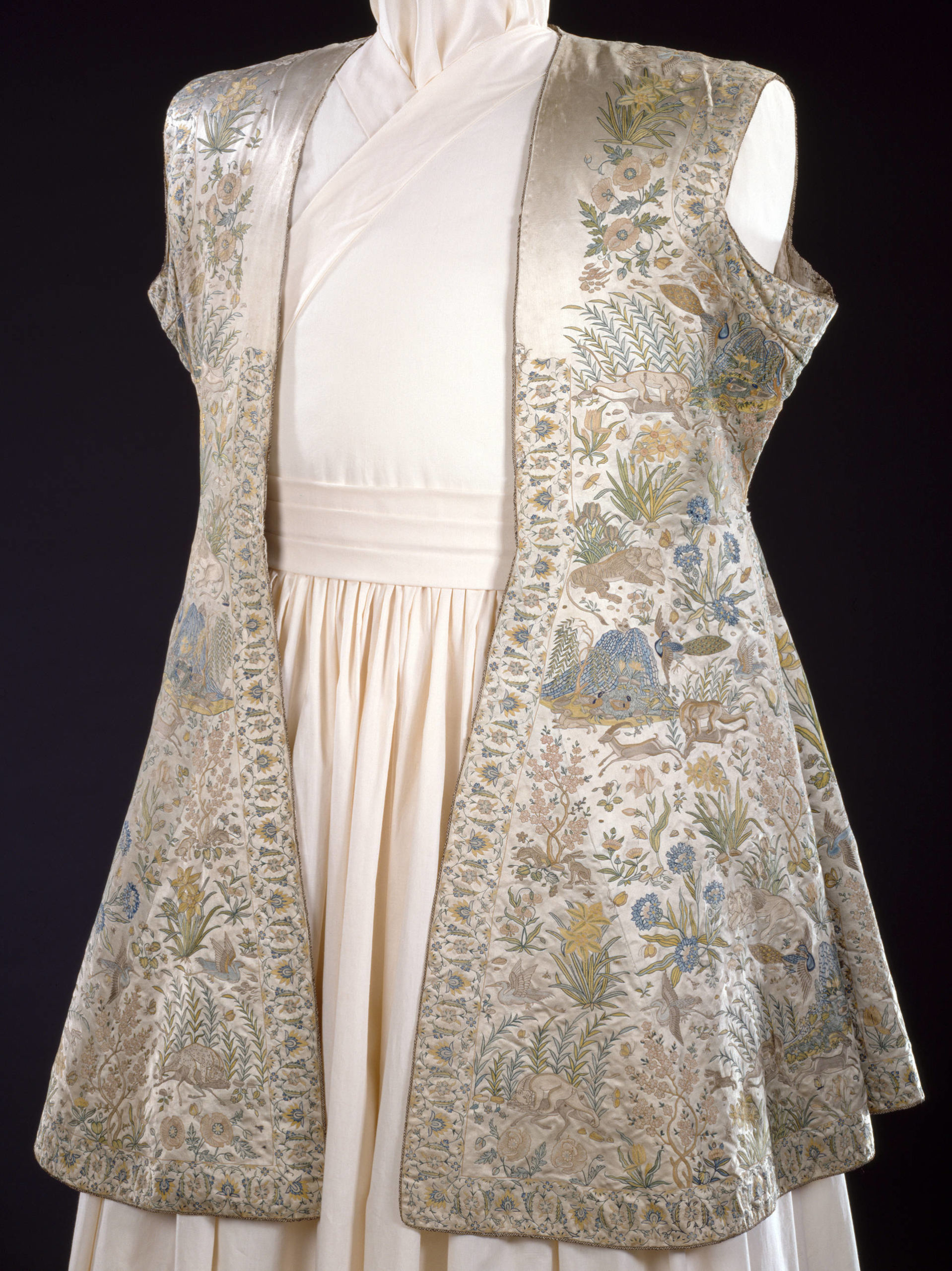
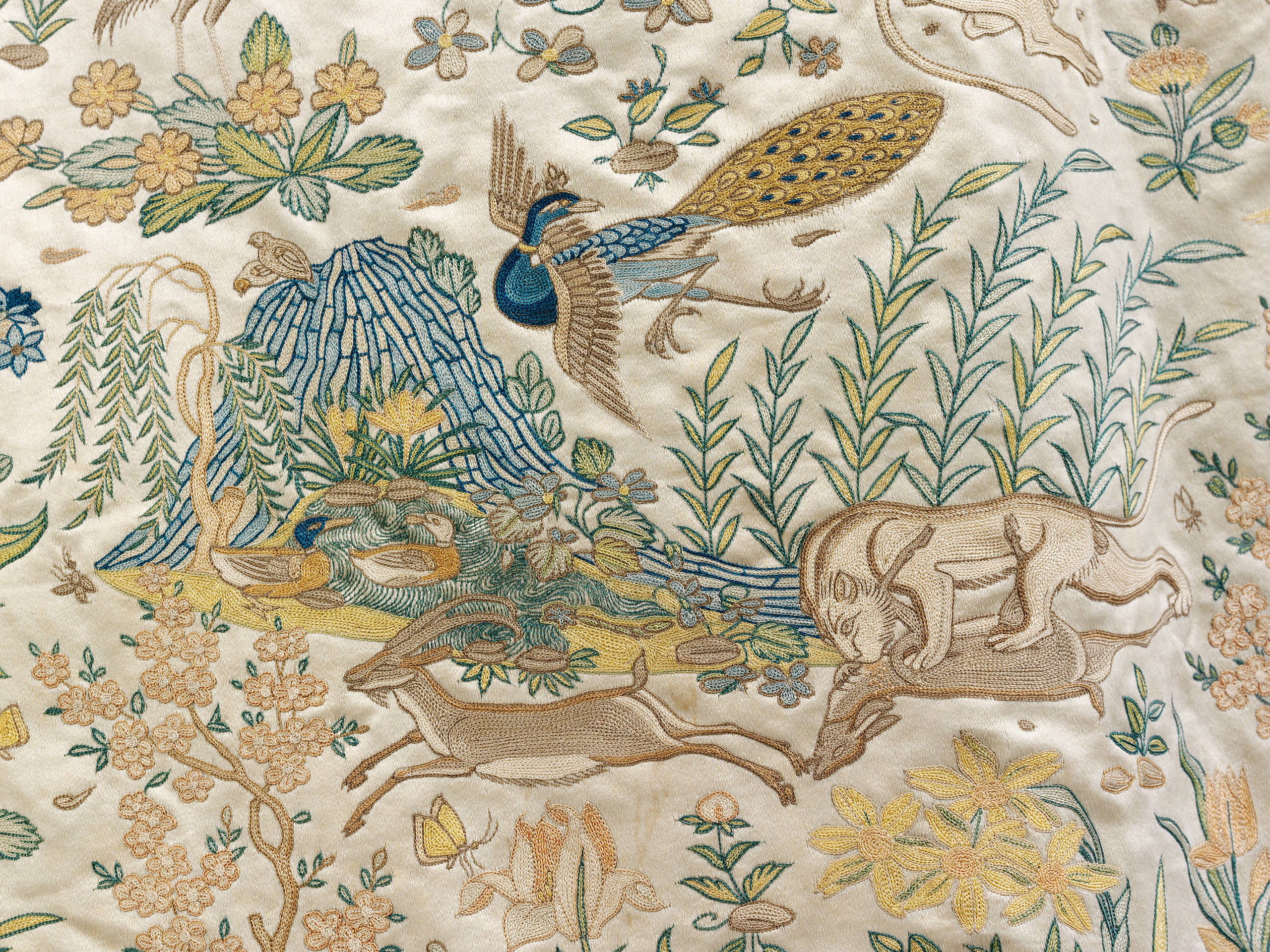
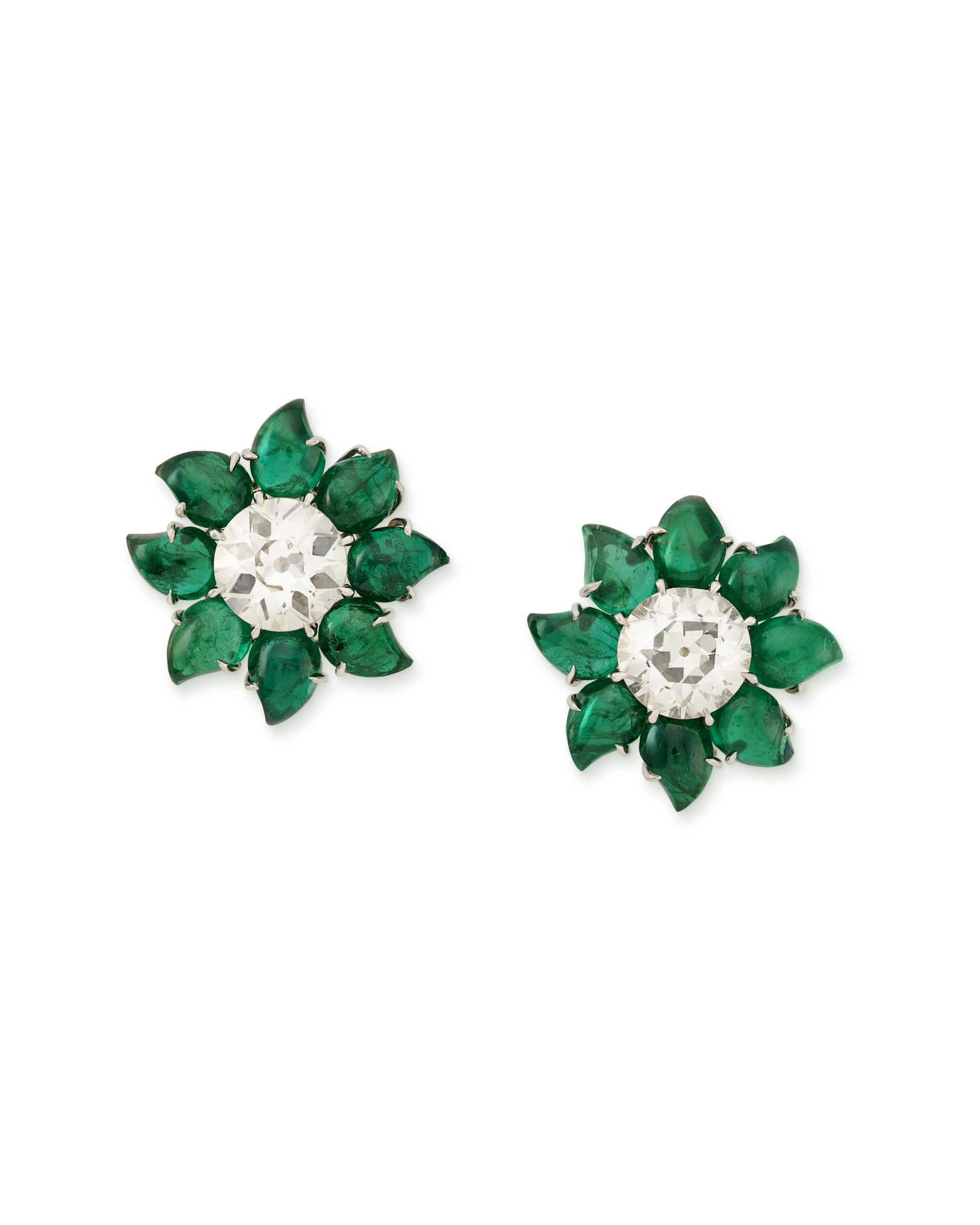
From the time of their arrival in India in the 16th century, the Mughal emperors developed plant and floral motifs extensively in their arts. There are two main reasons for this, explains Krishna Choudhary: “The first is the nostalgia of these emperors for the gardens of the East, Babur and the gardens of Samarkand, Humayun and the Persian gardens, Shah Jahan and the gardens of Shalimar etc... The second reason lies in the symbolism of the garden which in Islam represents paradise, peace and divine grace”.

Some characteristics of Mughal jewellery
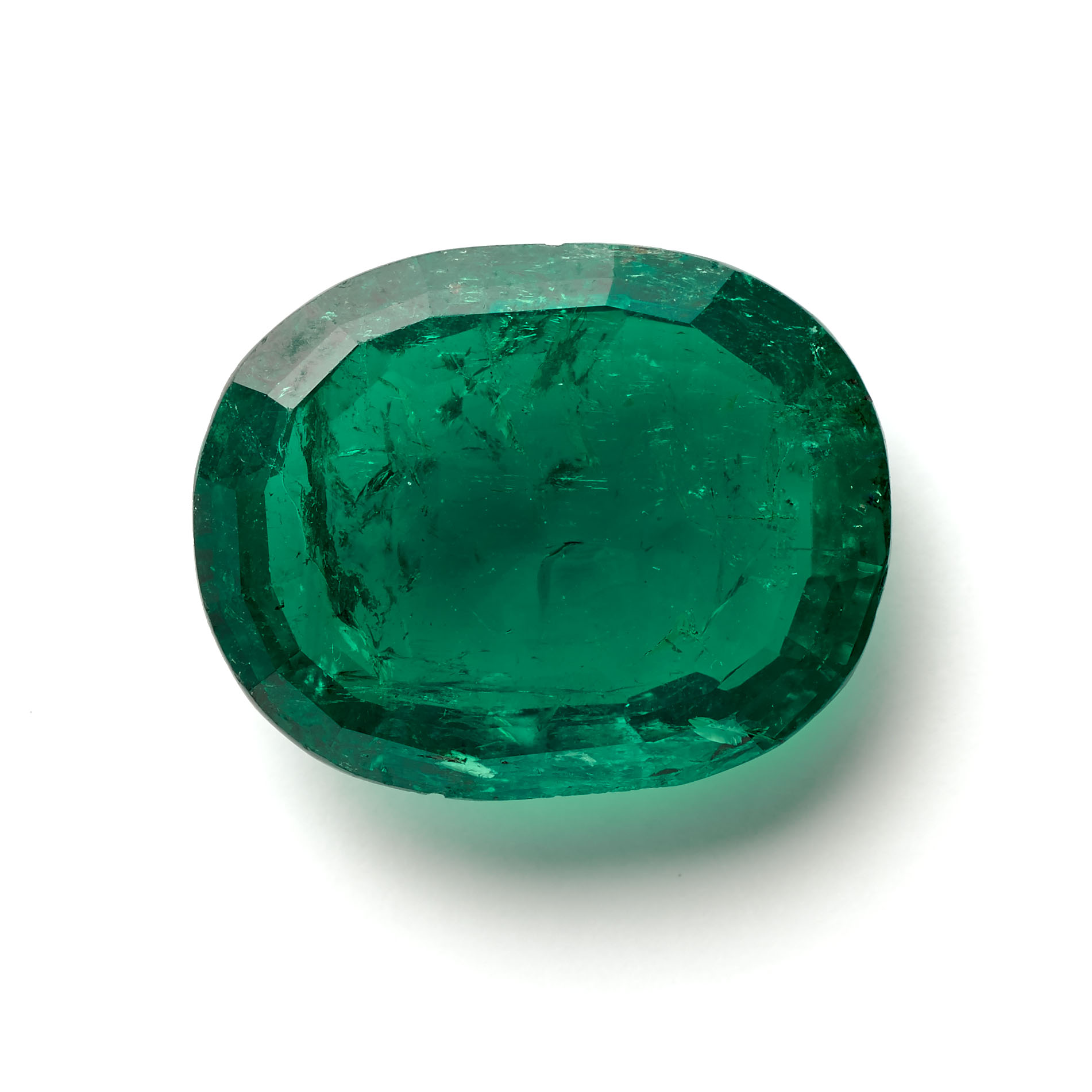
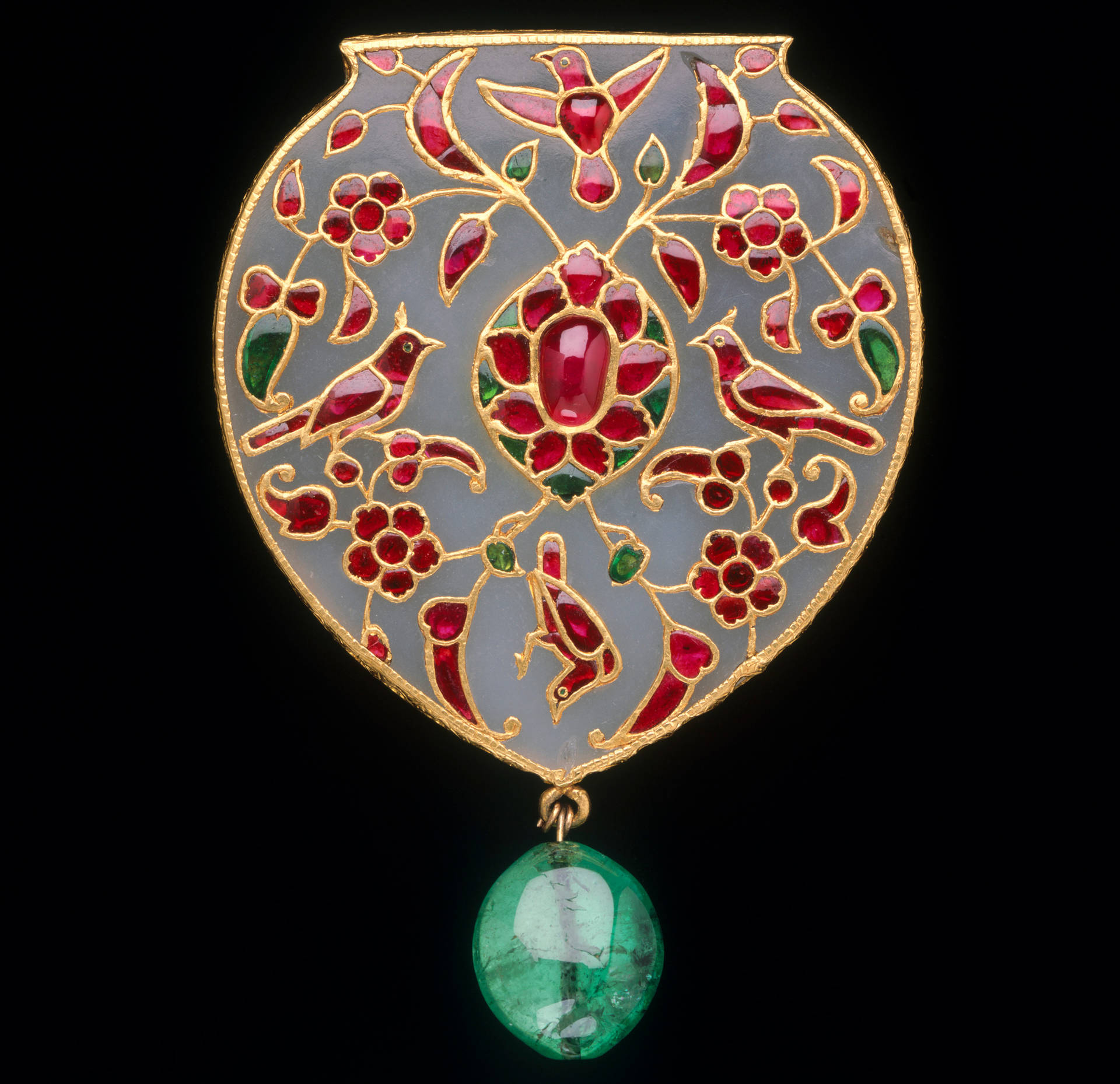
In Islamic art, there is a metaphorical language of colours. Applied to jewellery, the red of spinels imported from Badakshan (a mountainous region bordering Afghanistan and Tajikistan) expressed power and royalty. Emperors liked to wear long necklaces around their necks with spinels in the form of large oblong pearls combined with sumptuous emeralds imported from Colombia, and large pearls. The deep green of the emeralds was imbued with spiritual virtues and recalled the prophet's favourite colour. As for the fine pearls, fished in the Persian Gulf, they symbolised purity and were the most commonly worn gems of the Mughal emperors. Krishna Choudhary sees a practical reason for the abundant use of fine pearls in Mughal jewellery: they were simply easy to wear and fitted perfectly into the Mughal's flowing, loose-fitting clothes.

The most beautiful gems were sometimes engraved and became the central element of the jewellery. Spinels were engraved with royal titles, emeralds, protective amulets, calligraphed with verses from the Koran and/or decorated on their other side with floral motifs. Flowers and plants were represented in a naturalistic figurative style but were sometimes idealised, particularly in the designs of “celestial flowers”. The floral species of the Mughals differed from those favoured by the Hindus, notes Krishna Choudhary. The rose was a particularly beloved motif, and the Emperor Jahangir and his Persian wife Nur Jahan were devotees and encouraged its cultivation. But there were also tulips, poppies, carnations, irises, daffodils, lilies etc...
Some rare diamonds were also engraved. For example, the Shah rough diamond in the Kremlin Diamond Fund collections is engraved with the names of three of its owners: Nizam Shah (1591), the Mughal emperor Shah Jahan (1641) and Fath Ali Shah (1826).
Setting technique most closely associated with Mughal jewellery is kundan, mentioned above.
Jewellery making in India (from the north of the subcontinent to the Deccan plateau) underwent a profound evolution during the Mughal period. The craftsmen of the royal workshops skilfully combined the best of the Indian jewellery tradition with Persian influences and a style was born. This style, which embraced the jewellery arts, endured despite the decline and fall of the Mughal Empire. When India came under British control in 1858, the Mughal style gradually extended its influence on Western aesthetics.
The 20th century: jewellery influences shared between India and the West?
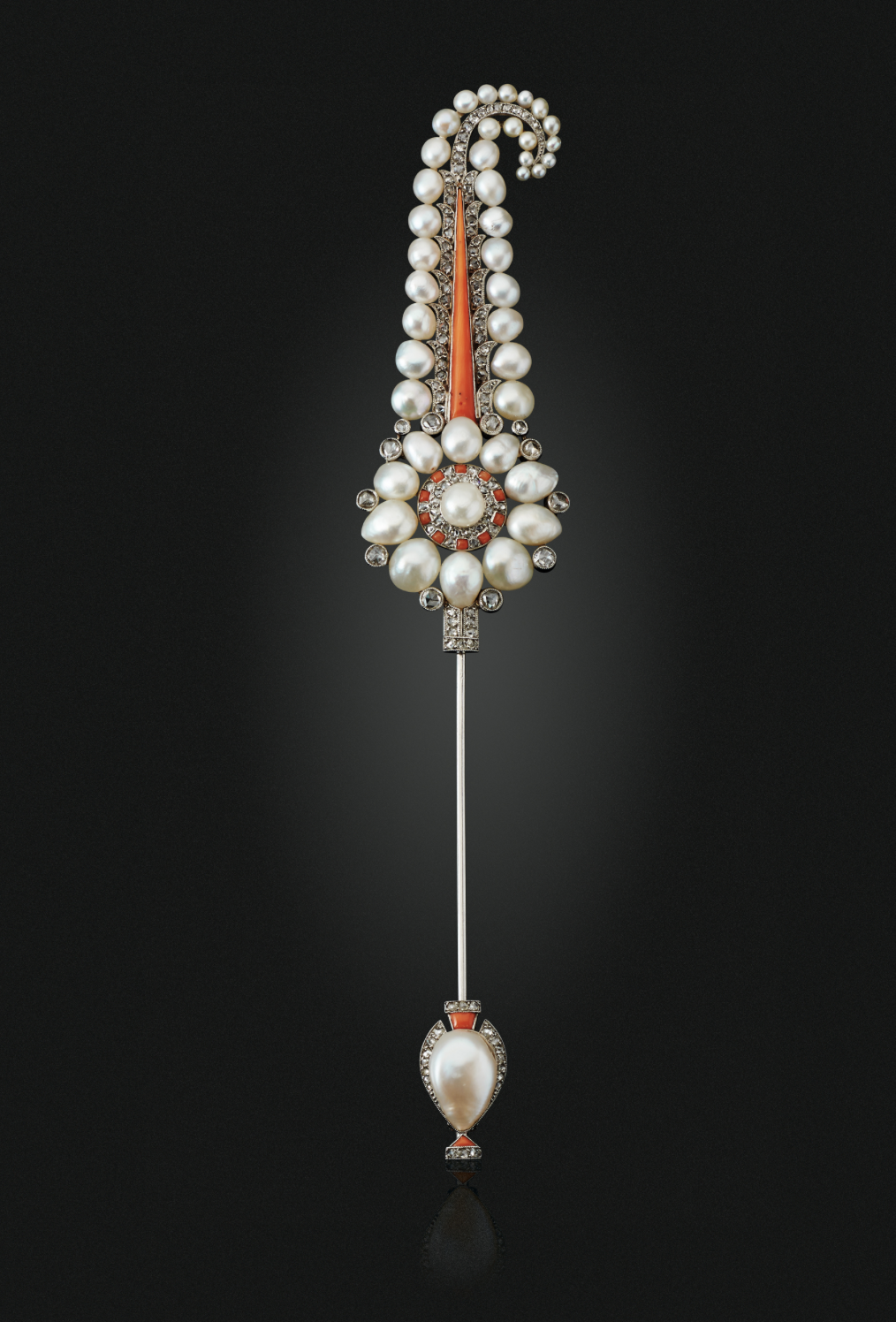
Indian aesthetics and Mughal jewellery strongly inspired the great European jewellery houses, which reinterpreted the combinations of gems, the shimmering mix of colours, the shapes - in particular the paisley motif in the shape of a teardrop with a curved upper end - and the use of engraved stones. The major jewellery houses of the first half of the 20th century, however, resisted the use of yellow gold because platinum was in vogue. Jewellery literature abounds with extravagant stories of Maharajas from the richest princely states in India coming to London and Paris to have entire chests of precious stones set in platinum. Conversely, the influence of European jewellery in India is rarely discussed.
Krishna Choudhary recalls that under the British Raj, jewellery workshops were created in Calcutta for Europeans who came to live or visit India. Jewellery inspired by what was done in Victorian London (1837-1901) appeared between the 1860s and 1880s. This influence of European design can be seen in the shape of several late 19th century rings from the Nizam collection in Hyderabad (see Jewels of the Nizam, Usha R Bala Krishnan, p.221-223). In contrast, yellow gold remained the precious metal of choice for Indian jewellers for decades to come. Since the 1980s, a new breed of jewellers, including Krishna Choudhary, has been breaking away from it.

It is astonishing to note that since the conquest of the Great Mughals, no new foreign influence has imposed itself on India; Westerners played an important but indirect role during the last third of the 20th century.
Independence, end of privileges and abolition of the privy purse: Indian jewellery in danger
The year 1947 was marked by the dissolution of the British Empire followed immediately by India's Independence on 15 August. At the time of Independence, there were 555 princely states covering almost half of India's territory and about one-third of its population. Under the Indian Independence Act and the incorporation of the various princely states into India or Pakistan, the various rulers (Maharaja, raja, Nizam...) were forced to give up their power in exchange for “privy purse” (a tax-free private grant of about a quarter of what they had previously earned).
Twenty years later, in 1971, Indira Gandhi (1917-1984) abolished the privy purse. Until then, these rulers had been the main sponsors of jewellery in India: their relative impoverishment was not without consequences for the Indian jewellery market.
Krishna Choudhary believes that the Indian jewellery industry was able to survive after independence thanks to foreigners. Many Western jewellers, following in the footsteps of Jacques Cartier, came to India to buy gems and engraved stones, not hesitating to acquire, when possible, elements of princely finery from penniless sovereigns. Media personalities such as Jackie Kennedy and her sister Lee Radziwill contributed to the watered-down, romantic image of India, while discerning collectors such as Sheikh Nasser Sabah al-Ahmad al-Sabah and Sheikha Hussah Sabah al-Salem al-Sabah of Kuwait came in 1975 to acquire the first pieces of their extraordinary collection of Islamic art.
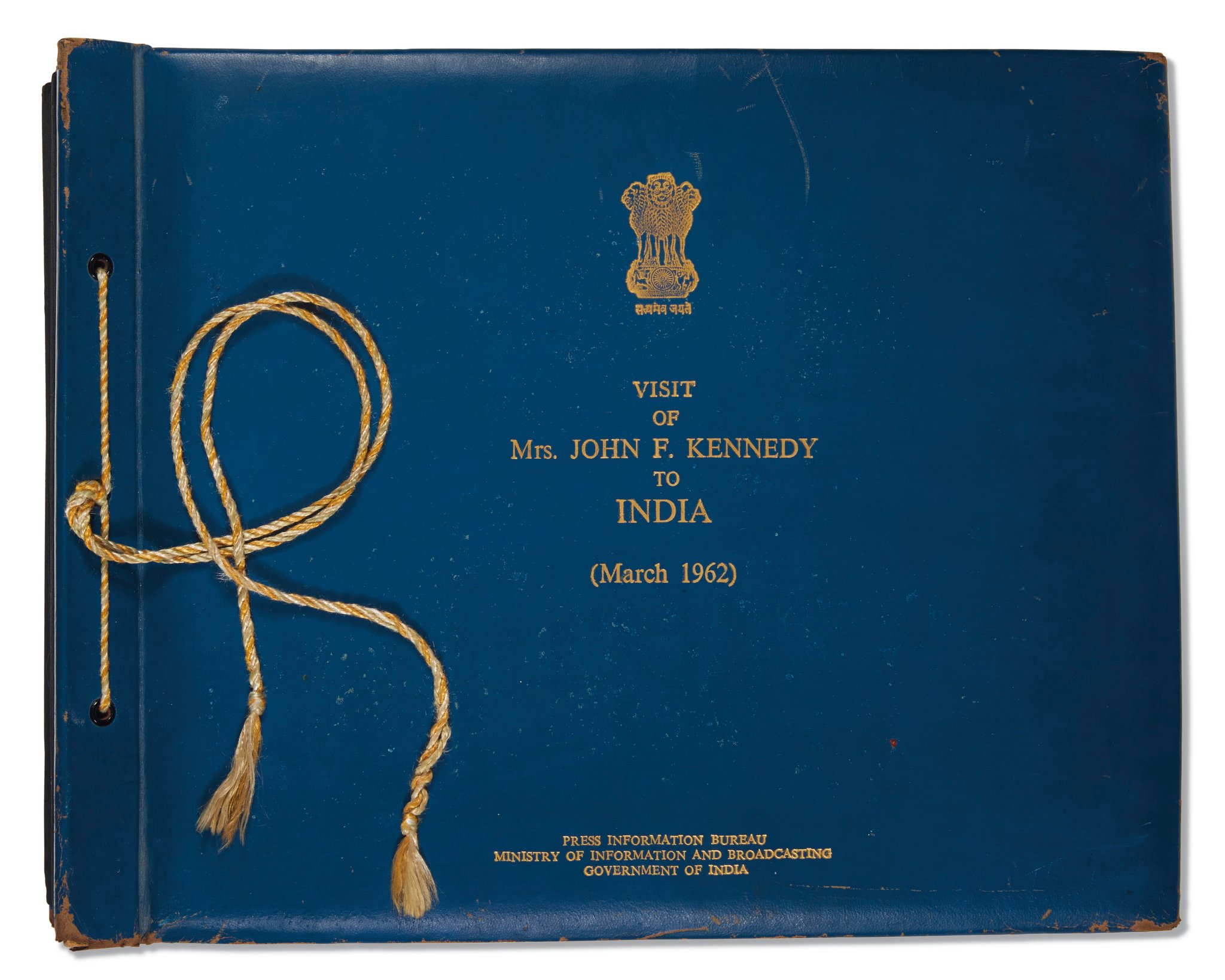
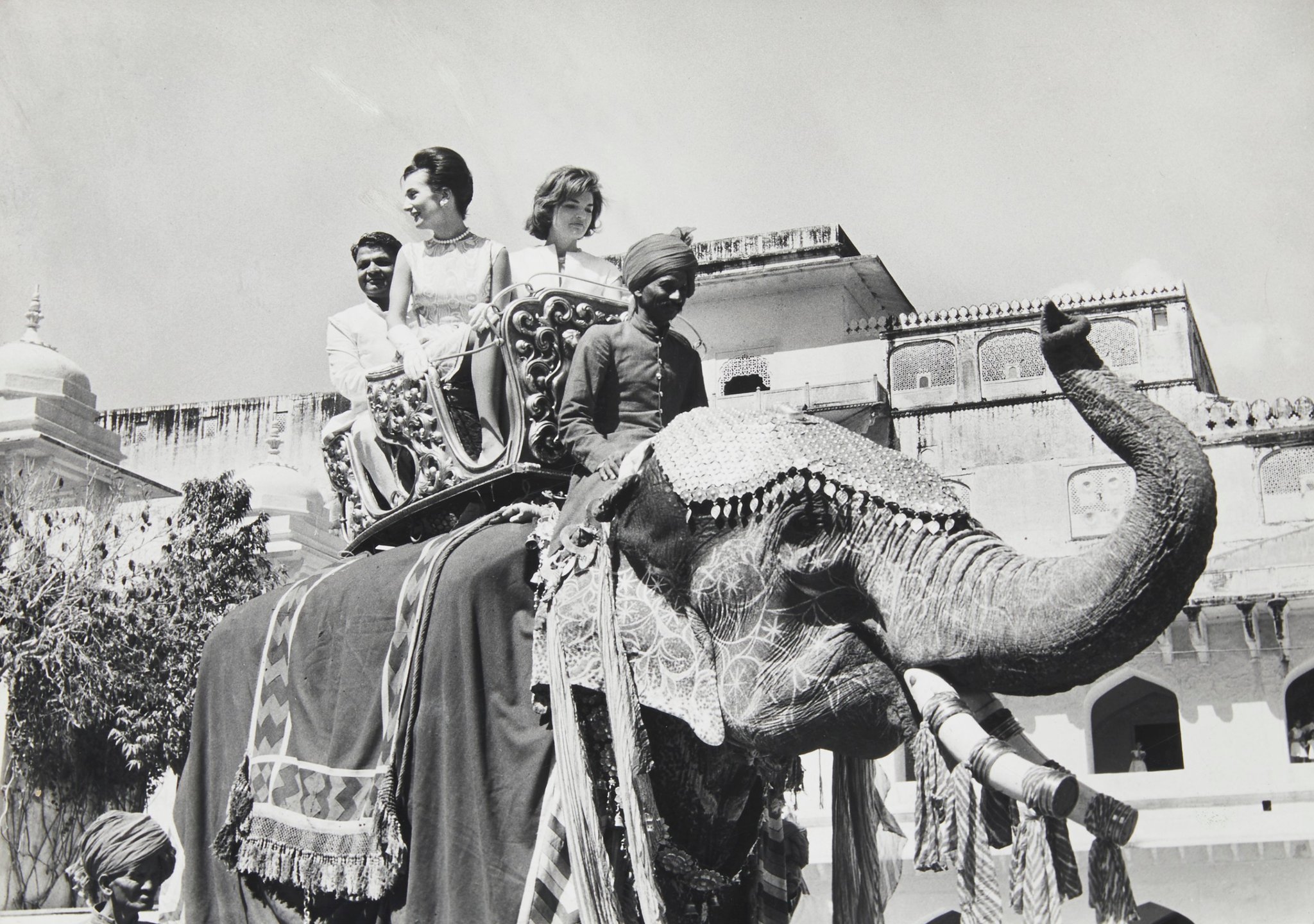
“It was in the 1960s, under the leadership of my father Santi Choudhary, adds Krishna Choudhary, that our family business was renamed “Royal Gems & Arts” in order to open it up more to international trade”. Until then, trade was conducted on the floor on large Persian carpets, as seen in the photographs of Jacques Cartier's trip to India in the 1920s and 1930s. Santi Choudhary began travelling to Europe in the 1970s to organise exclusive exhibitions of his creations. Today, Royal Gems & Arts has become an institution whose name regularly appears on the list of art exhibition lenders around the world.
Khrishna Choudhary & Santi Jewels
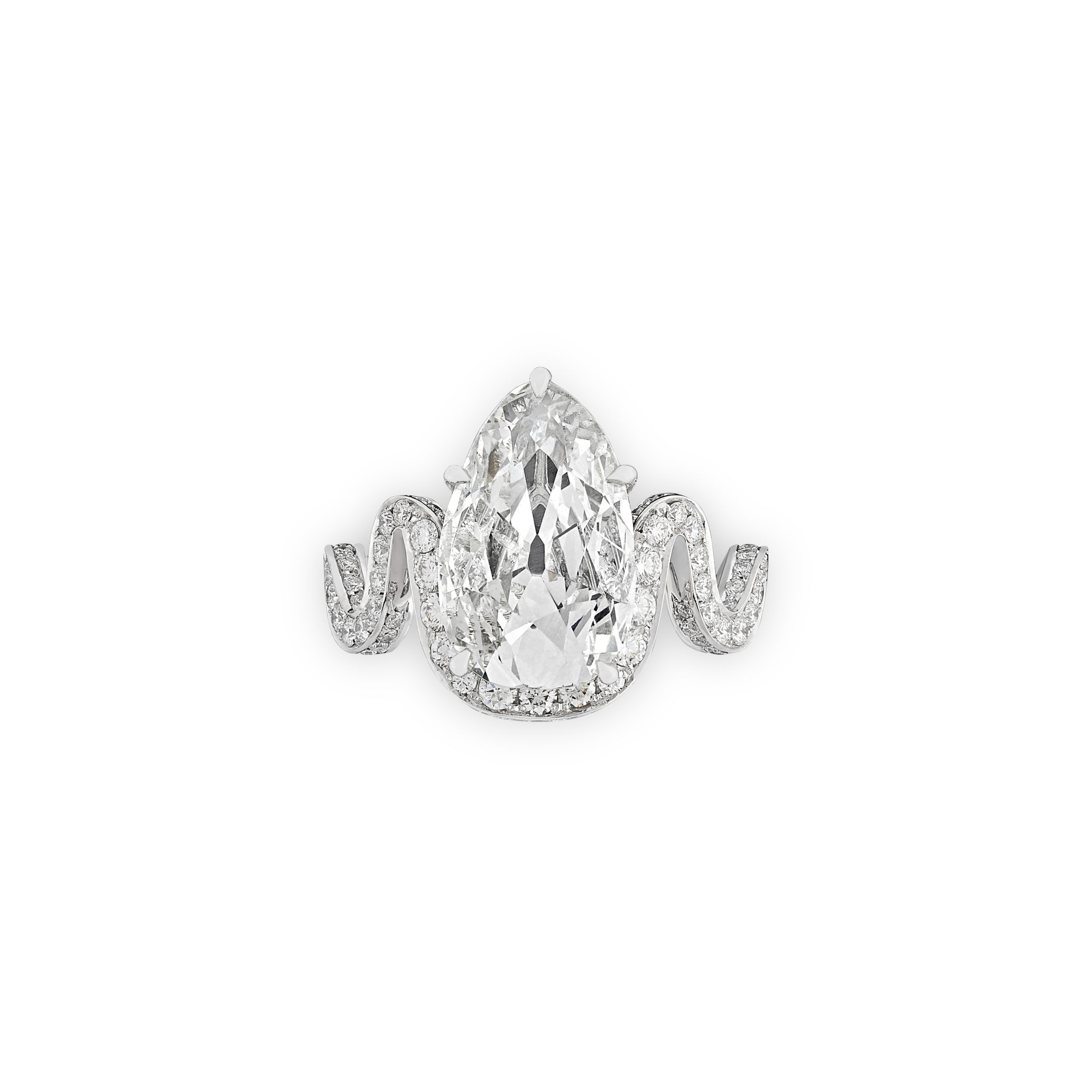
Krishna Choudhary is undoubtedly an heir to this long jewellery tradition. This legacy he received at birth is of immense wealth; it is also heavy with responsibility. Krishna Choudhary is aware of this. His extreme courtesy, great culture and deep modesty testify to this at each of our meetings. Krishna admits his humility in front of the treasures at his disposal. He works essentially with gems drawn from a family treasure accumulated over three centuries. The gems he uses most are the Maharatna: diamond, emerald, sapphire, pearl - but he readily replaces the ruby with spinel, the gem most associated with the Mughal Emperors.
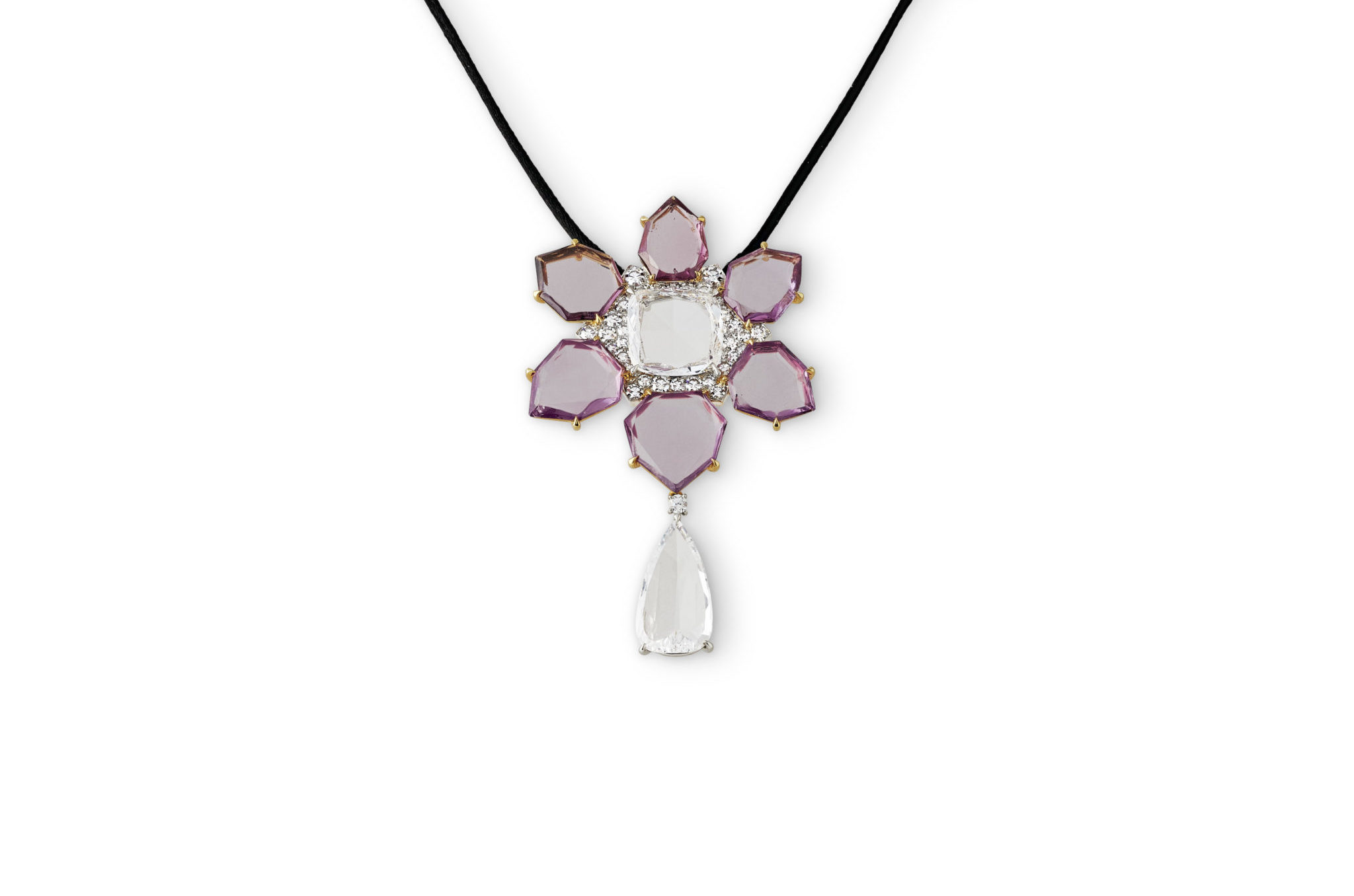
In this spirit, Krishna Choudhary has created a pendant composed of six flat spinels of heptagonal shape coming from the same mine, of which only one, placed at the top of the motif, has been slightly re-cut. (It should be noted that Krishna Choudhary, out of respect for the historical stones for which he creates new settings, tries as much as possible to keep them in their original size. If re-cutting is necessary, it is then entrusted to the hands of the best workshops in Jaipur). The spinels of a delicate pink and perfect purity, held by four fine yellow gold claws, form the petals of a stylised flower, the heart of which is a square old-cut diamond set on brilliants. A heavy diamond dewdrop drips from the flower. The jewel rests on a black silk cord in the pure Indian tradition. A double leaf on each side of the cord, or perhaps four paisleys, rests on the collarbones. The clasp repeats the same motif, but with lines of diamonds encircling a final spinel, this one octagonal. A true testament to the flat stone in India, this jewel celebrates India's heritage in a very contemporary style.
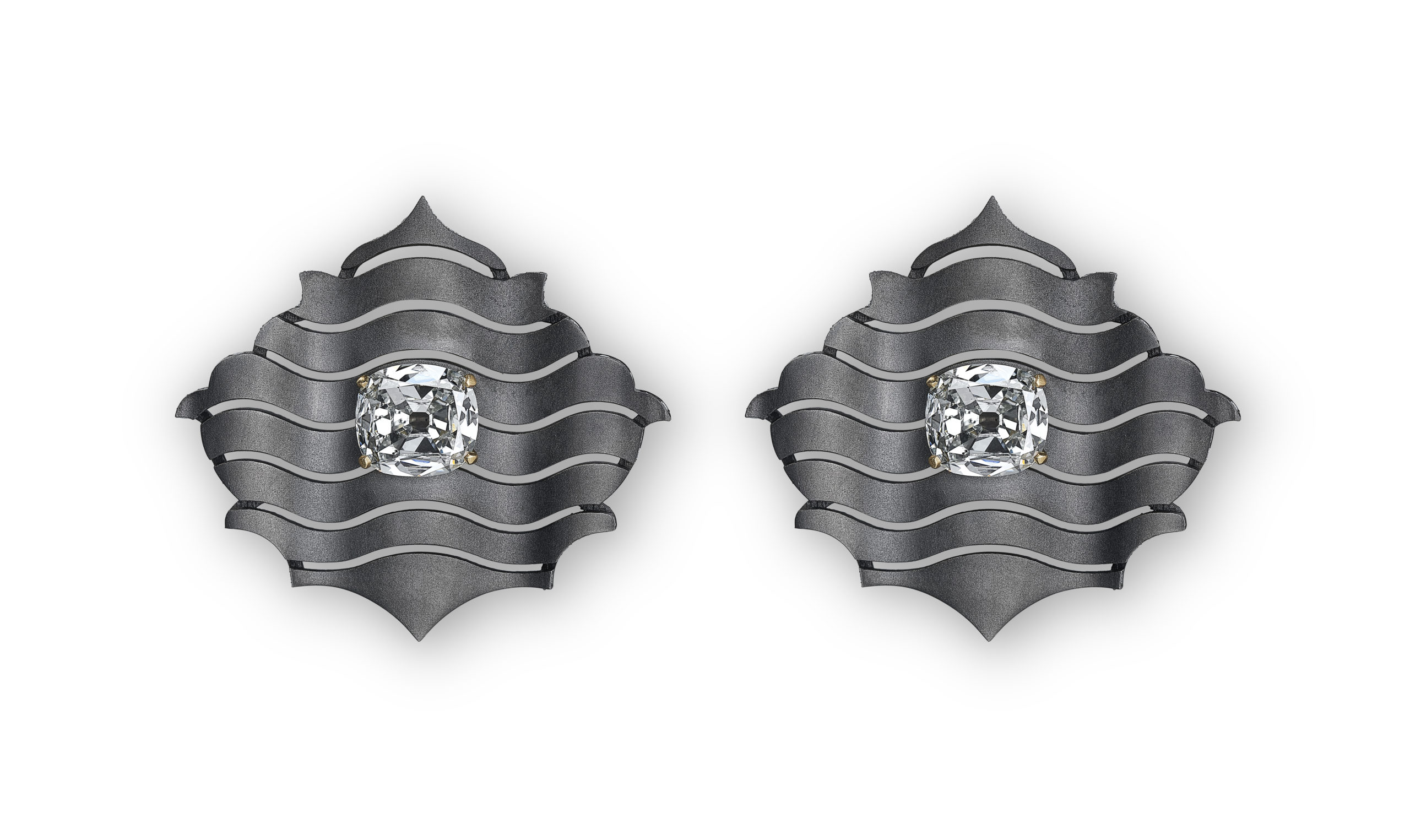
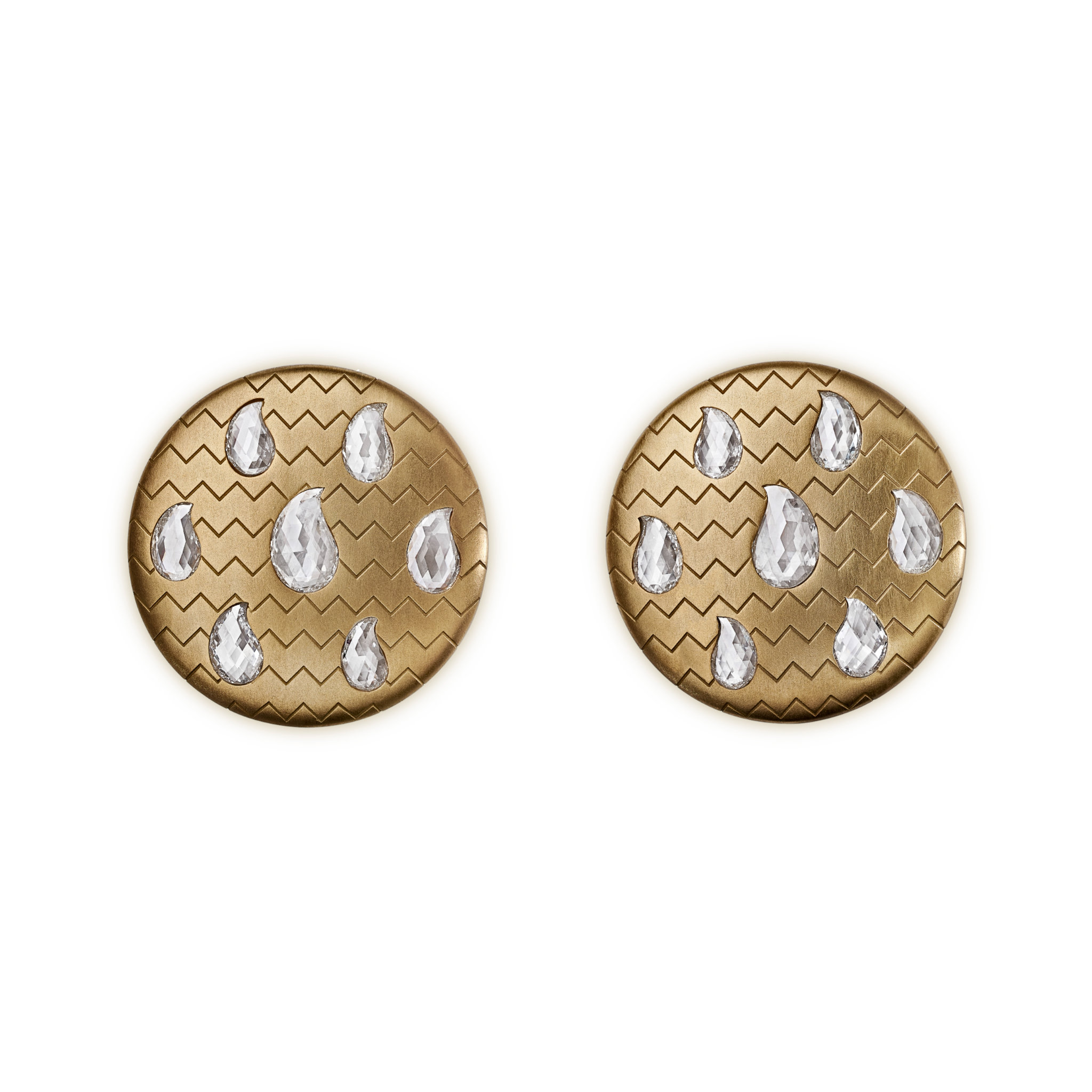
Krishna Choudhary likes to work with abstract, geometric figures. He has a predilection for herringbone patterns that combine geometry with movement and refer indirectly to the vast water features (pools, fountains, canals) that refreshed Mughal gardens. Two pairs of earrings of a completely different style, one in gold and diamonds cut in the shape of a paisley, the other in titanium and diamonds, symbolise this movement of water in the form of graphic chevrons.
When asked about the symbolism of the gems, Krishna Choudhary says that he does not attribute talismanic properties to the stones he works with: “I use them because I like them, because they have a history. I can be inspired by their ancient charm, but I do not rely on astrology or religion”. A proof of this is his passion for sapphires - a gem perceived by Hindus as potentially a bad omen because it is associated with Saturn. Santi Choudhary has in his private collection a magnificent Mughal-era cabochon star sapphire that is so large that it cannot be closed with the fingers. He called this exceptional sapphire "Krishna".
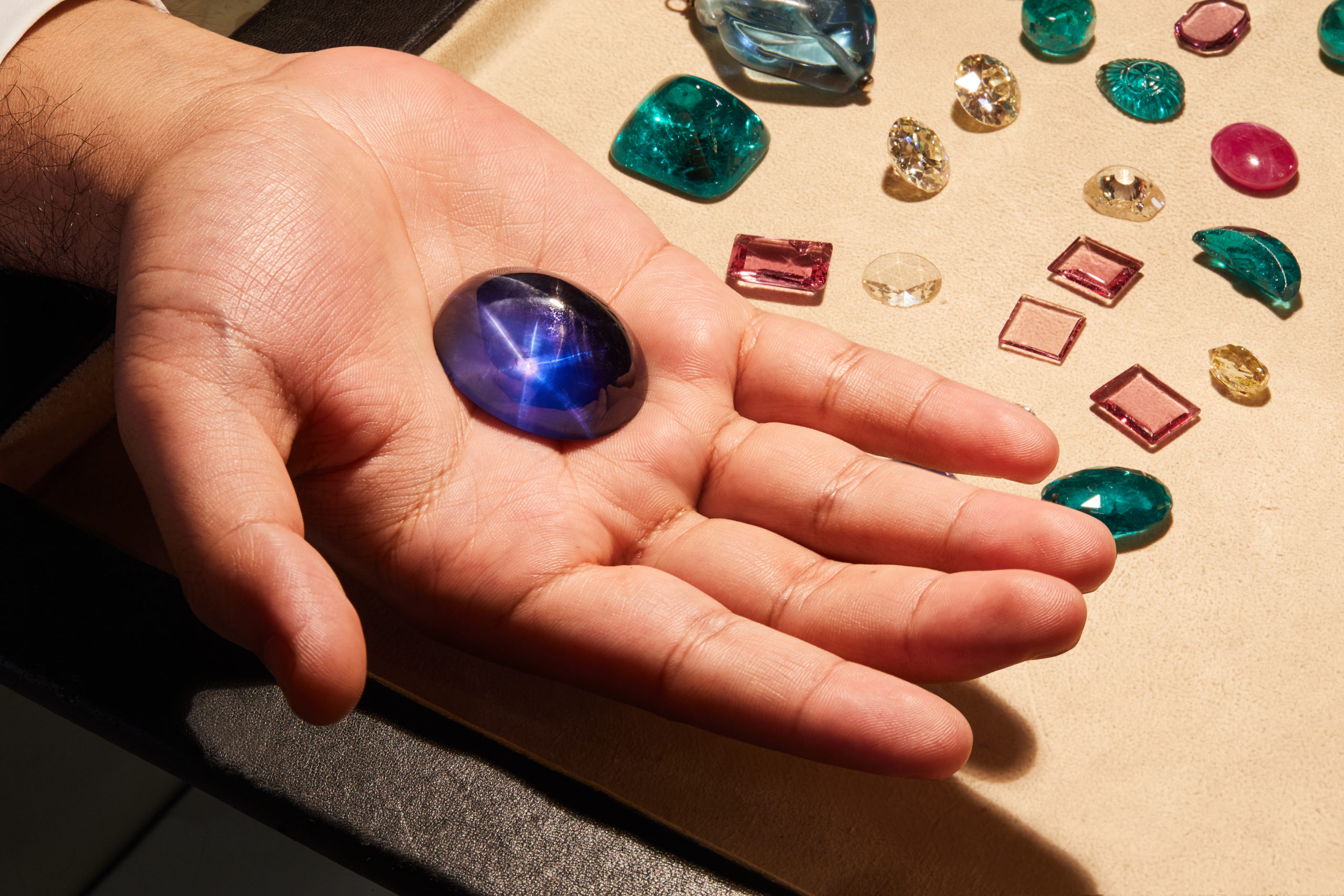
Courtesy Royal Gems Jaipur. Photo Ashish Sahi
Santi Choudhary, Jaïpur, the Mughal Emperors and India are the primary influences that nourished Krishna Choudhary, but did he have other less direct natural influences? Krishna answers immediately “The Cartier brothers because they took the quintessence of Indian jewellery and magnified it. I see a distant parallel with Mughal jewellery, which also drew on the best of different traditions to create a unique style”. JAR's unconventional designs gave Krishna the courage to dare new materials such as titanium; Suzanne Belperron (1900-1983) and her French style, and Ambaji Venkatesh Shinde (1917-2003) who made sumptuous baguette diamond necklaces for Harry Winston, are also a source of admiration for the jeweller.
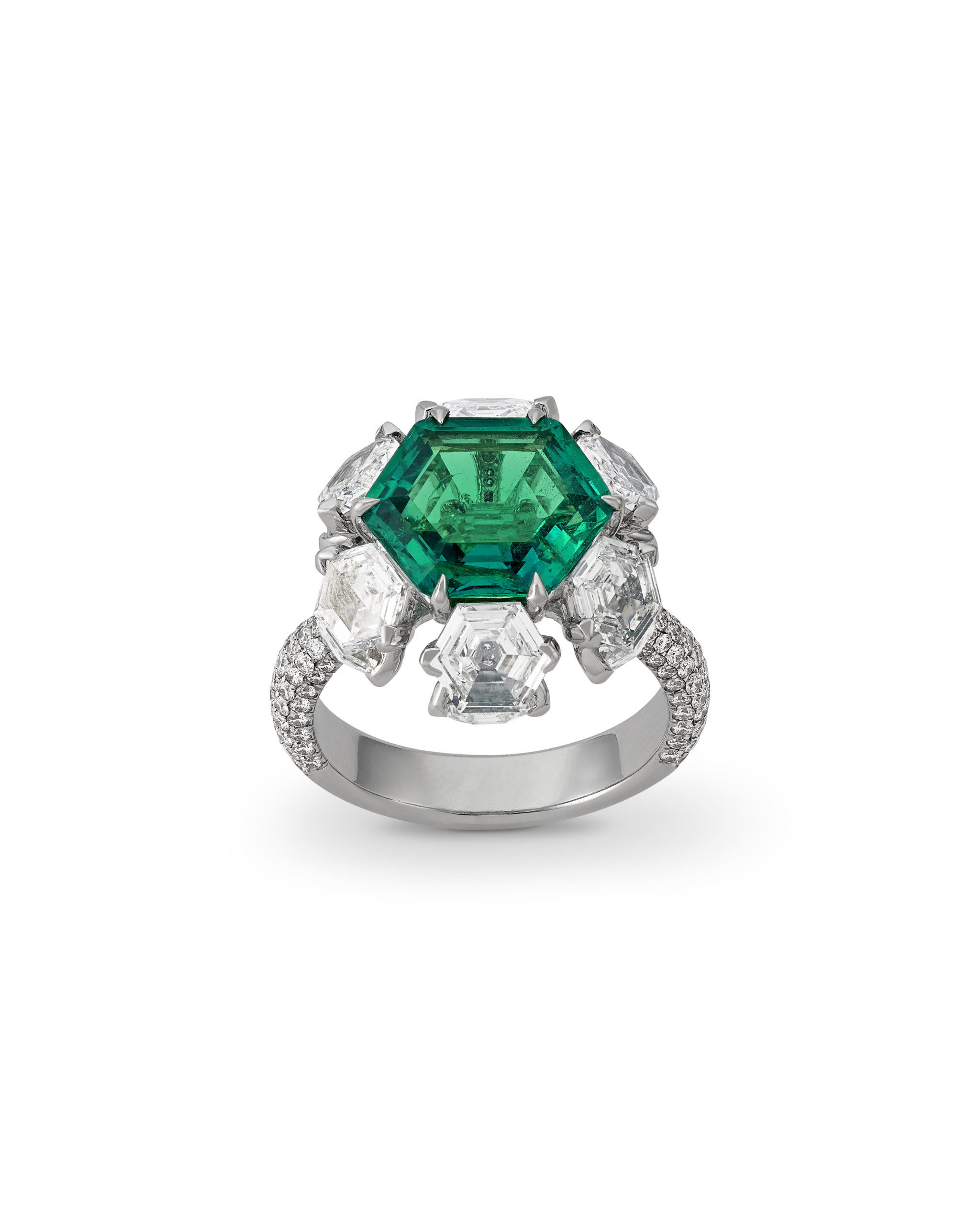
Santi Jewels is aimed at connoisseurs who enjoy the dialogue between the ancient and the modern that Krishna Choudhary subtly allows in the six to seven pieces he designs each year. In a time that sometimes gives in to the conveniences of mass production, this respect for tradition, this rootedness, this ability to make the contemporary resonate with the heritage are of great cultural and aesthetic value, making each piece an event in itself.
***
Santi jewels, by appointment only
Royal Gems and Arts
3768, Saras Sadan, Gangori Bazar
Jaipur, Rajasthan 302001, India
Victoria and Albert museum
Cromwell Rd, London SW7 2RL
***
Update September 19, 2022
Selling Exhibition Jewels by Santi
20 – 23 September 2022
Phillips London
30 Berkeley Square. London W1J 6EX
Phillips presents Jewels by Santi, a selling exhibition of the exceptional new creations by designer Krishna Choudhary together with many of the historical Mughal jewels and objects that inspired them.
Thomas Faerber (I) : A life for jewelry
Renowned jeweler specializing in precious stones, antique and vintage jewelry and exceptional pieces, Thomas Faerber, has been acknowledged for more than five decades for his contribution in the jewelry market throughout the world.
The “Faerber-Collection”, placed under the aegis of Thomas Faerber, Alberto Corticelli (at his side since 1988), his children Ida Faerber and Max Faerber, and Philippe Atamian (all three joined the company in 1998), buy and sells gems, antique and vintage jewelry, exceptional pieces in Europe (Geneva and Paris), America (New York) and Asia (Hong Kong). The House stands out, says Thomas Faerber, by a taste for "the emblematic jewels of an era; those of noble origin, created by the most remarkable craftsmen; pieces that, if they could speak, would tell a thousand stories. "
Thomas Faerber belongs to the exclusive club of major international collectors.
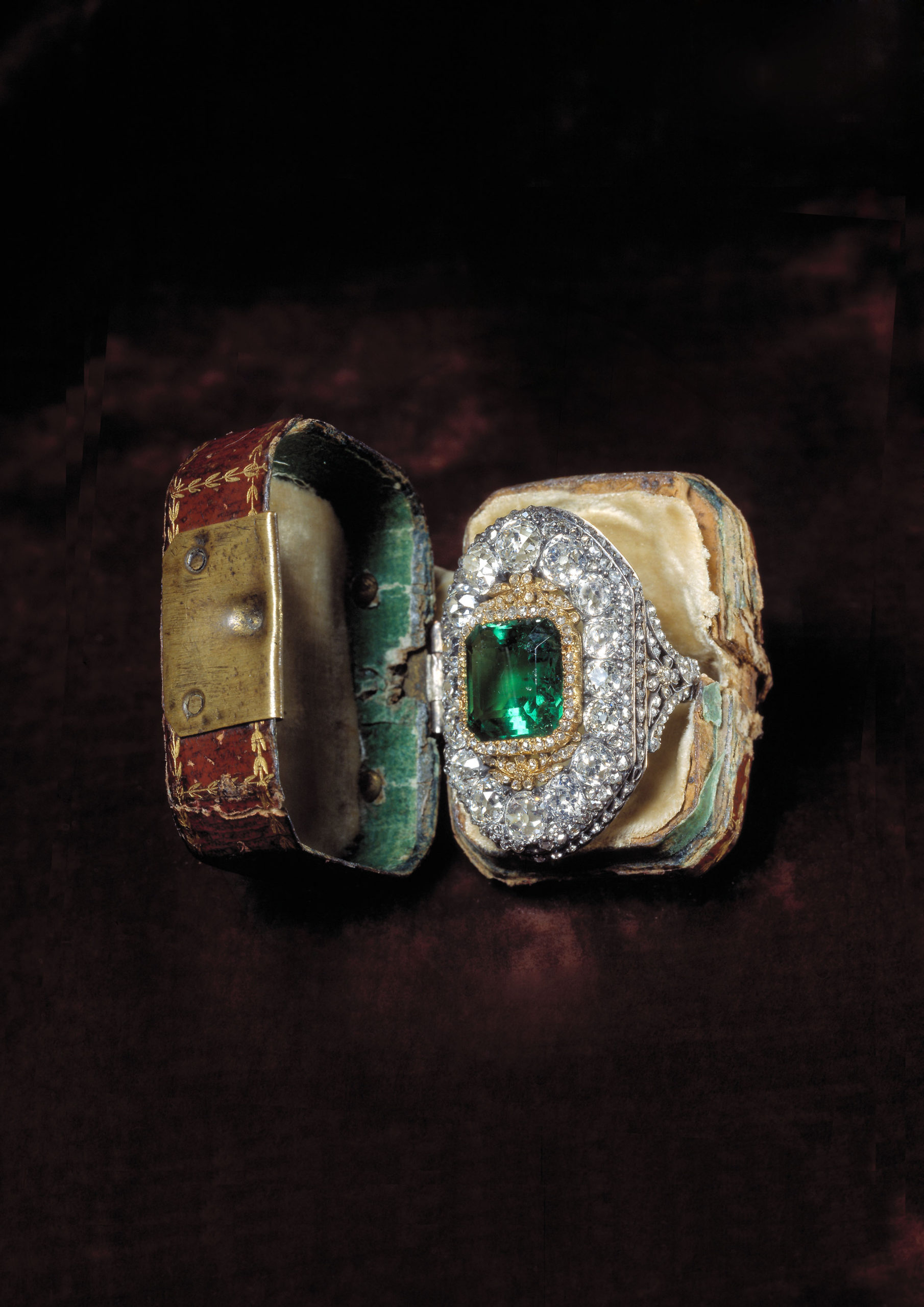
Given to a French nobleman as a present from Czar of Russia, Alexander 1st , in Erfurt.
The square step-cut emerald framed by a closed back yellow gold leaf and flower motif set with rose-cut diamonds, surrounded by 16 old mine-cut diamonds and a second line of rose-cut diamonds. The mounting is in silver and 14k gold, typical in the Russian work at the time. The emerald weighs 5.84 carat and is of Colombian origin. The 16 diamonds weigh circa 5.50 carat. The ring is in the original fitted box.
Length : 32mm. Width : 20mm. Height : 24mm. Size : 14 / 54.
Photo credit Katharina Faerber
It is a great honor for me and I am grateful to him for having opened these rarely seen pages of this private collection catalog, giving me the opportunity of presenting these masterpieces that he is particularly fond of and willing to lend to jewelry exhibitions as well as to the readers of Property of a Lady.
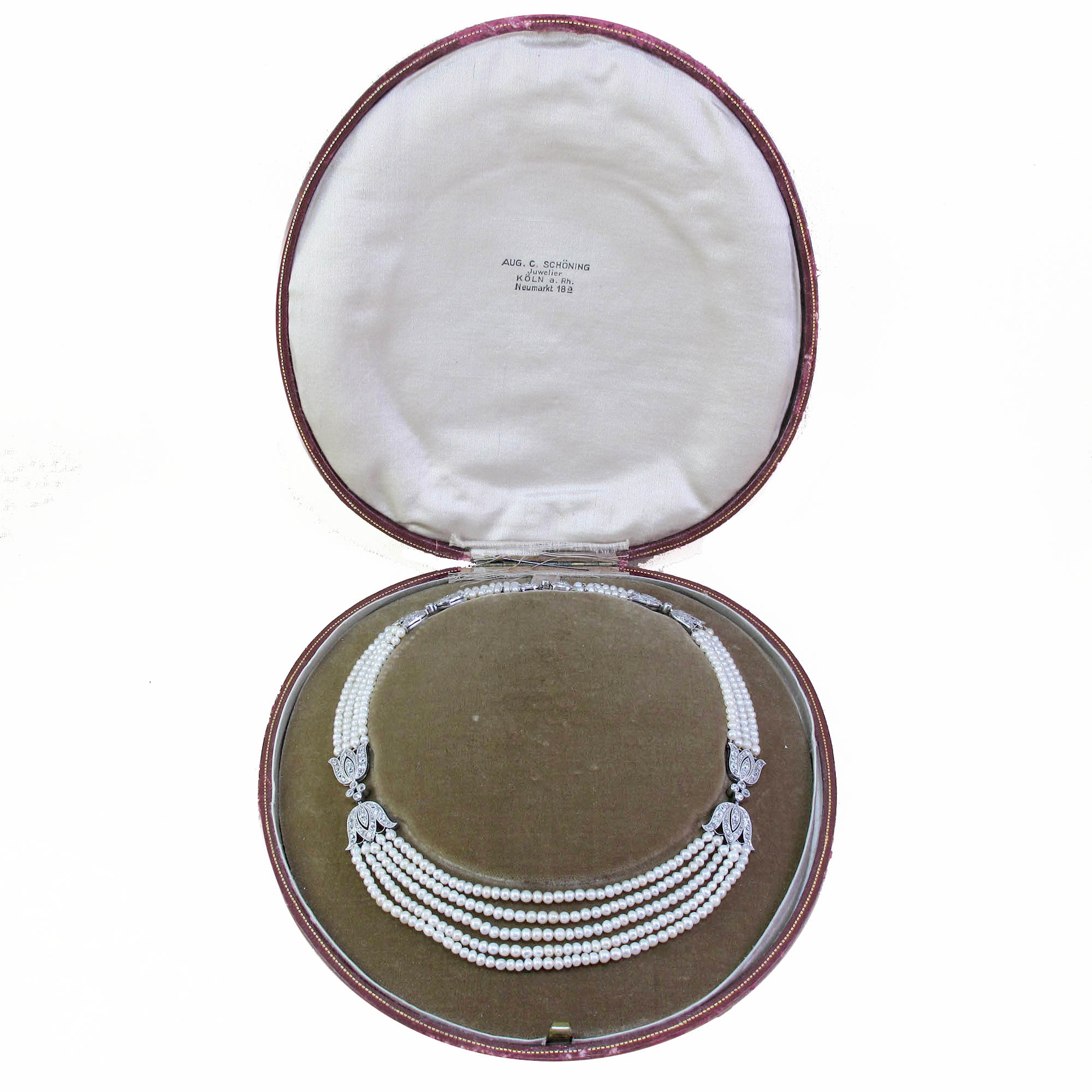
The collection is an amazingly eclectic set and includes pieces from the Renaissance to 2019. It mainly brings together pieces that were “love at first sight” and at times memories, explains Thomas Faerber. Just like this Belle Époque pearl necklace which was made by Thomas Faerber's maternal grandfather at the beginning of the last century.
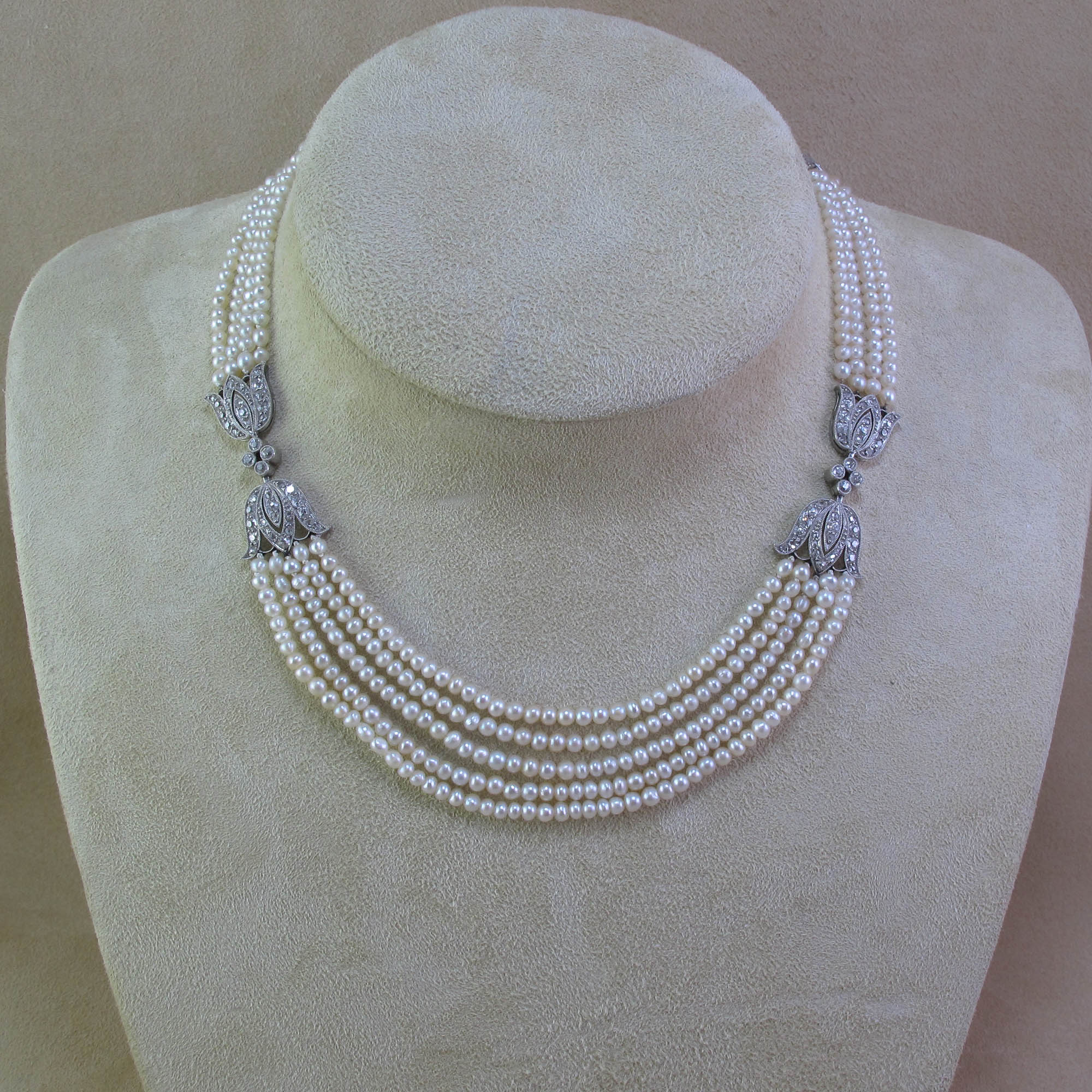
The five-strand necklace set with cream-colored natural pearls, ranging between circa 3.0 and 3.5 mm, decorated with four campanula-shaped spacers, delicately millegrain-set with rose- and old-mine cut diamonds, mounted in platinum, with original burgundy fitted case signed Aug. C. Schöning, Cologne, Germany, circa 1910, length circa 38 cm.
Photo credit Katharina Faerber
Let's discover parts of the collection and gain a better insight of the history of Thomas Faerber.
From the very beginnings to international recognition
August Schöning, the maternal grandfather of Thomas Faerber, was a jeweler and a goldsmith in central Cologne, Germany, between the Belle Époque and WWII. He died in the Fifties. “This necklace is the only piece I own from my grandfather,” explains Thomas Faerber. It was cheer luck that made it possible at an auction in 2019 in Cologne. "I had gone there for another piece that interested me and then came across this necklace. It was one of the most exciting auction in my life because I absolutely wanted to get it! "
Thomas Faerber's father, Ernst Faerber, came from Bavaria. He was born at the turn of the century, in 1900. He was dreaming of becoming a photographer and wanted to take part of the creative development that this technique was experiencing in those years. However, in the sadly difficult context of the end of the Twenties, he couldn't find a job fulfilling his dream and finally had no other choice than to become an intern for a pearl merchant in Berlin. He lost no time and learned the various technics of coating, piercing and bead threading.
Thomas Faerber explained to me that a man in 1930 came forward to sell a very beautiful necklace of fine pearls. “My father asked the pearl merchant, his boss, if they could purchase it and he refused. He then asked for permission to buy it himself and he also asked if he could obtain a raise to no avail. This gave him no other choice than to set up his own business and buy the necklace." Ernst Faerber worked several weeks on the necklace, peeling it meticulously and turning it into a stunning piece it is today.
Having become a recognized trader in fine pearls and precious stones, he began to travel through Germany. One day, on his way to Cologne to see his client August Schöning, Ernst Faerber came across a thief running away from the jeweler's store and the jeweler chasing after him with a gun. Ernst Faerber did the only thing his heart told him to do and rushed to the jeweler's daughter in distress.
"My story began with love and a piece of candy"
The first thing Ernst Faerber did was to offer the young woman a piece of candy, as he always had some in his pockets -and "this is how my parents met! "
Ernst Faerber, married Maria Schöning (August's daughter) in the early 1930s. Ernst Faerber worked until he died in 1961. "I was barely 17", says Thomas Faerber. The Ernst Färber House, located on the elegant Promenadeplatz in Munich, was taken over by Rudolf Biehler, his former assistant after Ernst Faerber's death. Dominik Biehler is now in charge of the House Ernst Färber in Munich.
"It was agreed by the family that I would be trained by Rudolf Biehler so that at the age of twenty-five I would have an equal 50% partnership with him. I then went to Amsterdam where I learned to cut diamonds and then to Antwerp where I learned to negotiate them, notably at Backes & Strauss.
Thomas Faerber continued his training in London at Australian pearl company and after in Paris with Jean Rosenthal (1906-1993), a great dealer in precious stones, whom he affectionately nicknames "his great master". These months spent at his side are described as "wonderful". Today, it is with his son, Hubert Rosenthal, that he continues to maintain an indestructible friendship.
In 1968, Thomas Faerber decided to create his own trading company in precious stones and jewelry in Zurich, Switzerland, thus leaving the German market to Rudolf Biehler: “The markets were not then as globalized as they are nowadays, everyone had his own territory ". He recalls that when he started traveling in Switzerland, working around with modest jewelers and the few watch factories that existed at this time, was quite "difficult".
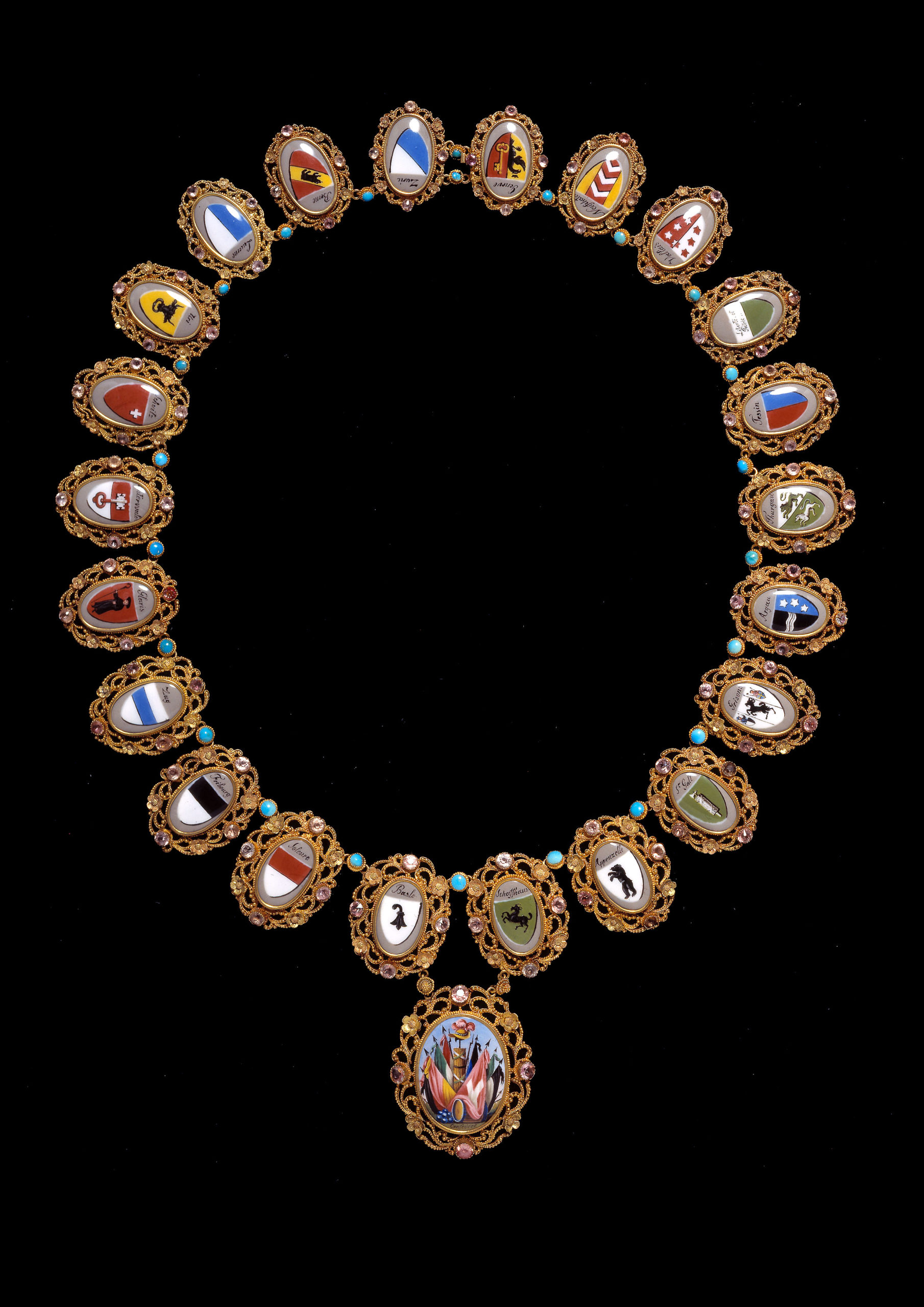
Composed of 22 oval enamel plaques each depicting the arms of a Canton within a varicolored gold openwork filigree mount set with spaced close-set pink topaz and with a collet set small cabochon turquoise between each mount. With a pendant drop suspended in the center depicting the symbols of the Confederation.
"Swiss enamel was a very popular souvenir for tourists visiting Switzerland in the 19th century, especially for the British. Geneva was the center for enameling. This Necklace depicting the 22 Cantons of Switzerland is a typical souvenir of that time" explains Thomas Faerber. Photo credit Katharina Faerber
The year 1969 was an important turning point in the life of Thomas Faerber. That summer he visited New York for the first time and made two momentous encounters there. First Katharina, a photographer, who would become his wife and then Paul Fisher (1927-2019), a major player in the jewelry industry of the second half of the 20th century, whom his peers regard as a model. Thomas Faerber fondly remembers a man whom he considers a second father. “He guided me a lot. We have worked together in America and all over the world”.
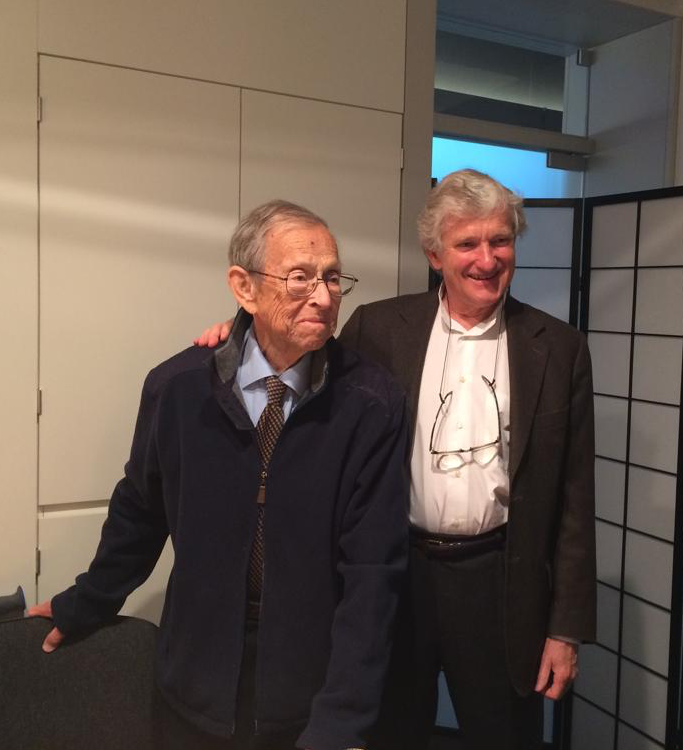
Another major year in Thomas Faerber's professional life was 1973. He took his first booth, precisely 9m2, in Basel, the jewelry and watchmaking fair that had not yet become Baselworld. Exhibiting mainly for the Swiss market, Thomas Faerber remembers that his activity was mostly devoted to diamonds, with stones rarely exceeding 1 carat. In order to develop his entreprise, Paul Fisher suggested that Thomas Faerber present antique jewelry as well. In Switzerland at that time customers wanted modern jewelry he explains : “My reputation was just starting to establish itself, so I was hesitant, but not for long. I was the first jeweler and gems dealer to exhibit antique jewelry. At the end of the fair, the three antique jewels that Paul Fisher had given me were sold and this allowed me to meet new customers ". Thomas Faerber never left the antique jewelry market again and remained an exhibitor Basel until 2017.
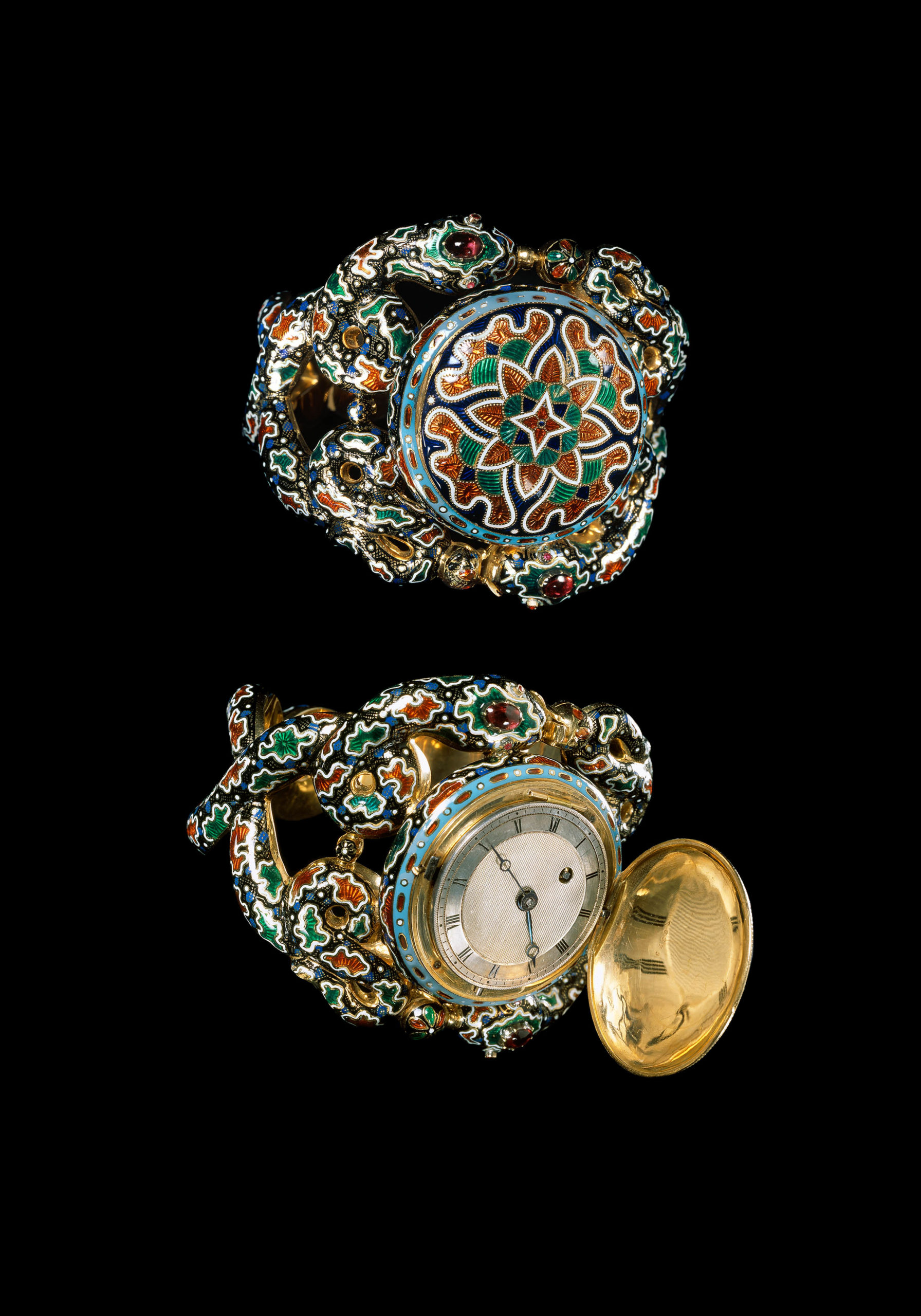
The wristwatch designed as two enlaced snakes, decorated with black, green, red and blue colored enamel, the heads embellished with a collet-set garnet- cabochon, to the gem-set eyes, the snakes centering upon the round-shaped case with guilloché enamel reminiscent of a rose glass window, opening to reveal roman numerals, numbered ‘46373’, mounted in 18k yellow gold, probably English, circa 1840, inner circumference circa 19 cm, with winding key.
Photo credit Katharina Faerber
In 1980, Thomas Faerber moved to Geneva, a city with a prosperous jewelry and watchmaking tradition, while continuing to travel. America in the late 1970s was a haven for discerning dealers coming from all over the world as the dollar began to fluctuate. "I bought some beautiful vintage signed jewelry there: at the time, between a Cartier bracelet and an unsigned Art Deco bracelet there was 15% to 30% difference. It was later, from the 1980s, that signatures and origins became much more important. The fact that jewelry began to be exhibited in museums (e.g. Van Cleef & Arpels exhibition in 1992 at the Fashion and Costume Museum at the Palais Galliera in Paris) has contributed in changing mentalities as well as the international jewelry market."
Over the years, thanks to his in-depth knowledge and business ethics, Thomas Faerber has been able to establish a notoriety (from 1993 to 1998 he chaired the Swiss Precious Stones Dealers Association) as he never stopped acquiring new important pieces.
In 2004, he provided the Louvre with a necklace of emeralds and diamonds and matching earrings that Napoleon I presented to the Archduchess Marie-Louise on the occasion of their wedding in 1810. Thomas Faerber explains that after acquiring these two exceptional pieces, miraculously preserved in their original state, he very much wanted them to be part of the fabulous Louvre collection. This half-set created by François-Regnault Nitot was part of the Empress Marie-Louise's personal jewelry items and has since entered the window display of the admirable Diamonds of the Crown of France located in the splendid Galerie Apollon.
That same year, Thomas Faerber was made a Chevalier of the "Ordre des Arts et Lettres".
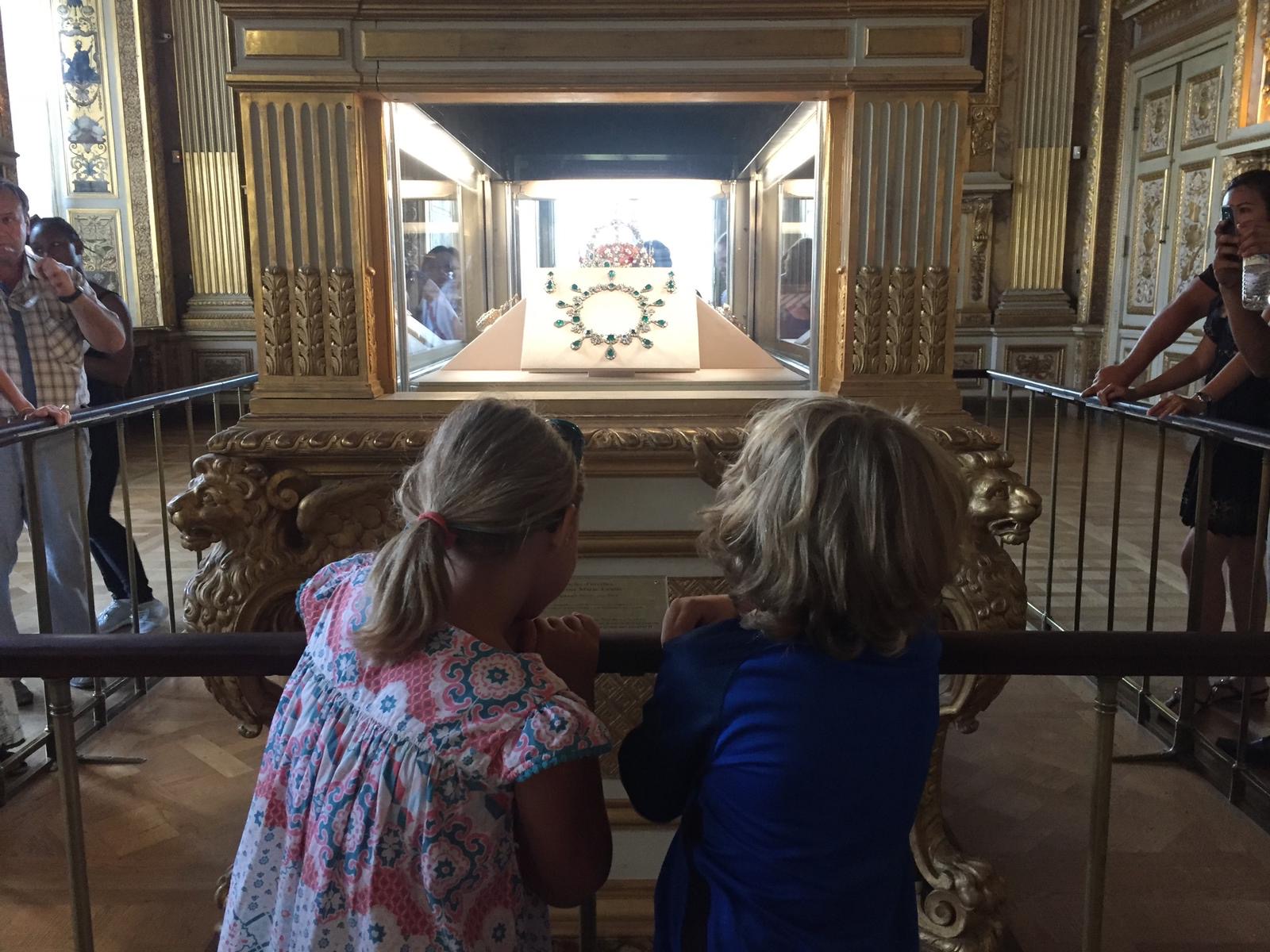
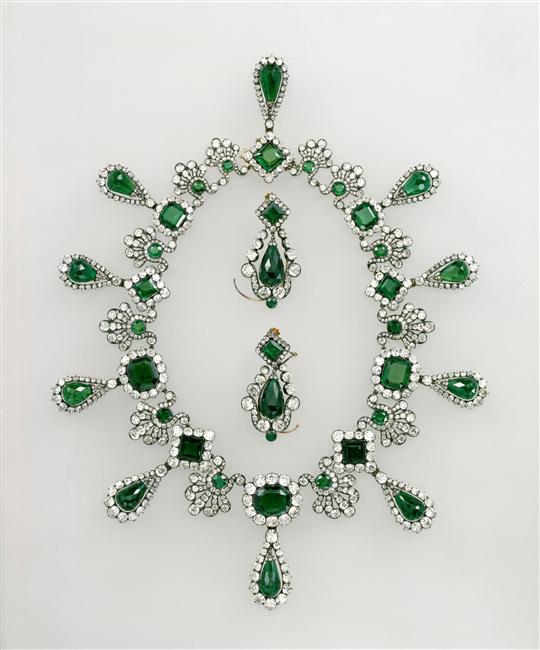
Pieces made by the jeweler François-Regnault Nitot (1779 - 1853) in Paris. The necklace consists of 32 emeralds (13.75 ct central emerald); 1138 diamonds (874 brilliants and 264 roses); gold ; money. The earrings are made of 6 emeralds; 108 diamonds; gold ; money.
Photo (C) RMN-Grand Palais (Louvre museum): Jean-Gilles Berizzi
Thanks to many years of experience and a large international network, Thomas Faerber and his colleague Ronny Totah joined forces four years ago to create "with colleagues, friends and other dealers, a quality, friendly and family-like jewelry fair on a human scale”: GemGenève.
The first two exhibitions, which brought together jewelers, dealers, designers, collectors, gemological laboratories, booksellers and enthusiasts, took place in 2018 and 2019 successfully bringing together exhibitors and visitors from all over the world.
Hopefully GemGenève will reopen its doors in November 2021.
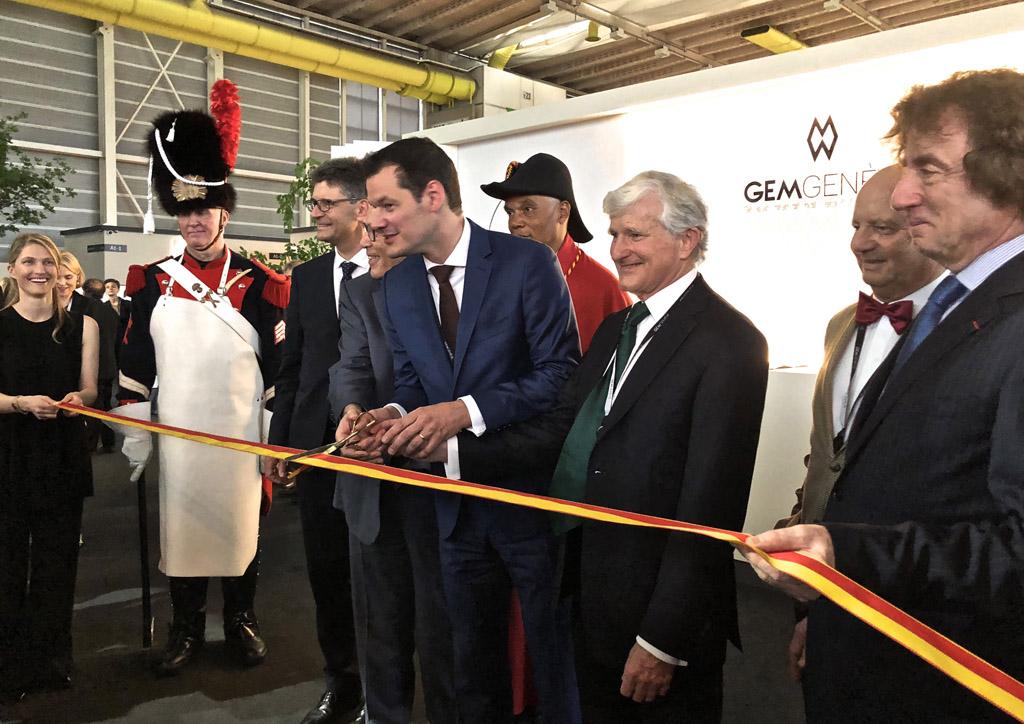
This conversation with Thomas Faerber will continue here : "About the collection"
***
Visual at the top of the article: An antique sapphire and diamond bangle mid 18th century.
The brooch element set with a sapphire of circa 56 carats, within an old mine cut diamond surround dated from the time of Catherine the Great (mid-18th century). According to family tradition, this jewel belonged to the Zoubov family.Possibly a gift by the Empress Catherine the Great to Platon Alexandrovitch Zoubov (1767-1822) who was the Empress' last favorite.
The yellow gold bangle, a later addition, has the St. Petersburg mark used from 1826 up until 1876 and master’s mark, Cyrillic script P I. It is encrusted with small ivy diamond motif of pre-art nouveau style. With report no. 47838 from the SSEF stating that the sapphire is from Ceylon (Sri Lanka) with no indications of heating.
Photo credit Katharina Faerber
***
Many thanks to Myriam de Mareuil for her very careful proofreading of my translation
Thomas Faerber (II) : A conversation about the Collection
Pour lire cet article en français, cliquer ici
“The collection is eclectic,” says Thomas Faerber. I purchase what I like. It can be antique, modern or contemporary ”.

Designed as a flexible torque, composed of brushed gold links on a black rubber band, mounted in 18k yellow gold, with Austrian assay marks, with Manfred Seitner maker's mark, circa 1970, inner circumference circa 50cm, width circa 3.2 cm.
Photo credit Katharina Faerber
Jewelry, watches and precious objects make up for this collection, which began in the 1970s with “a few pieces of lesser importance”. Over time and through the various fairs, Thomas Faerber regretted having sold certain pieces. "This, I believe, is how the collection started." He adds that even today, most of the pieces that he and his associates buy are intended to be sold: "I remain a dealer at heart. "
Do you plan to exhibit your collection one day?
I prefer to lend parts of it.
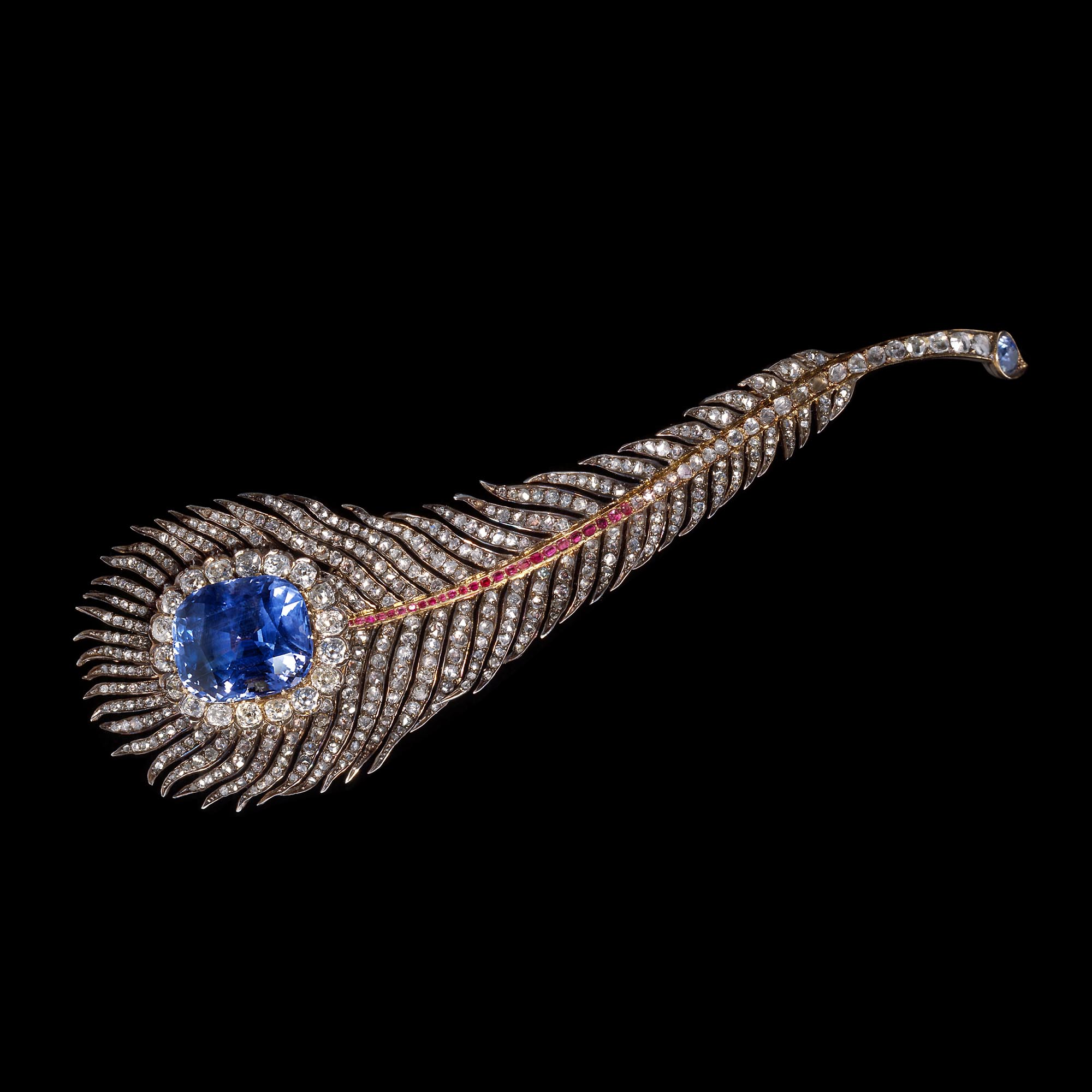
With report no. 63234 dated 26/04/12 from SSEF stating that the sapphire is from Ceylon with no indications of heating.
With a certificate of authenticity by Chaumet.
The original drawing of this piece is kept in the archives of Chaumet.
Photo credit Katharina Faerber
The great Houses of Place Vendôme and the museums are mostly aware of this and don't hesitate if needed to ask me. Some of you may have already admired this brooch during the "Chaumet en Majesté" exhibition at the Grimaldi Forum in Monaco in the summer of 2019? It was also featured at the Beijing exhibition.
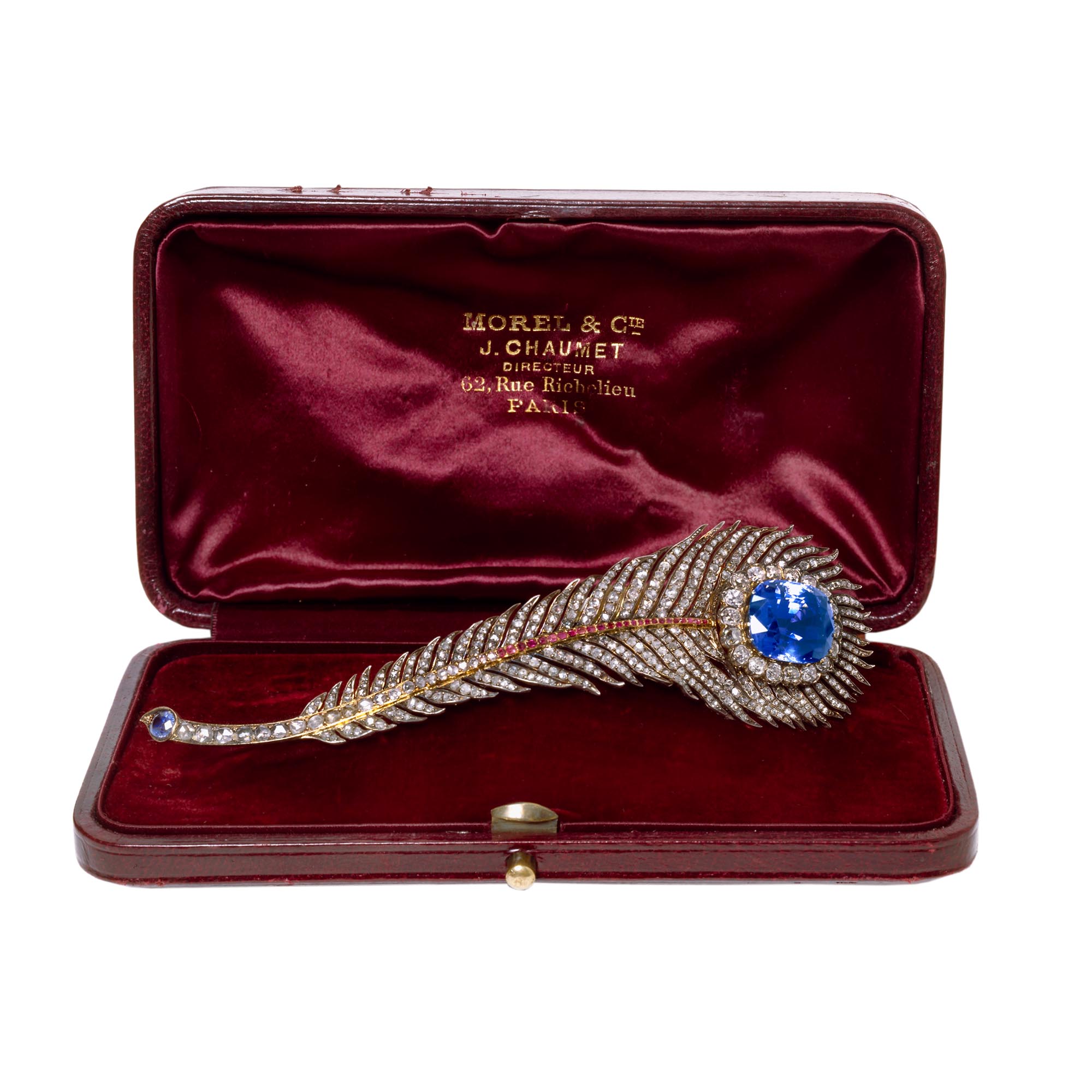
"Plume" brooch by Morel & Cie, J. Chaumet.
Photo credit Katharina Faerber
At the beginning of September, Thomas Faerber left an exceptional necklace in emerald drops and diamonds designed by Jacques Arpels in 1950, as well as a pair of matching earrings, on loan for the Pierres Précieuses exhibition at the Museum of Natural History (MNHN) in Paris.
This set belonged to Maharani Sita Devi of Baroda (1917-1989), wife of Maharaja Pratapsingh Gaekwar.
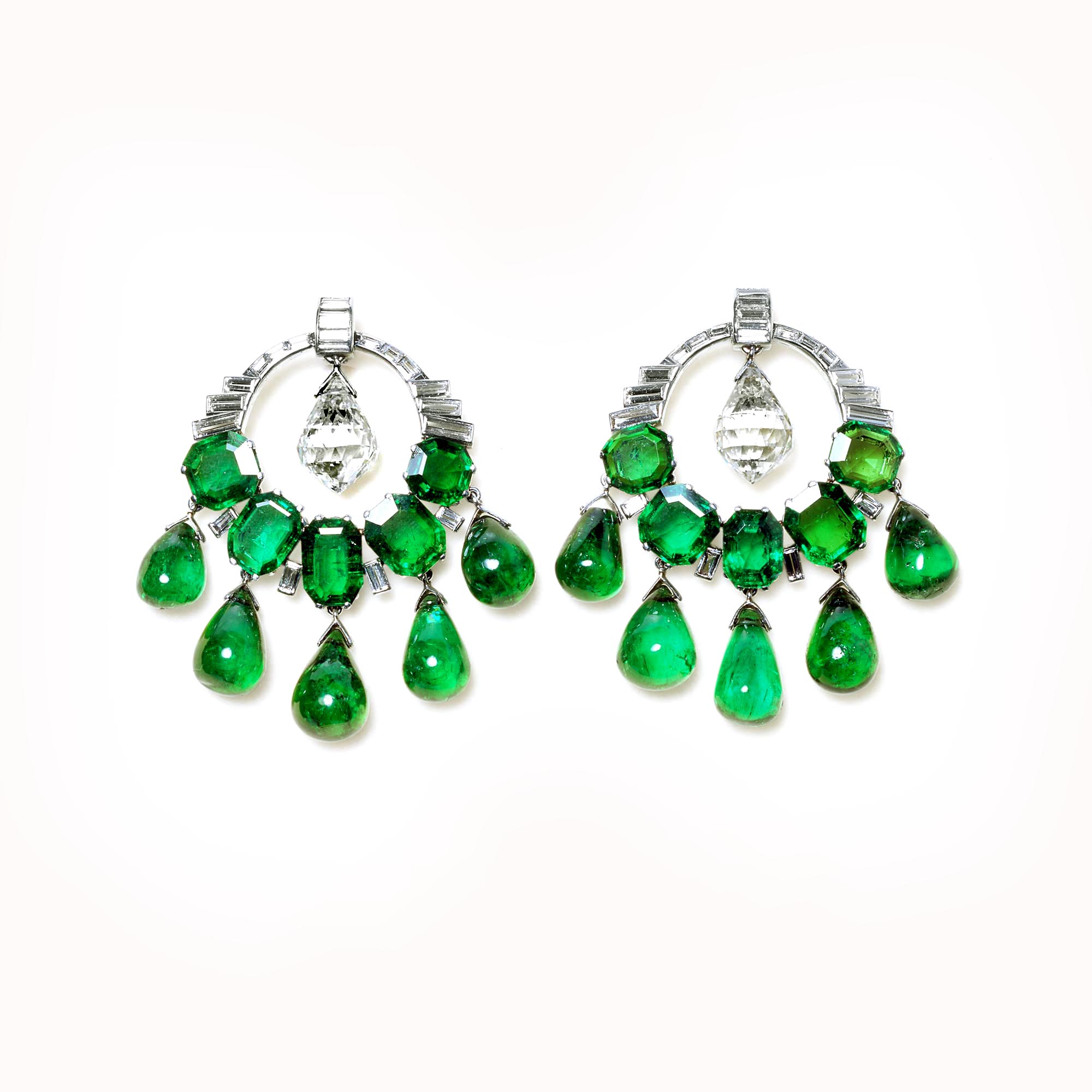

Photo credit Katharina Faerber
Sita Devi had an unrestrained passion for jewelry and possessed extraordinary gems which she drew from the Baroda treasury. Some of these precious stones date back to Mughal times. In the latter part of her life, the Maharani saw her jewelry dispersed during an auction organized by Crédit Mobilier de Monaco on November 16, 1974. The emerald and diamond half-set created by Jacques Arpels was part of a private collection before Thomas Faerber acquired it at an auction in May 2002.
Almost twenty years later, the collector continues to admire the design and the gems of this magnificent set that he considers exceptional.
Do you have a favorite jeweler?
I have great admiration for the work of Lalique, Vever, Cartier and, today for JAR - but one of my great heroes is Frédéric Boucheron (1830-1902)!
The tremendous quality of the execution of the pieces created under his direction, the human value of the character, his sensitivity, the fact that he was so involved in the profession and that he was keen to help younger generations aroused my admiration.
That is why the first major acquisition in my collection was a Boucheron necklace.
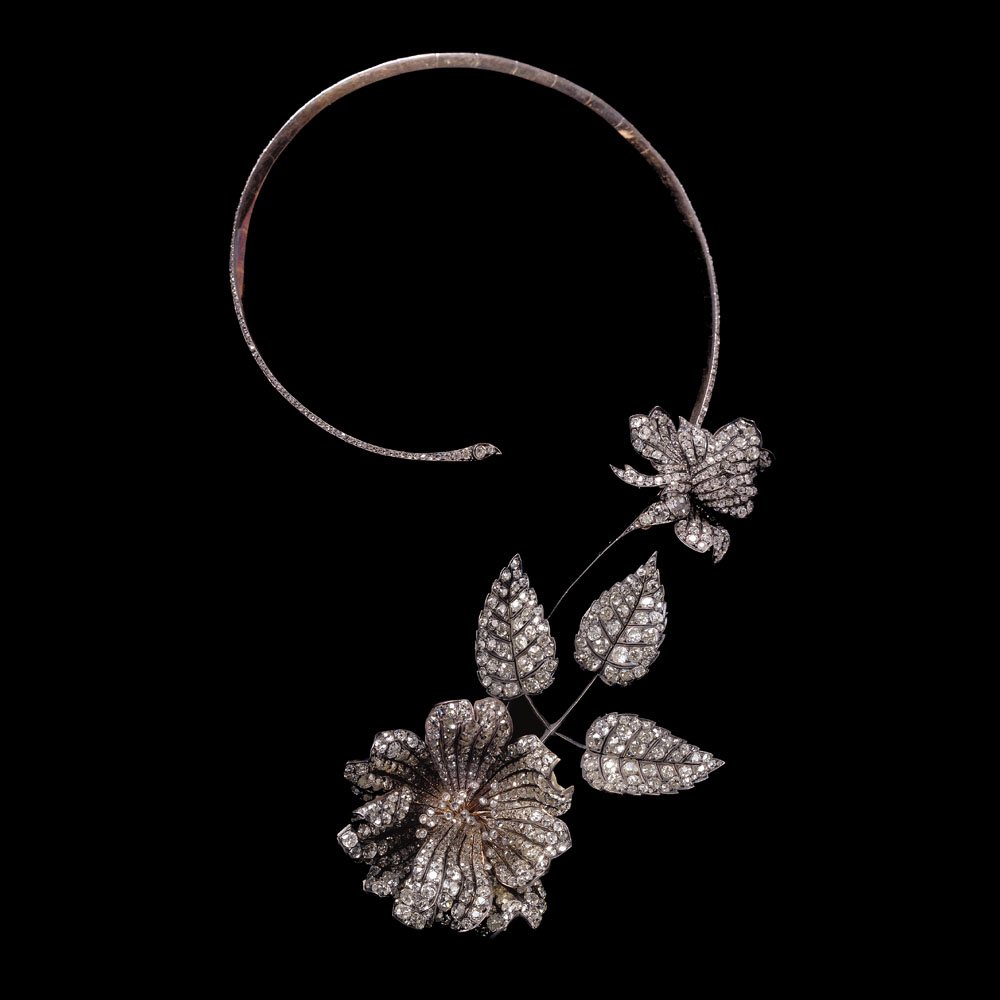
Composed of 900 diamonds for a total weight of circa 45.75 carats, this necklace is the only surviving piece to be known according to the technique invented by Frederic Boucheron in the end of the years 1890. The necklace is composed of a very thin flexible steel thread covered in silver. It can be transformed into a brooch, length : 21 cm, rose width : 3 cm, rose height : 12.5 cm.
Photo credit Katharina Faerber
The first drawing of this necklace made by Paul Legrand, main designer of the House of Boucheron at the time of Frédéric Boucheron, dates from 1879. It then took a few years to carry out this project and invent a technique which made it possible to bend and thread the metal around the neck, without the diamonds jumping under the pressure of the movement. Achieving this extraordinary flexibility was an incredible challenge for the workshop. It was only in 1889, during the Universal Exhibition in Paris, that Frédéric Boucheron officially presented his technical innovations, including engraved diamonds and the so-called "Point d'Interrogation" (Question mark) necklaces. The jeweler won the "grand prix" there - the highest distinction after the gold medal - for his remarkable work, and was soon after made an officer of the Legion of Honor.
"Spring collars" (another name for this invention) impressed critics who described them as “revolutionary”! explains Boucheron's Heritage Director, Claire de Truchis-Lauriston. She also draws our attention to how much Frédéric Boucheron was attentive to the comfort of his clients, who at the time had to have a maid to dress and adorn themselves, in particular with their choker (dog collar) so difficult to attach behind the neck. Frédéric Boucheron certainly wanted to free them from constraint. The "Point d'Interrogation" necklaces come without a clasp and most have a central part that can be transformed into a brooch or hair ornament.
Almost all of these necklaces represented nature: flowering branches of acacias, plaine trees, lotus flowers, ears of wheat, peacock feathers, ivy leaves, poppies, snakes… The necklace that Thomas Faerber owns is made up of a blooming rose, surrounded by three leaves, topped with a a rose bud about to bloom.
To this day, this is the only “Point d'Interrogation necklace” in its original state.
“When this necklace was put on sale in Paris in the Eighties at Drouot, says Thomas Faerber, it was estimated at a reasonable price, but during the sale, the bids flew - I had had a formidable opponent in front of me! Nevertheless, I won the bid and this necklace now belongs to my wife. "
Is there a gem that particularly appeals to you?
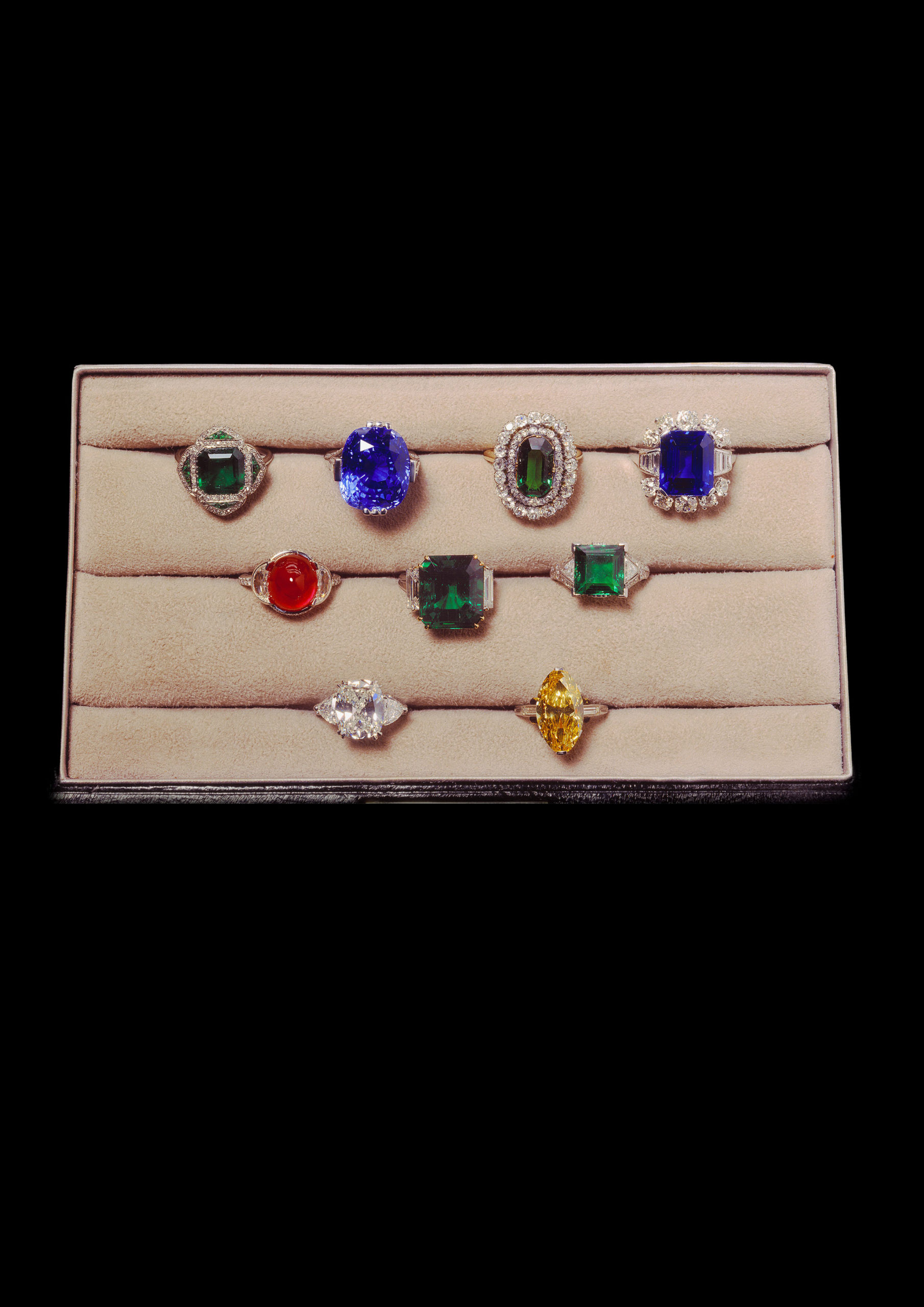
Photo credit Katharina Faerber
I don't have a favorite stone; nevertheless there is one that has always fascinated me, is the alexandrite, the color change variety of chrysoberyl which has the particularity of changing colors depending on the light (green in daylight, red under a lite candle).
I'm still trying to get chrysoberyls, but their prices are prohibitive. I took a huge risk to get an alexandrite of almost 8 ct put on sale last June in Vienna at the Dorotheum. Estimated between € 13,000 and € 16,000, it was sold for € 115,300. It truly had a very nice color-change. Fortunately, it was another who got it, he said with a smile.
What type of jewelry is particularly sought after by dealers today?
I would say the tiara.
In the 1970s, tiaras were unsaleable, we bought them to take them apart. It reminds me of an anecdote: in the 90s, there was a beautiful tiara for sale at Christie’s. I admit, I had done my calculations to make five brooches, three pairs of earrings ... I won the bid and the tiara was delivered in a beautiful initialed Chaumet case. I thought maybe I wasn't going to take it apart right away, he laughs. I wrote to Madame Béatrice de Plinval, Chaumet's Heritage director, to tell her that I had been able to acquire this tiara. This tiara has since become one of the centerpieces of their Heritage Collection.
Today tiaras are a real craze, e.g. this sale on June 10, 2020 at the Dorotheum, still, a Cartier tiara in aquamarines and diamonds mounted on platinum. Characteristic of the Art Deco style, it was created in London by Jacques Cartier around 1930-35. Estimated between € 34,000 and € 70,000, it sold for € 582,800 (more than seventeen times over its low estimate!).
You also own exceptional objets in the collection. Are there any that you would like to present?
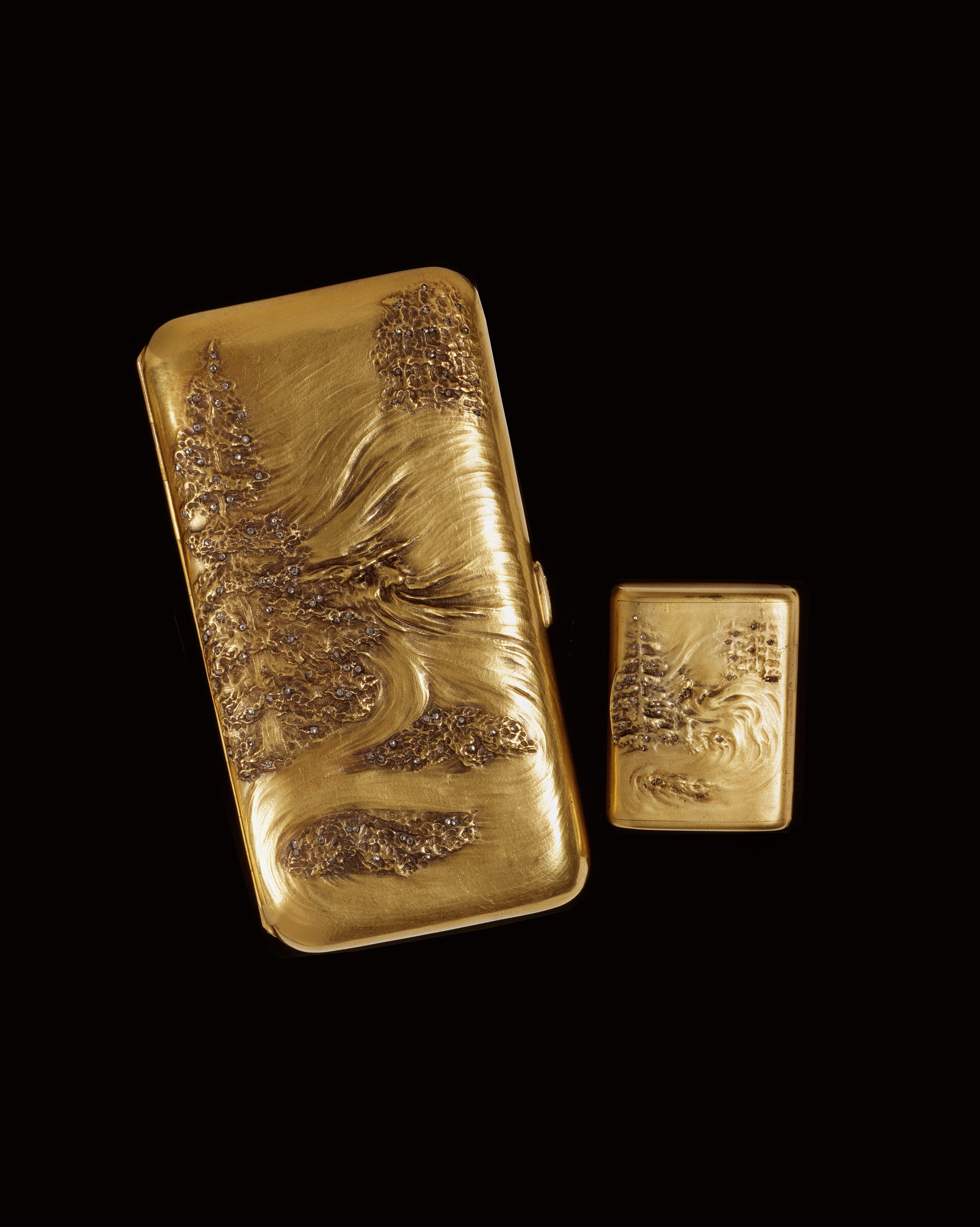
The rectangular case with round corners in 14k yellow gold with a samorodok finish surface, inset with rose-cut diamond, opening on a compartment for the cigarettes, and a smaller case of similar design for the matches, a mirror in the lid, a diamond set push piece, with Russian assay mark for Kiev after 1908 and maker's mark for Josef Marchak, circa 1910, 10.5 x 5.5 cm.
Photo credit Katharina Faerber
This rectangular cigarette case with rounded corners depicts a winter landscape around the ghostly face of Ded Moroz, the “Grand Father of Frost” or Russian Father Christmas.
"I don't smoke," says Thomas Faerber, "but the elegance of this set appealed to me."
The cigarette and matching case, both illustrate the technique of samorodok, a Russian word meaning "nugget" or "virgin metal." At the end of the 19th century, this technique was used by Russian silversmiths and in particular by Fabergé who applied it when creating precious objects.
Obtained by heating silver or gold to a temperature near the melting point and then suddenly cooling it in water, the samorodok produces a textured effect on the surface of the object, which suggests snowy forest paths in Switzerland, sand games in the desert, the lunar surface ... Everyone is free to let their imagination run wild!
This technique is nevertheless very difficult to master, the samorodok is rare.
Will you create a Faerber museum in Geneva?
I believe my collection should stay in the family company. I am fortunate to be surrounded by two children and five grandchildren; my daughter Ida Faerber is very attached to our legacy, she'll guard the temple.
***
Visual at the top of the article : A Joël Arthur Rosenthal ring that belonged to Marie-Hélène de Rothschild (1927-1996).
Recently acquired at the Pierre Bergé & Associés auction on Tuesday, December 15, 2020, Lot 100. This 18K (750) yellow gold ring is adorned with a troidia-shaped diamond weighing 6.31 carats.The ring is covered with a mosaic of agate geode studded with shards of diamonds. Work from the 1980s. Signed JAR.
Photo credit Katharina Faerber
***
Many thanks to Myriam de Mareuil for her very careful proofreading of my translation
***
Thomas Faerber SA
29, rue du Rhône
1204 Genève
Switzerland
Tel: +41 22 318 66 33
Gourdji
1 rue de Châteaudun
75009 Paris
France
Tel: +33 1 48 78 84 65
gourdji@faerber-collection.com
Faerber Inc.
589 Fifth Avenue, Suite 1103
New York, NY 10017
U.S.A.
Tel: +1 212 752 42 00
ny@faerber-collection.com
Faerber-Collection (HK) Limited
1503 15/F, 9 Queens Rd.
Central – Hong Kong
Hong Kong
Tel: +852 2520 2521
hk@faerber-collection.com
Geneva International Gem & Jewellery Show
Palexpo Genève Halle 7
Route Francois-Peyrot 30
1218 – Le Grand-Saconnex
Genève. Suisse
