Suzanne Belperron at Home in Montmartre

An expert in antique jewellery and a leading specialist in the work of Suzanne Belperron, Olivier Baroin reconstructed the history of the pieces in this sale by consulting the designer’s personal archives, and issued their certificates of authenticity.
In December 2007, he discovered Suzanne Belperron’s personal effects in an apartment at the foot of Montmartre Hill, which had remained closed since her death in 1983. In 2008, he acquired, in addition to these effects, the entirety of the archives found there, notably the appointment books kept on a day-to-day basis from 1937 to 1974, as well as part of the furniture. Mandated, among other things, to safeguard “[…] the future of the expertise of all the work produced by Madame Suzanne Belperron,” Olivier Baroin now lives in Montmartre, at the top of the hill, and has overseen the auctions of the most prestigious collections of the designer’s work.
A conversation with an expert who brings to Suzanne Belperron’s oeuvre an eye of rare precision, combining intimate knowledge of the corpus with avowed admiration and rigorous critical standards.

In your view, is this the largest collection of Suzanne Belperron pieces ever offered at auction?
Strictly speaking, one cannot say that this is the largest collection of Suzanne Belperron jewels ever to appear at auction. Last year, around the same time, Christie’s in New York presented an exceptional collection, achieving a world record with a bracelet that fetched nearly one million dollars.


In the archives, certain order lists suggest breathtaking suites that may one day appear on the market.
That said, this collection nonetheless constitutes a major ensemble, built up in two stages: some of the jewels were commissioned by the collector’s mother-in-law, who acquired certain pieces directly from Suzanne Belperron, and the other part was assembled by her husband, whose taste differed markedly from that of his mother. These two distinct sensibilities are clearly perceptible throughout the collection.
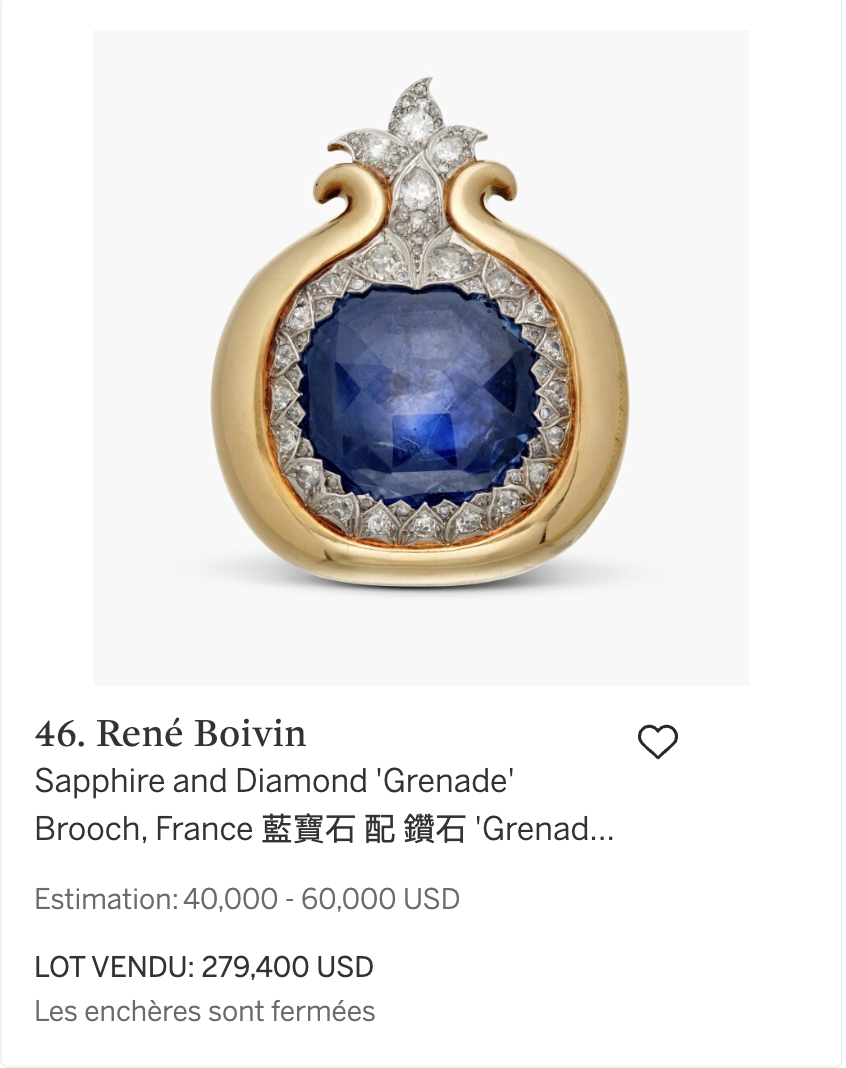
Some pieces date from the period when Suzanne Belperron was working at René Boivin, which might suggest a long-standing rapport between the collector and the designer.
A few pieces do indeed go back to Madame Belperron’s years at Boivin. However, it appears that the client who originally formed this collection was above all a loyal patron of Suzanne Belperron and that, even if she placed a few late and very occasional orders with René Boivin, most of the pieces from that house in fact came from public auctions.
Research carried out by Thomas Torroni on Boivin, and by me on Belperron, shows that only the lion, created in 1967, was commissioned from Boivin by the present owner.
Looking at this ensemble of Boivin and Belperron pieces, can we conclude that the client was above all seeking a style?
Indeed. But René Boivin and Suzanne Belperron are really part of the same family: we are, in a sense, dealing with one and the same creative universe – that of the same designer, active from 1919 to 1932 at Boivin, then from 1933 to 1974 as an independent.
When a jewel is recognisable by its style and you immediately perceive the artist’s hand, the name of the house matters little.
At Maastricht, when your eye falls on a Matisse, a Modigliani or a Picasso, it is the artist who captivates you – not the place or the precise date of creation.
Boivin was the house that allowed Belperron to reveal her talent, to emerge from the chrysalis as a butterfly.

In your opinion, does the pink and blue necklace offered in this sale rank among the most spectacular pieces ever created by Suzanne Belperron?
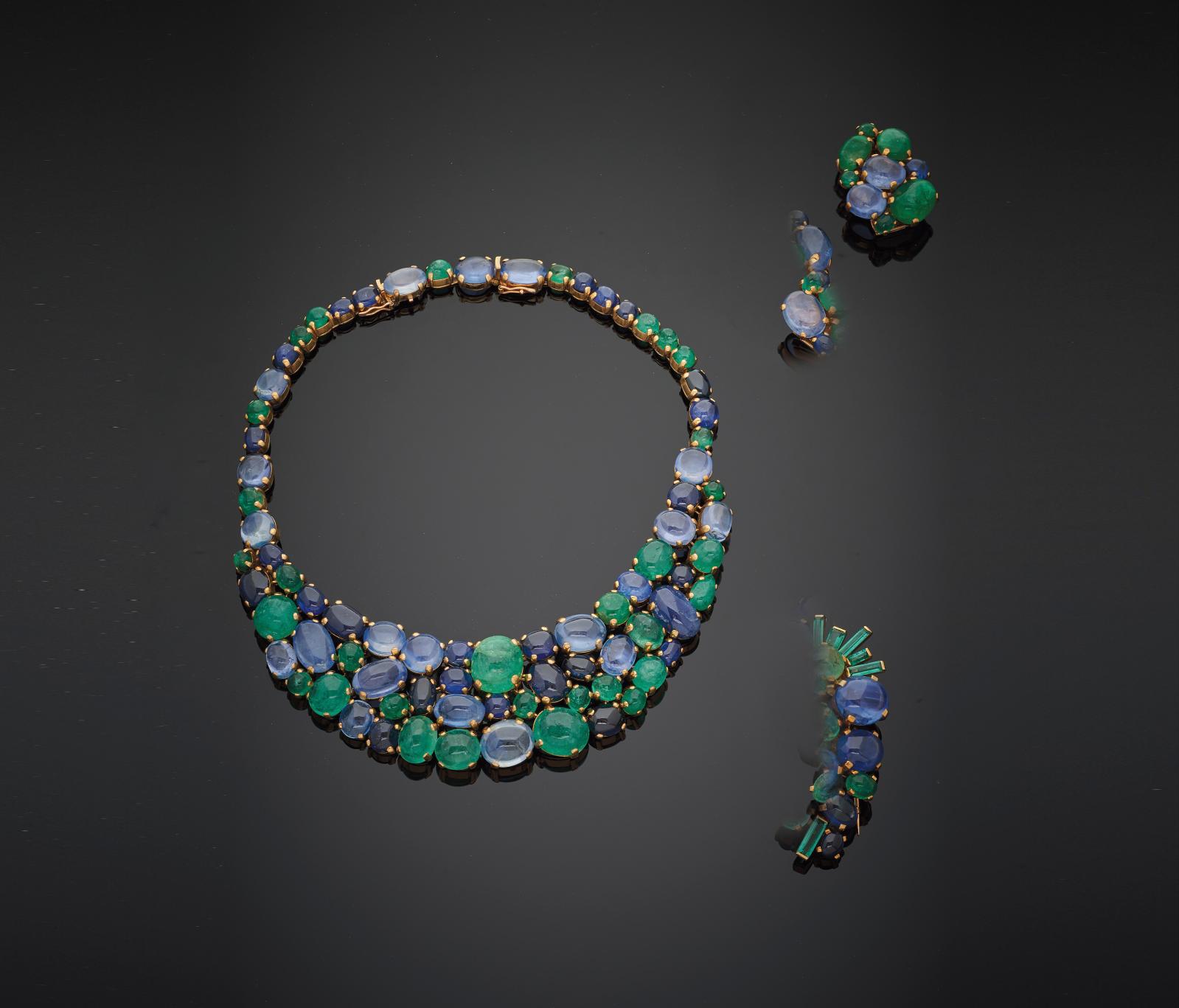
 I wouldn’t describe it as “spectacular.” Suzanne Belperron created pieces that are literally breathtaking. This necklace is very much part of her repertoire and perfectly reflects her talent as a colourist, but it does not rank among the most “spectacular” creations in her oeuvre.
It is a very beautiful necklace, a finely composed piece.

Could you shed some light on how to wear this superb ensemble comprising five platinum fuchsias pavé-set with diamonds, and on this torque necklace element, which appears to have been designed to receive them?
When one sees the swan-neck fittings at the back of the fuchsias, it is quite difficult to understand how the mounting was originally intended to work.

 This necklace element is most likely a presentation mock-up.
According to the archives, the “fuchsia” clips, which were originally brooches, were delivered to the client on 8 December 1949.
The records also note that, in September 1946, she acquired a so-called “Berber” necklace. This latter piece was subsequently altered to accommodate the five fuchsias: the order was placed on 28 September 1972, the finished jewel was then delivered, before being brought back by the client on 20 October 1972 for a final adjustment.
The necklace element presented here is therefore distinct from the ‘Berber’ necklace altered in 1972: it is indeed a presentation mock-up.
The photo shoot for this collection took place in your apartment, which houses Suzanne Belperron’s furniture. How did that session go?

Indeed, I had the pleasure of welcoming the photographer Sabine Villiard and her team. It was quite moving to see these jewels by Suzanne Belperron worn by a stunning model, Amelie Cara, seated on the very furniture that belonged to the designer. When one thinks that Madame Belperron may once have sat in those same armchairs, some of these jewels in her hands, one cannot help but be touched.
Madame Belperron was very close to Marcel Coard, to whom Amélie Marcilhac has devoted a remarkable book that I strongly recommend. This interior designer and decorator, who sadly did not enjoy fame in his lifetime, is today as sought after and esteemed as Émile Ruhlmann.

Belperron is not simply a jeweller; she is an artist who speaks through jewellery. She never ceased to reinvent herself, displaying remarkable imagination and working in close, creative dialogue with her clients.
 Each commission was a unique creation, giving rise to a piece that was always different.
This constant renewal continues to bring astonishing jewels to light, which explains why collectors remain so deeply drawn to her work.

You carried out the authentication of the Suzanne Belperron pieces now held by the Musée des Arts décoratifs in Paris (MAD). What can you tell us about them?
The Musée des Arts décoratifs first approached me to authenticate a feather-shaped brooch in platinum and diamonds, which subsequently entered their collections.

They also asked me to examine a ring set with rubies and diamonds prior to its acquisition, in order to confirm the attribution.
The MAD subsequently entrusted me with identifying a necklace which, after study, proved not to be by Suzanne Belperron but by René Boivin, circa 1950, after a design by Juliette Moutard. I then called on Thomas Torroni to co-authenticate the piece.
Finally, the museum approached me to suggest works by Suzanne Belperron that might be presented to potential patrons, as the curator, Mathieu Rousset-Perrier, is particularly committed to ensuring that the designer’s oeuvre is properly represented within the MAD collections.
 Suzanne Belperron has now become an essential reference in museums and major international private collections. Do you see this as a culmination?
The presence of Madame Belperron’s jewels in museum collections establishes her as an artist in her own right. Whether at the Musée des Arts décoratifs in Paris, the Victoria and Albert Museum in London or, in the United States, major institutions such as the MFA Boston, the Brooklyn Museum, the Toledo Museum of Art or Cooper Hewitt, her creations now take their place within a truly international museum narrative, particularly in exhibitions devoted to modern jewellery and major private collections.
I see this as a profound form of recognition, an institutional tribute that helps to secure her work’s lasting place in the heritage of jewellery.
Among international collectors, I also observe a clear shift, particularly among Chinese clients and, more broadly, in Asia. Their tastes are gradually shifting away from antique jewellery – notably nineteenth-century pieces – towards signed jewels and, more recently, towards the acquisition of creations by major women jewellers, among whom Suzanne Belperron occupies a central position.
This collection brings together jewels by two great artists, Suzanne Belperron and JAR. Would you place them on the same level?
 Suzanne Belperron was a pioneering, innovative artist. In her day, she conceived pieces that no one else had imagined or produced; she was, by nature, avant-garde.
She inspired leading designers and all the Place Vendôme maisons, and continues to inspire them today. The discovery of each new piece – each a work of art in its own right – provokes an immediate emotional response.
One might say, perhaps, that she was the JAR of her time.

What makes her style remain so modern and captivating to collectors?

Her style is timeless: it endures while remaining profoundly in tune with the present. Suzanne Belperron’s jewels possess an unmistakable character.
Broadly speaking, two types of jewellery clients can be distinguished today: those who seek a brand to display, a visible, sometimes ostentatious signature; and those who prefer to stand out through a jewel of character, whose formal language speaks immediately to those with a cultivated eye for exceptional pieces.
Jewellery is a language: some wish to assert themselves through display, others to be noticed through discretion and the assurance of style. Suzanne Belperron’s work is a signature in itself, instantly recognisable to informed connoisseurs.

A final thought, a last nod to evoke this sale?
Each Belperron sale is, by its very nature, unique. Every discovery brings its own emotion: the pleasure of imagining oneself wearing a jewel never before seen, and one that corresponds profoundly to the image one wishes to project – that of a style embodied by a signature.

To end on a playful note, a thought for Karl Lagerfeld, an avid Belperron collector, who would no doubt have been especially moved to discover these jewels in which his own image is reflected, particularly when one thinks of that rock crystal brooch.


In the footsteps of Suzanne Belperron: from Montmartre to the Nouvelle Athènes
14, rue d’Aumale, 75009 Paris, France


In early 1945, Suzanne Belperron left her apartment in Montmartre and moved to 14, rue d’Aumale, in the neighbouring district of the Nouvelle Athènes, at the foot of the hill and only a few minutes from her professional salons at 59, rue de Châteaudun.
This choice enabled her to remain close to her professional activities while making her home in a district whose architecture and history still bore the strong imprint of the nineteenth century.


The address lies at the heart of the Nouvelle Athènes, a district profoundly transformed under the July Monarchy.
The opening of rue d’Aumale was authorised by royal ordinance on 14 September 1846. It was named after Henri d’Orléans, Duke of Aumale (1822–1897), one of the sons of Louis-Philippe. Nos. 12 and 14 rue d’Aumale formed part of the former Dosne property. Behind No. 14 survives a handsome paved courtyard corresponding to the former outbuildings of the property. Carriage houses, stables and servants’ quarters were arranged around this space; a surviving fountain-trough still recalls its original function. A passage once provided access to the garden of the Dosne family’s private mansion on place Saint-Georges.


The history of this ensemble is closely associated with Alexis Dosne, a stockbroker and major property owner in the Saint-Georges district. His daughter Élise Dosne married Adolphe Thiers in 1833. The family mansion on place Saint-Georges thereafter became inseparable from the history of the Thiers family. Destroyed during the Paris Commune in May 1871, it was rebuilt under the direction of the architect Alfred-Philibert Aldrophe and completed in 1875. After Élise Thiers’s death in 1880, her sister Félicie Dosne took responsibility for the house and the family collections before donating them to the Institut de France. The present-day Fondation Dosne-Thiers perpetuates their memory.

It was therefore in a place steeped in the history of nineteenth-century Paris that Suzanne Belperron chose to settle in 1945. Once again, she entrusted Marcel Coard with the interior design of her apartment. Marcel Coard, a collector of Far Eastern objects, had long incorporated the arts of Asia into his decorative vocabulary. This sensibility found an echo in Suzanne Belperron, whose own collections likewise nourished her creative imagination.


Credits and Additional Information
La Golconde
9, place de la Madeleine, 75008 Paris
Tel.: +33 (0)1 40 07 15 69
Opening hours: Tuesday to Friday, 11.30 am–6.30 pm; Saturday, 2.30–6.30 pm
Website: https://olivierbaroin.fr/en/

Image credits
Sotheby’s 8 December 2025, New York
A Legacy of Elegance: Jewels from an Exceptional Collection
Photographer : Sabine Villiard
Model : @Amelie Cara Klingel
Guillaume de Laubier, Paris Living, Lannoo 2025

Paris living binnenwerk 01-12 (2) pages 49
Sotheby’s 8 December 2025, New York
A Legacy of Elegance: Jewels from an Exceptional Collection
• Lot 3 – Pair of Ruby and Citrine Earclips, France
• Lot 4 – Pair of Ruby and Colored Diamond Clip-Brooches, France
• Lot 5 – Pair of Gold and Diamond Clip-Brooches and a Pair of Pendant-Earclips, France
• Lot 6 – Two Gold and Diamond “Papillote” Cuff-Bracelets
• Lot 7 – Gold and Cultured Pearl Clip-Brooch, France
• Lot 10 – Pair of Chalcedony and Sapphire Brooches
• Lot 11 – Sapphire and Diamond Necklace, France
• Lot 14 – Rock Crystal Clip
• Lot 17 – Topaz, Morganite, Aquamarine and Diamond Necklace, France
• Lot 32 – Pair of Sapphire and Diamond “Branche” Clip-Brooches, France
• Lot 37 – Abalone and Chalcedony “Grappe de Raisin” Clip-Brooch, France
• Lot 38 – Gold and Jade Clip-Brooch, France
• Lot 39 – Chalcedony and Diamond “Grappe de Raisin” Clip, France
• Lot 40 – Chalcedony and Amethyst Cuff-Bracelet
• Lot 42 – Aquamarine and Sapphire Clip-Brooch and Ring
• Lot 43 – Pair of Gold and Diamond Clip-Brooches, France
• Lot 44 – Gold and Diamond “Nymphea” Clip-Brooch, France
• Lot 47 – Set of Diamond “Fuchsia” Pendants
• Lot 48 – Rock Crystal, Pearl, Onyx, Lacquer and Diamond “Pyramid” Clip, France
• Lot 49 – Pair of Rock Crystal and Diamond “Éventail” Clip-Brooches, France
• Lot 50 – Rock Crystal and Diamond “Éventail” Clip-Brooch, France
• Lot 51 – Rock Crystal and Diamond “Natte” Cuff-Bracelet
Suzanne Belperron for René Boivin
• Lot 15 – Rock Crystal, Pearl and Diamond Brooch, France
• Lot 16 – Rock Crystal and Diamond “Octagon” Brooch, France
Amélie Marcilhac, Marcel Coard, décorateur. Catalogue raisonné, Éditions de l’Amateur, 2012, 245 p.
MAD – Musée des Arts décoratifs, Galerie des Bijoux
Rue de Rivoli, Paris
Victoria & Albert museum
V&A South Kensington
Cromwell Road,
London, SW7 2RL
9.XII.2025 Sale update:
Sotheby’s December 8, 2025, New York
A Legacy of Elegance: Jewels from an Exceptional Collection
A resounding success! The sale realised approximately $13.9 million, with all 56 lots sold; the 24 lots associated with Belperron realised approximately $3.5 million in total.
Congratulations to Sotheby’s and Suzanne Belperron’s leading expert, Olivier Baroin